Background check and drug screen for USI nursing students
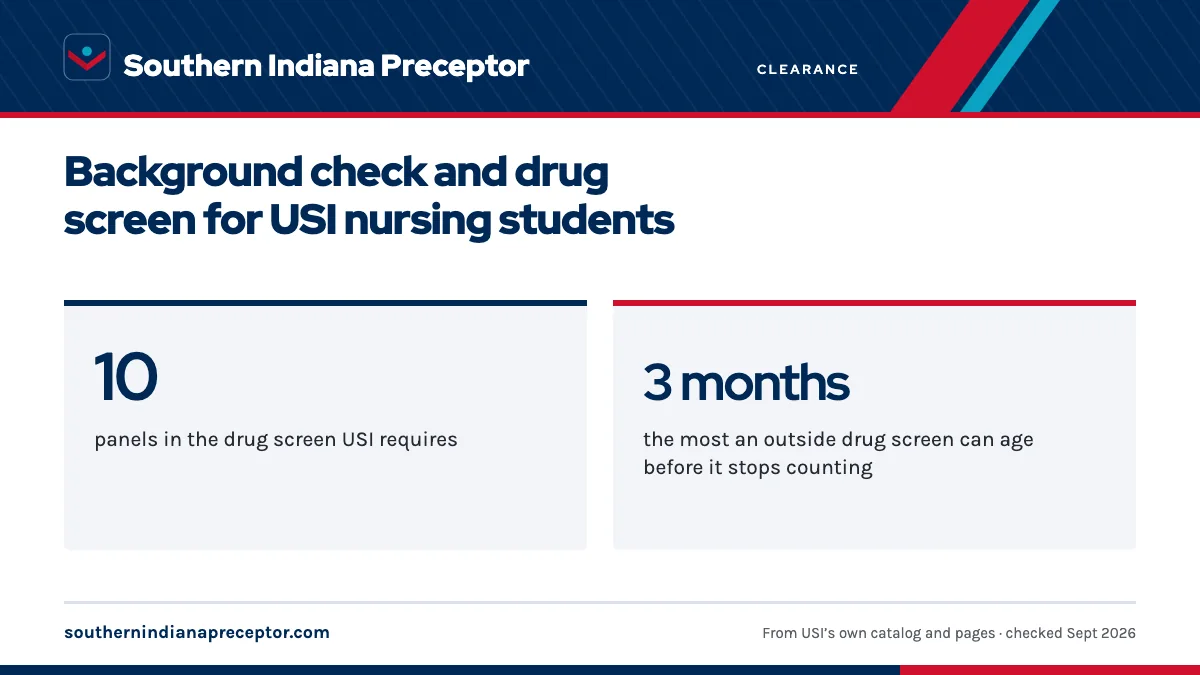
Before your first graduate nursing course at the University of Southern Indiana, you complete a national criminal background check and a 10-panel drug screen and submit both to the designated compliance agency. An Indiana registry check under Zachary's Law then repeats every year you stay enrolled, and any new charge goes to the Program Chair straight away.
Get your placement plan
Tell us your USI program and where you live. A placement advisor replies with the preceptor and site options that fit your course.
When USI needs your clearance
The timing rule sits on the Graduate Nursing Handbook's Clinical Practice Requirements page: "All students must complete a drug screen and criminal background check upon entry into the program, with documentation submitted to the University's designated third-party agency before enrollment in the first graduate nursing course." That agency is CastleBranch, now operating as DISA (what the record holds).
The requirement reaches every graduate route: the three MSN nurse practitioner tracks, the leadership and education tracks, the post-master's certificates and both DNP entries. Because it attaches to entry, it lands well before your first clinical course. Treat it as part of your admission paperwork rather than something to arrange once a preceptor agrees to take you.
The national background check
The Kinney College of Nursing and Health Professions set its current policy on background checks and drug screens in March 2026. It calls for a national criminal background check "through the College's approved service provider," so the check is ordered through the channel USI names.
The outside-results allowance USI publishes is written for drug screens, not background checks. If you already hold a recent report from an employer or another school, ask the program before assuming it can substitute, and otherwise order a new one through the college's provider.
A clean report is where your clearance starts, not where it ends. The college expects you to report anything new, and the Zachary's Law check repeats every year; both are covered below.
The 10-panel drug screen
USI's drug screens are 10-panel screens. A screen collected somewhere else, such as through your employer, can stand in only if it covered at least 10 panels and was done within the three months before it is used for USI.
Two rules raise the stakes. A positive result makes a student ineligible to apply to any program in the college for one year. And a missing upload counts against you even when the result was negative: the graduate handbook warns that failing to submit required information may jeopardize enrollment or progression.
| Item | When | What USI requires |
|---|---|---|
| National criminal background check | On entry, before your first graduate nursing course | Ordered through the college's approved service provider |
| Drug screen | On entry, before your first graduate nursing course | 10 panels; an outside screen needs 10 or more panels and a collection date within the prior 3 months |
| Zachary's Law registry check | At least once a year while enrolled | Indiana sex-offender registry check |
| New criminal charge | Immediately after it occurs | Disclosure to the Program Chair |
Zachary's Law: a registry check every year
Zachary's Law is the Indiana sex-offender registry check USI runs on its nursing students. Both the graduate and the undergraduate handbooks say the check will continue "at least annually for as long as the student remains in the program."
The check follows your enrollment rather than your home address, so it applies whether you live in Evansville, across the river in Kentucky, in southern Illinois or farther away. Count it among your yearly renewals with the flu shot and your HIPAA and OSHA training, so it never lands as a surprise in the middle of a clinical semester. The handbooks do not describe the steps of the yearly run in detail, so if you are unsure whether anything is needed from you, ask the Nursing Clinical Coordinator before each new academic year begins.
New charges after you are cleared
Your first background check covers your history up to the day it runs. After that, reporting is on you: the college policy says charges that occur after the date of the initial background check must be disclosed to the Program Chair immediately.
Do not hold a new charge until the yearly registry check or until a clinical site asks. Reporting right away is what the policy requires, and it keeps the program informed before a placement is affected. The policy names the Program Chair as the person to tell, so start there rather than with your preceptor or site. If a charge could also touch your nursing license, remember that USI treats an unencumbered RN license as a condition of staying enrolled; the RN license page explains that rule.
When a clinical site runs its own checks
USI's policy covers USI's own clearance. A hospital or clinic that hosts you may add steps of its own. Deaconess, for one, tells NP students it handles rotations and student compliance in myClinicalExchange once a student is approved, and Daviess Community Hospital lists documents students must send before a start date.
Ask early. The office manager or education coordinator who names the agreement signer on the Request for USI Clinical Education Agreement is usually the right person to say what the site needs. Health systems also set their own calendars: Deaconess, for instance, posts semester application deadlines months before each term begins. If a site asks for anything beyond USI's list, send it to the site and let the Nursing Clinical Coordinator know.
How our placement desk works alongside your clearance
Your clearance and your preceptor search should move side by side, and that is how we run them. While your background check and drug screen clear, we search for preceptors near home who fit your USI course, confirm each site's onboarding steps, and gather what the Preceptor Packet asks for so it reaches USI complete and early. If a site adds a background or drug-screen step of its own, we flag it when we propose the site so you can schedule it before the start date.
Students choose us because we plan all three specialty semesters at once and stay on call if a preceptor leaves mid-course. Our how it works page walks through the service and the form below starts it; the deadlines page lists the dates your paperwork has to meet.
Questions USI students ask
Can I use a drug screen from my employer for USI?
It can count if it meets the college policy: at least a 10-panel screen, collected within the three months before you use it. Upload the result to your CastleBranch (DISA) account like any other item. If your employer's screen tested fewer panels or is older than that, order a new screen through the process USI names.
What happens if a USI nursing drug screen comes back positive?
Under the college policy, a student with a positive drug screen becomes ineligible to apply to any program in USI's Kinney College for one year. That applies across nursing and the other health professions programs in the college, so take the screen when you are ready for it to count and direct questions about a result to the Program Chair.
Does USI repeat the background check every year?
The national background check and the drug screen are entry requirements. What repeats is the Indiana Zachary's Law registry check, at least once a year for as long as you remain in the program. Between checks, any new charge has to be reported to the Program Chair immediately rather than held until the next review.
Is the clearance due before admission or before classes start?
The handbook ties it to entry: documentation must reach the designated agency before you enroll in your first graduate nursing course. Build it into the weeks between your acceptance and your first registration, so an unfinished item never holds up enrollment in the course you planned.
Do DNP and post-master's certificate students follow the same rules?
Yes. The graduate handbook's wording applies to all students, which covers the MSN tracks, the post-master's certificates, the BSN-to-DNP and the post-MSN DNP. The yearly registry check and the duty to report new charges apply in the same way, whichever program you entered.
Related pages
Last checked 2026-09-25
We check these pages against USI's own bulletin, program pages and Graduate Nursing Handbook. Your handbook, course faculty and the Nursing Clinical Coordinator have the final word.
USI makes the search your job. We make it the easy part.
Tell us your USI track, your city and your next clinical semester. We find preceptors who fit the NRSG course and fill the Preceptor Packet and Clinical Education Agreement request with typed, complete details, well before USI's 6-week window.
- Preceptors matched to the course: family primary care for FNP, acute care teams for AGACNP, PMHNPs and psychiatrists for PMHNP
- Preceptor license, certification, years of practice and the site's agreement signer ready for the packet
- Fall, Spring and Summer planned together, close to home in a state USI enrolls
Start your placement plan
Track, city and clinical start is all we need to begin.