USI health requirements for clinicals: immunizations, TB and insurance
The University of Southern Indiana sets its clinical health rules in the Kinney College Infection Control Policy for 2026-2027: MMR and varicella, a completed hepatitis B series with a titer, Tdap, a flu shot every year, TB screening and a comprehensive medical evaluation. You also keep your own health insurance, and every record has to stay valid until the semester ends.
Get your placement plan
Tell us your USI program and where you live. A placement advisor replies with the preceptor and site options that fit your course.
The document behind every health item
Every health item on your checklist traces back to one PDF: the Kinney College Infection Control Policy for Academic Year 2026-2027, 32 pages, marked "Revised August 2025." Page 5 lists the immunizations, page 6 addresses COVID-19, and pages 9 and 10 cover tuberculosis screening.
The policy also asks for a full health review before you begin: "All students admitted to a clinical program … are required to undergo comprehensive medical evaluation prior to enrolling in professional courses." What you submit is held by CastleBranch, the compliance platform now called DISA (how that account works), alongside your background check and drug screen.
One oddity is worth knowing. The PDF's title says 2026-2027 while its page footers still read 2025-2026. Work from the version USI currently posts, and if a requirement looks different from what you were told at orientation, ask the Nursing Clinical Coordinator which edition applies to your cohort.
Immunizations USI lists on page 5
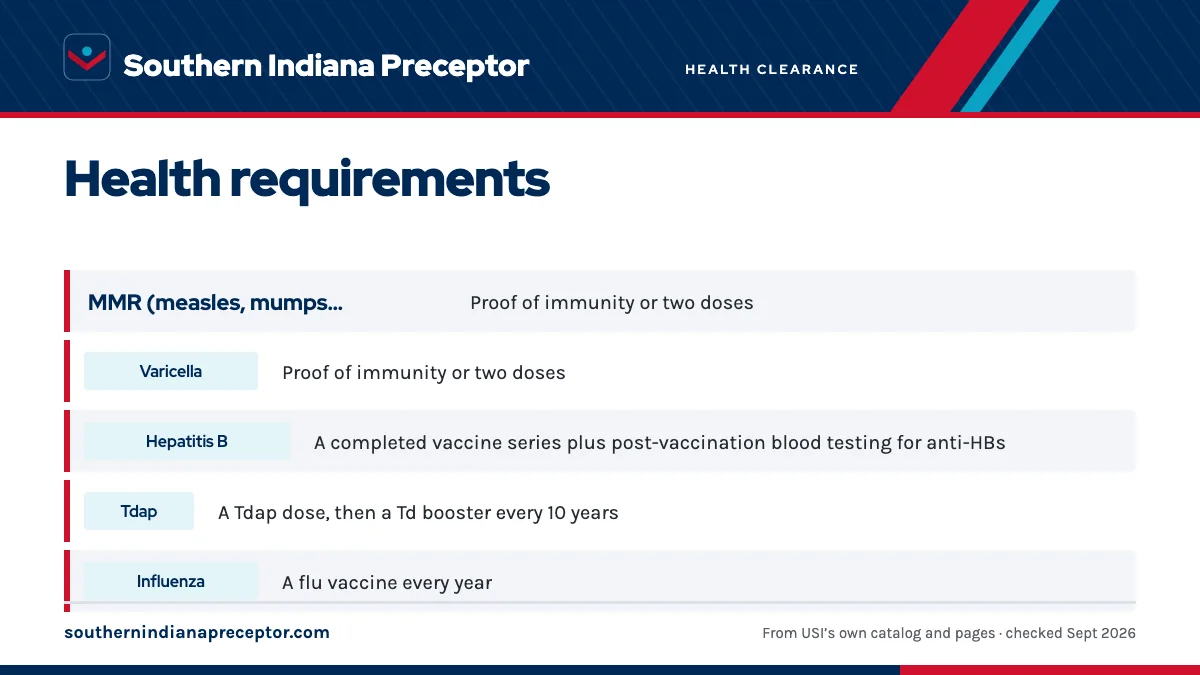
| Item | What the policy asks for |
|---|---|
| MMR (measles, mumps, rubella) | Proof of immunity or two doses |
| Varicella | Proof of immunity or two doses |
| Hepatitis B | A completed vaccine series plus post-vaccination blood testing for anti-HBs |
| Tdap | A Tdap dose, then a Td booster every 10 years |
| Influenza | A flu vaccine every year |
| COVID-19 | Strongly encouraged (page 6), not on the required list |
Start with hepatitis B. The policy wants the full series and the anti-HBs blood test that follows it, and neither step can be squeezed into the week before a due date. If you cannot find childhood records for MMR or varicella, proof of immunity satisfies the policy as well as two documented doses, which often means a blood draw rather than new shots.
Tdap works on a long cycle. Once you have the Tdap dose on record, the policy asks for a Td booster every ten years, so check the date on your last one before you upload it.
Tuberculosis screening
TB screening has its own section on pages 9 and 10 of the policy, which includes the two-step tuberculin skin test among the screening methods. Read those pages before you book anything, because the form your result takes has to match what the policy describes before it can clear.
Because TB screening and the flu shot both recur, their dates deserve a second look every term. Check each one against the final day of the semester you are entering: USI's graduate handbook allows no health record to lapse partway through a term. If your employer screens you on its own schedule, confirm that the employer result is dated and documented the way the policy expects before you rely on it.
Health insurance and exposure costs
USI expects you to carry health insurance for the whole program, and the handbook is direct about who pays: "The student is responsible for all costs related to their healthcare, including any costs associated with any type of clinical exposure."
That covers a needlestick or a splash during a clinical shift as much as routine care. The Infection Control Policy and the handbook's clinical FAQs set out what to do after an exposure, so read them before your first day, follow the reporting steps they describe, and keep your insurance details with you at the site.
USI's student malpractice coverage is a separate matter. It protects you in the student role of advanced practice nurse; it does not pay your own medical bills. The BLS, ACLS, HIPAA and OSHA page explains that coverage and who it leaves out.
Staying current through each semester
A health record that clears in August can fail in November. The graduate handbook bars any document from expiring before the semester ends, and a record not approved by the due dates can bring a Performance Improvement Plan and a possible course drop, as the deadlines page explains alongside the packet dates.
A routine that keeps the record clean
- Before each term, list every health item with its expiration date next to the term's last day.
- Get the new season's flu shot early enough to upload it before the due date.
- Check pages 9 and 10 for how your TB screening must be timed and documented.
- Keep a PDF of each record so a rejected upload can be redone the same day.
- If a clinical site asks for health items beyond USI's list, give them to the site and keep the Nursing Clinical Coordinator informed.
How we help you start clinicals on time
USI students choose us because we plan the whole clinical year, not just the next rotation. We work from your semester dates and your compliance due dates, line up preceptors and sites that fit your USI course close to home, and prepare the Preceptor Packet details so the paperwork reaches USI complete and well ahead of the 6-week window.
When a hospital or clinic keeps its own health checklist, we pass it to you as soon as the site is in view, so the site's list and USI's list are both finished before your first shift. If a preceptor withdraws mid-course, we stay on call and find a replacement. Read how it works or reach the placement desk through the form below.
Questions USI students ask
Is the COVID-19 vaccine required for USI nursing clinicals?
USI's 2026-2027 Infection Control Policy lists COVID-19 vaccination as strongly encouraged, not among the required items on page 5. A clinical site can set its own rules, so ask your site's office manager or education coordinator what it expects before your start date, and tell the Nursing Clinical Coordinator if the site's answer differs from USI's list.
Do I need a hepatitis B titer or only the vaccine series?
Both. The policy asks for a completed hepatitis B vaccine series and evidence of post-vaccination serologic testing for anti-HBs, which is the titer. Start early: the series is spread over months and the blood test comes after it, so this is the item most likely to hold up a new student's record.
Who pays if I am exposed to blood or an infection at my clinical site?
You do, through your own health insurance. USI's graduate handbook makes the student responsible for all healthcare costs, including those tied to any clinical exposure, and expects students to stay insured throughout the program. Follow the exposure steps in the Infection Control Policy and the handbook FAQs as soon as it happens.
Do I need a physical exam before USI clinicals?
The Infection Control Policy requires a comprehensive medical evaluation for students admitted to a clinical program, completed before they enroll in professional courses. Check the policy for what the evaluation must include, then upload it to your CastleBranch (DISA) account with the rest of your health records.
Does the flu shot have to be repeated every year?
Yes. Page 5 of the policy calls for annual influenza immunization. Since graduate clinical courses run through Fall, Spring and Summer, make it a yearly routine: get the new season's shot, upload it before the due date, and confirm the record keeps you covered for the whole term you are entering.
Related pages
Last checked 2026-09-25
We check these pages against USI's own bulletin, program pages and Graduate Nursing Handbook. Your handbook, course faculty and the Nursing Clinical Coordinator have the final word.
USI makes the search your job. We make it the easy part.
Tell us your USI track, your city and your next clinical semester. We find preceptors who fit the NRSG course and fill the Preceptor Packet and Clinical Education Agreement request with typed, complete details, well before USI's 6-week window.
- Preceptors matched to the course: family primary care for FNP, acute care teams for AGACNP, PMHNPs and psychiatrists for PMHNP
- Preceptor license, certification, years of practice and the site's agreement signer ready for the packet
- Fall, Spring and Summer planned together, close to home in a state USI enrolls
Start your placement plan
Track, city and clinical start is all we need to begin.