Typhon NP Student Tracking at USI
Every graduate nursing program at the University of Southern Indiana records clinical work in Typhon's NP Student Tracking System (NPST). You buy access once, it lasts through your coursework and up to five years after graduation, and it holds your patient encounters, your preceptor's co-signatures and the feedback forms faculty read each semester.
Get your placement plan
Tell us your USI program and where you live. A placement advisor replies with the preceptor and site options that fit your course.
What Typhon does in a USI clinical course
USI's Course Requirements page describes the platform in one line: "Typhon's NP Student Tracking System (NPST) … logs, tracks, and manages student clinical data." In practice it is where your direct clinical hours become a record faculty can read, encounter by encounter, toward the 200, 250 and 300 hours of the three specialty courses (hours by program).
Students in all graduate nursing programs must buy the software as a one-time purchase, and that single purchase covers your coursework plus up to five years after you graduate. The cost is the student's responsibility, like your compliance account.
The campus BSN uses Typhon as well, for hours, patient encounters, case types and clinical evaluations, so some USI graduates arrive already knowing the screens.
Before the first entry: USI loads your preceptor and site
You cannot simply open Typhon and start counting hours at a new clinic. The office-use box on page 2 of the Preceptor Packet (Form G) shows the order USI works in: licenses verified, the Clinical Education Agreement checked, faculty approval, the green light email sent, and then two Typhon entries, one for the preceptor and one for the site.
That sequence is why hours only begin after approval. The green light approval page explains what has to be true before you see a patient, and every additional preceptor at the same site needs an approved Preceptor Agreement of their own before their time counts (additional preceptors and observation).
One vocabulary point: the graduate handbook often calls Typhon the "third-party clinical repository." The same handbook uses similar words for CastleBranch (DISA), your compliance account, so read the sentence around the phrase to tell which system it means (CastleBranch (DISA)).
Logging encounters and getting them co-signed
The handbook FAQs set the standard: "students must accurately document each patient encounter in the third-party clinical repository. Preceptors must review and co-sign the student's entries where applicable." When you first meet a preceptor, USI has you explain that they will need to verify your time electronically in the same system.
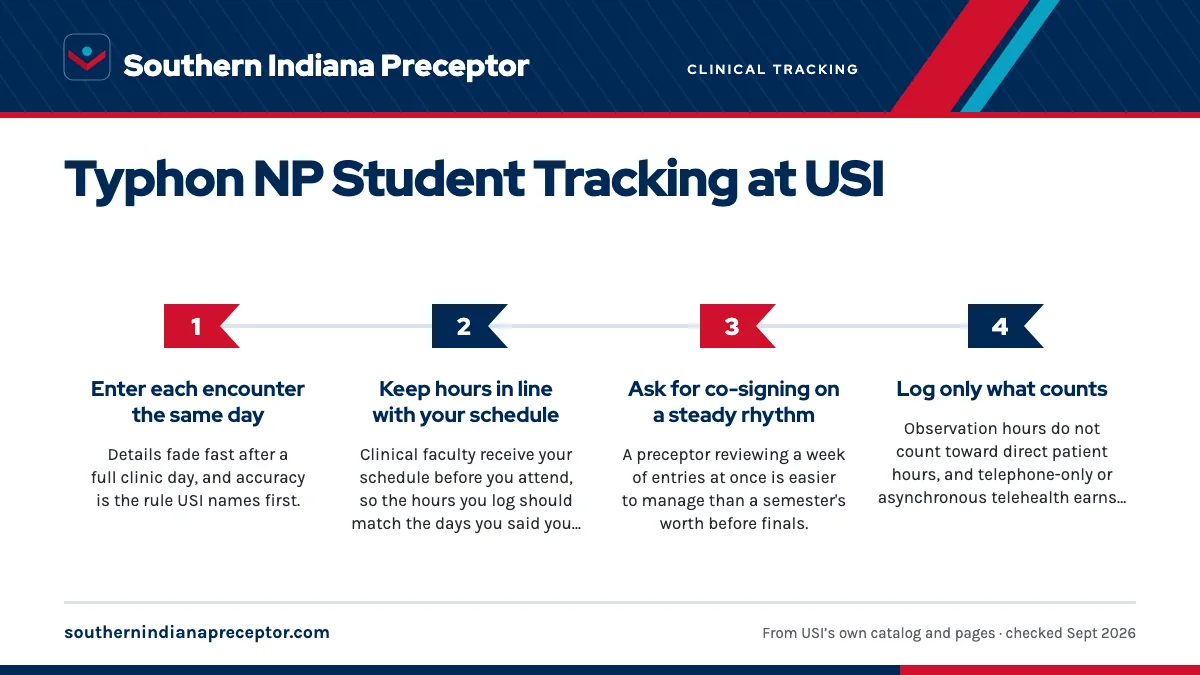
- Enter each encounter the same dayDetails fade fast after a full clinic day, and accuracy is the rule USI names first.
- Keep hours in line with your scheduleClinical faculty receive your schedule before you attend, so the hours you log should match the days you said you would be there.
- Ask for co-signing on a steady rhythmA preceptor reviewing a week of entries at once is easier to manage than a semester's worth before finals.
- Log only what countsObservation hours do not count toward direct patient hours, and telephone-only or asynchronous telehealth earns no credit. Ask course faculty how, or whether, to record anything outside direct care.
Feedback forms live in Typhon too
Preceptor Feedback Forms are completed twice a semester, once at midterm and once at the end, and USI requires all of them to be completed and stored in Typhon. You complete Student Feedback Forms on the same twice-a-semester schedule, also inside Typhon.
Those two preceptor forms are part of the minimum of seven touchpoints between your preceptor and your course faculty each semester. The rest are faculty emails and scheduled phone calls, and the clinical evaluations page lays out all seven with the midterm and final ratings. Mention the forms to your preceptor in the first week so the midterm one arrives as expected rather than as a surprise, and put both of your own form dates in your calendar next to the midterm and final calls.
DNP project hours use a separate log
DNP students meet two kinds of hours. The specialty clinical courses in the BSN-to-DNP APRN tracks sit inside the same graduate programs that buy Typhon, while hours earned in the DNP project courses follow the handbook's DNP logging rule: every practice hour must be recorded with the activity, the date, the relevant course objectives, the program outcomes and the DNP Essentials.
The catalog names the form for that work, the Doctor of Nursing Practice Hour Tracking form. How project hours add up toward the 1,000 post-baccalaureate hours is covered on the DNP practice hours page; ask your faculty mentor which log each course expects if you are unsure. Post-MSN students who bring fewer than 240 clinical hours from their MSN complete extra practice hours inside the project courses, which makes that log carry even more weight.
Why preceptors we place are ready for Typhon
A preceptor who says yes to a USI student is also saying yes to co-signing entries, two feedback forms and two calls with faculty each semester. We explain all of that at the first conversation, so the preceptors we introduce know the Typhon side of the role before they sign Form G.
We then gather the preceptor and site details USI needs to verify and load them, and we send them to you typed and complete, with weeks to spare before USI's 6-week deadline. Students choose us for that thoroughness and because we plan all three specialty semesters and keep a replacement search ready should a preceptor step away. Start with how it works or the form below.
Questions USI students ask
Who pays for Typhon at USI?
The student does. USI's Course Requirements page says students in all graduate nursing programs must buy the software as a one-time purchase, which covers the platform during coursework and for up to five years after graduation. Buy it before your first clinical course so the account is ready when USI loads your preceptor and site.
Does my preceptor need a Typhon account?
Your preceptor works inside Typhon: they review and co-sign your encounter entries and complete a Preceptor Feedback Form at midterm and at the end of the semester. The Preceptor Packet's office-use box shows USI entering the preceptor and the site in Typhon after approval, so the program handles that setup.
Can I log hours before USI's approval email arrives?
No. USI tells students not to begin clinical practice until the approval email confirms the Preceptor Packet and the Clinical Education Agreement have been accepted, and the preceptor and site are added to Typhon as part of that approval. Hours done before approval have no approved preceptor or site to attach to.
Do observation hours go in Typhon?
Observation hours do not count toward USI's required direct patient hours, though students are encouraged to request about eight hours of observation with a preceptor before seeing patients more independently. Ask your course faculty whether they want that time recorded in Typhon at all, and keep it separate from direct hours.
Is Typhon the same thing as the third-party repository in the handbook?
Sometimes. The graduate handbook uses third-party clinical repository for Typhon, where encounters are logged and co-signed, but it also calls CastleBranch (DISA) a third-party repository for compliance records such as BLS cards. If a sentence is about hours or encounters it means Typhon; if it is about documents and clearance it means DISA.
Related pages
Last checked 2026-09-25
We check these pages against USI's own bulletin, program pages and Graduate Nursing Handbook. Your handbook, course faculty and the Nursing Clinical Coordinator have the final word.
- University of Southern Indiana, Graduate Nursing Handbook: Course Requirements
- University of Southern Indiana, Graduate Nursing Handbook: FAQs
- University of Southern Indiana, Preceptor Packet (Form G, PDF)
- University of Southern Indiana, Graduate Nursing Handbook: University Clinical Requirements and Clinical Evaluation
- University of Southern Indiana, Graduate Nursing Handbook: BSN-DNP and Post MSN-DNP
USI makes the search your job. We make it the easy part.
Tell us your USI track, your city and your next clinical semester. We find preceptors who fit the NRSG course and fill the Preceptor Packet and Clinical Education Agreement request with typed, complete details, well before USI's 6-week window.
- Preceptors matched to the course: family primary care for FNP, acute care teams for AGACNP, PMHNPs and psychiatrists for PMHNP
- Preceptor license, certification, years of practice and the site's agreement signer ready for the packet
- Fall, Spring and Summer planned together, close to home in a state USI enrolls
Start your placement plan
Track, city and clinical start is all we need to begin.