USI's online MSN in Adult-Gerontology Acute Care: courses, 750 hours and acute care preceptors
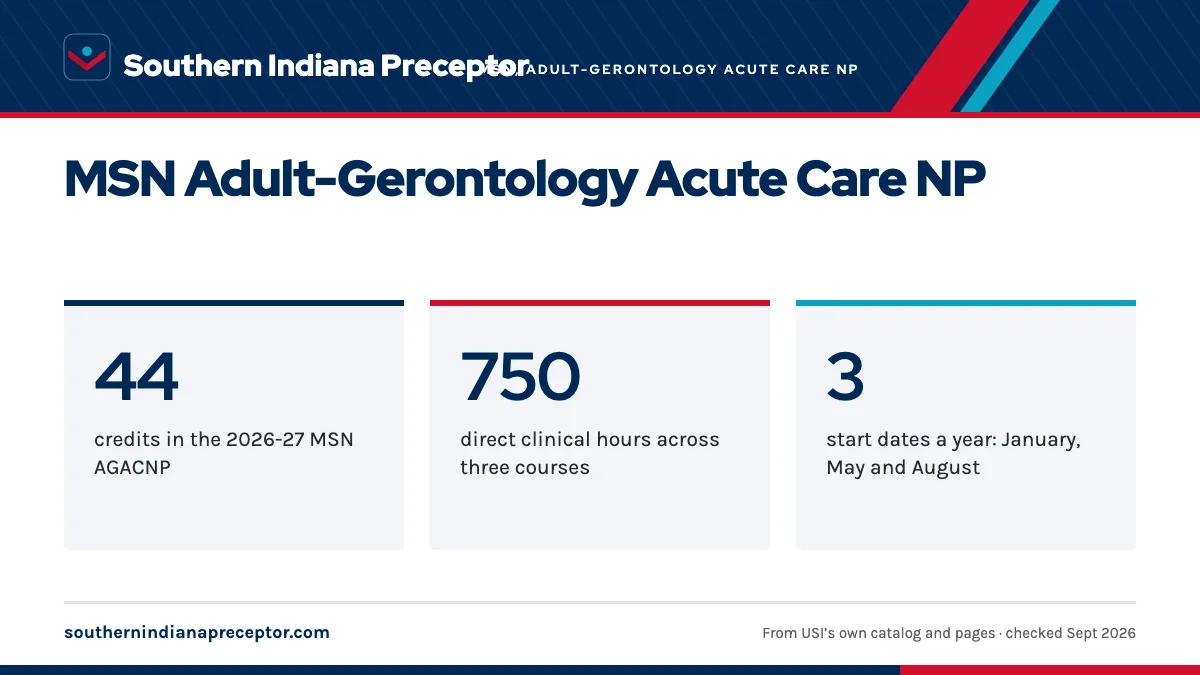
The University of Southern Indiana's AGACNP track is a 44-credit online MSN whose 750 direct clinical hours sit entirely inside three acute care courses, one each in Fall, Spring and Summer. You identify NP, PA or physician preceptors who practice in acute care, USI approves them, and you hold current ACLS throughout. USI puts the time to finish at 2.5 to 3 years.
Get your placement plan
Tell us your USI program and where you live. A placement advisor replies with the preceptor and site options that fit your course.
The curriculum at a glance
The 2026-27 Graduate Bulletin lists the track at 44 credits and sets B as the lowest acceptable grade in each of them. USI's program page describes it as 100% online. Direct clinical hours sit only in the three management courses of the specialty; the nursing core and the clinical core carry none, although NRSG 623 relies on i-Human cases, which USI books as indirect time.
Two credit figures are in circulation. The program-search tool behind USI's degree lists still shows 42 credits, the total before the 2026-27 rebuild, while the bulletin and the program page say 44. Go by the bulletin.
| Block | Courses | Credits |
|---|---|---|
| MSN Nursing Core | NRSG 601, NRSG 602, NRSG 603, NRSG 604, NRSG 605, NRSG 606 | 16 |
| MSN Clinical Core (the 3Ps) | NRSG 621 Advanced Pathophysiology, NRSG 622 Advanced Clinical Pharmacology, NRSG 623 Advanced Health Assessment (each for the APRN) | 9 |
| Acute Care Nurse Practitioner specialty | NRSG 631, NRSG 633, NRSG 635, NRSG 637 | 19 |
750 direct hours, course by course
USI's Specialty Track Overview gives the track a total of 750 direct clinical hours, and the Course Requirements page writes each course's share as a minimum. Hours count only after USI approves the preceptor and site and sends its approval email, and each course has its own page with the dates and planning detail.
The number has moved over the years. The 2023-24 bulletin said 705 clinical hours; the 2024-25 bulletin and the 2025-26 handbook said 675, split 180, 225 and 270 across NURS 674, 675 and 676. The 2026-27 rebuild renamed the courses to NRSG and set the floor at 750. If you began under the older plan, the 750-hour change page explains what shifted.
| Course | Term | Credits (lecture-lab) | Minimum hours | Setting and limits |
|---|---|---|---|---|
NRSG 633 Adult and Geriatric Acute Care Management I | Fall | 6 (4-2) | 200 | Various acute care settings |
NRSG 635 Adult and Geriatric Acute Care Management II | Spring | 6 (3.5-2.5) | 250 | Up to 36 hours a week |
NRSG 637 Adult and Geriatric Acute Care Management III | Summer | 5 (2-3) | 300 | Critical care or hospitalist preferred; up to 36 hours a week |
Who precepts AGACNP students, and where
USI allows "NPs, PAs, MDs, or DOs in the acute care setting" to precept acute care students. That is a much wider pool than the PMHNP track, which accepts only PMHNPs and psychiatrists, and it lets you look across hospital medicine, critical care and inpatient specialty teams.
In describing the track, the bulletin ranges from acute care hospitals and long-term care facilities to physician offices and urgent and ambulatory care centers. The clinical courses are narrower. Management I asks for a variety of acute care settings, and Management III leans toward ICU or hospitalist work, weighing anything else case by case.
One difference from the other NP tracks is easy to miss. USI permits telehealth clinical hours only for FNP and PMHNP students, so every AGACNP hour is in-person care with your preceptor physically present. The general graduate rules apply on top: an unencumbered license, specialty certification, a year as an advanced provider, board certification matching your track for NPs and PAs, and no relatives. See the full preceptor rules.
Requirements that come with acute care
Most compliance items are shared across USI's graduate programs, but a few are specific to this track or matter more in it.
- ACLS: every AGACNP student must hold current Advanced Cardiac Life Support, in addition to the BLS every graduate student needs, both verified in DISA (formerly CastleBranch).
- i-Human: a required purchase for
NRSG 623,NRSG 633andNRSG 635, logged as indirect hours and never as direct ones. - 3-P Diagnostic Exam: sat once the 3Ps are finished, ahead of
NRSG 633. - Barkley Board Review: a required purchase during the second half of
NRSG 635. - Predictor exams: nationally normed, required in your final semester.
- Clearance: criminal background and 10-panel drug screening on entry, filed with DISA before any graduate nursing course, then yearly HIPAA, OSHA and Zachary's Law registry checks.
- Licensure: an RN license with no encumbrance in each state you log hours in.
Renewal timing for the certifications is on the BLS, ACLS, HIPAA and OSHA page, and the exam pieces are explained under i-Human and board review.
When clinicals begin, and who finds the preceptor
USI publishes no graduate sample plan, but the bulletin's term listings fix the order. NRSG 621 runs in Fall and NRSG 622 in Spring; NRSG 623 runs in Summer beside NRSG 631, which needs NRSG 622 first. After that the three management courses follow in a row: Fall, Spring, Summer. Whether you start in January, May or August, your acute care hours begin in a Fall and end the following Summer.
Under the Graduate Nursing Handbook, finding preceptors is the student's responsibility, within your own community; the catalog frames it as encouragement with help from the clinical liaison. How that works day to day, including the handbook's note that some students turn to third-party placement organizations at their own cost, is on finding your own preceptor.
Acute care adds a hospital layer. Many health systems run their own NP student applications with deadlines months ahead of USI's 6-week window, and the Evansville-area guide lists what systems in the tri-state publish.
Where you can enroll and do clinicals
The Enrollment Not Allowed column of USI's licensure disclosure, a table marked Updated Fall 2025, closes the MSN NP tracks to residents of the states listed below, along with DC and several territories. The same table puts Massachusetts under both Meets and Does Not Meet and omits Colorado from the MSN NP rows altogether, so a Colorado resident should get an answer from USI before applying.
Moving mid-program carries its own risk. USI warns that relocating to a state its graduate program does not recognize ends your ability to keep taking courses, unless you are on active military status, so tell the Program Chair and APRN Director about any planned move in advance. State-by-state detail is on the licensure disclosure page.
| Region | States and jurisdictions |
|---|---|
| South | Alabama, Delaware, Louisiana, Mississippi, Oklahoma |
| Northeast | Massachusetts, New York, Pennsylvania |
| Midwest and Plains | Minnesota, North Dakota |
| West | Arizona, Nevada, Oregon, Wyoming |
| Also listed | District of Columbia, Guam, Northern Mariana Islands, Puerto Rico, U.S. Virgin Islands |
Why AGACNP students choose us
Acute care placements reward preparation more than any other NP track, and preparation is what we bring. Your placement advisor searches for hospital-based NPs, PAs and physicians close to home, in a state where USI enrolls students, screens each one against USI's acute care preceptor rules, and plans all three courses together: a strong first acute care site for Fall, a Spring placement that can carry 250 hours within the 36-hour weekly limit, and the critical care or hospitalist placement USI prefers for Summer.
For every rotation we assemble the facts USI's two forms call for, from license numbers, board certification and DEA to years at the practice, site survey figures and the hospital's agreement signer. Each packet is timed around the hospital's own student process as well as USI's window. When a preceptor drops, your advisor goes straight back to the search. The approvals belong to USI; our part is making sure each request is whole when it arrives. Tell us your start term or use the form below.
Questions USI students ask
How long does USI's online AGACNP MSN take?
USI's program page says 2.5 to 3 years. The clinical stretch is fixed at three back-to-back semesters, Fall, Spring and Summer, because NRSG 633, NRSG 635 and NRSG 637 are each offered in one term a year. Your start date and plan of study decide how many terms the nursing core and the 3Ps take before that.
When does ACLS need to be current for the AGACNP track?
USI requires every AGACNP student to hold current ACLS, uploaded to DISA along with BLS, and its compliance timeline expects both to be current by the start of each semester. Nothing in DISA may expire before the semester ends, so renew early enough that a card cannot lapse during NRSG 633, NRSG 635 or NRSG 637.
Can a physician assistant precept me in the AGACNP track?
Yes. The Course Requirements page names PAs alongside NPs, MDs and DOs for acute care, and a PA preceptor needs board certification in the specialty that lines up with your track. Only the PMHNP track shuts PAs out, limiting its preceptors to PMHNPs and licensed psychiatrists.
Which certification exams do USI AGACNP graduates take?
USI's student and program outcomes page reports AGACNP results from two certifying bodies, ANCC and AACN. For 2025 it lists 85% on ANCC and 100% on AACN, and for 2024, 100% on both. The required Barkley review during NRSG 635 and the final-semester predictor exams are the preparation USI builds in.
Is there a BSN-to-DNP version of the AGACNP track?
Yes. The BSN-to-DNP AGACNP route runs the same acute care sequence under 800-level numbers, NRSG 831 through NRSG 837, with the same hour minimums, then adds doctoral courses and a DNP project for 1,510 practice hours in all. It is 72 credits, and USI lists August as its only start.
Does the online AGACNP MSN require campus visits?
No set residency or immersion appears in USI's MSN materials. The bulletin keeps the option of calling students to campus to show clinical competency, and faculty can also check your skills through site visits, calls that include your preceptor, and video recordings during the acute care courses. Keep that possibility in mind when you plan time away from work.
Related pages
Last checked 2026-09-25
We check these pages against USI's own bulletin, program pages and Graduate Nursing Handbook. Your handbook, course faculty and the Nursing Clinical Coordinator have the final word.
- University of Southern Indiana 2026-2027 Graduate Bulletin: MSN, Adult-Gerontology Acute Care Nurse Practitioner
- University of Southern Indiana: Master of Science in Nursing, Adult-Gerontology Acute Care Nurse Practitioner
- University of Southern Indiana Graduate Nursing Handbook: Course Requirements
- University of Southern Indiana Graduate Nursing Handbook: Specialty Track Overview
- University of Southern Indiana Professional Licensure Disclosure
USI makes the search your job. We make it the easy part.
Tell us your USI track, your city and your next clinical semester. We find preceptors who fit the NRSG course and fill the Preceptor Packet and Clinical Education Agreement request with typed, complete details, well before USI's 6-week window.
- Preceptors matched to the course: family primary care for FNP, acute care teams for AGACNP, PMHNPs and psychiatrists for PMHNP
- Preceptor license, certification, years of practice and the site's agreement signer ready for the packet
- Fall, Spring and Summer planned together, close to home in a state USI enrolls
Start your placement plan
Track, city and clinical start is all we need to begin.