USI's nursing licensure disclosure: enrollment limits and the table's own conflicts
The University of Southern Indiana's Professional Licensure Disclosure, labeled "Updated Fall 2025" on a page last modified in September 2026, answers two different questions for every nursing program: may residents of a state enroll at all, and does the curriculum meet that state's educational requirements for licensure. The bans differ by program, so read your own row, and watch three cells where the table disagrees with itself: Massachusetts, North Dakota and Colorado.
Check your state before you search
Tell us your program and the state where you live and plan to do clinicals.
How the nursing table is laid out
The nursing section of the disclosure is a six-column table: the program, its college, the certificate or license it leads to, then three columns of state codes headed "Enrollment Not Allowed for Residents of These States (due to State Nursing Regulations)," "Meets Requirements (additional req's may be needed to obtain licensure/certification)" and "Does Not Meet Requirements." Nursing has no "Not Determined" or "Not Required by State" column, although some other disciplines on the page use the second.
Keep the two questions apart as you read. A state can appear under both "Meets Requirements" and "Enrollment Not Allowed" for the same program, as Alabama does for every nurse practitioner row. That is consistent: the curriculum would satisfy Alabama's board, but Alabama residents cannot enroll.
Enrollment Not Allowed, program by program
This column is the one that decides whether you can start. It is read by residence, and USI's Full Admission Requirements page confirms that applicants living in a state where USI does not meet licensure requirements, or where it is not authorized to enroll students, are ineligible for the graduate nursing program.
| Program row | States | Count | DC and territories |
|---|---|---|---|
| MSN FNP, AGACNP and PMHNP | AL, AZ, DE, LA, MA, MN, MS, ND, NV, NY, OK, OR, PA, WY | 14 | DC, GU, CNMI, PR, VI |
| Post-Master's Certificates (FNP, AGACNP, PMHNP) | AL, CO, DE, LA, MA, MN, ND, NV, NY, OK, OR, PA, SD, WA, WY | 15 | DC, AS, GU, CNMI, PR |
| BSN-to-DNP FNP, AGACNP and PMHNP | AL, AZ, CO, DE, LA, MA, MN, MS, NV, NY, OK, OR, PA, SD, WA, WY | 16 | DC, AS, GU, CNMI, PR |
| DNP Advanced Nursing Practice (post-MSN) | AL, AZ, CO, DE, LA, MA, MN, MS, NV, NY, OK, PA, WA, WY | 14 | DC, AS, GU, CNMI, PR |
| MSN Healthcare Systems Leadership and Nursing Education Leadership | AL, AZ, CO, DE, LA, MA, MN, MS, NV, NY, OK, WA, WY | 13 | DC, AS, GU, CNMI, PR, VI |
| BSN-to-DNP Organizational and Systems Leadership | CO, DE, MN, MS, NY, OK, PA, WY | 8 | DC, AS, GU, CNMI |
| RN-to-BSN (online) | AL, CO, LA, MN, MS, NV, NY, OK, WY | 9 | DC, AS, GU, CNMI, PR |
| BSN (on campus) | None | 0 | None |
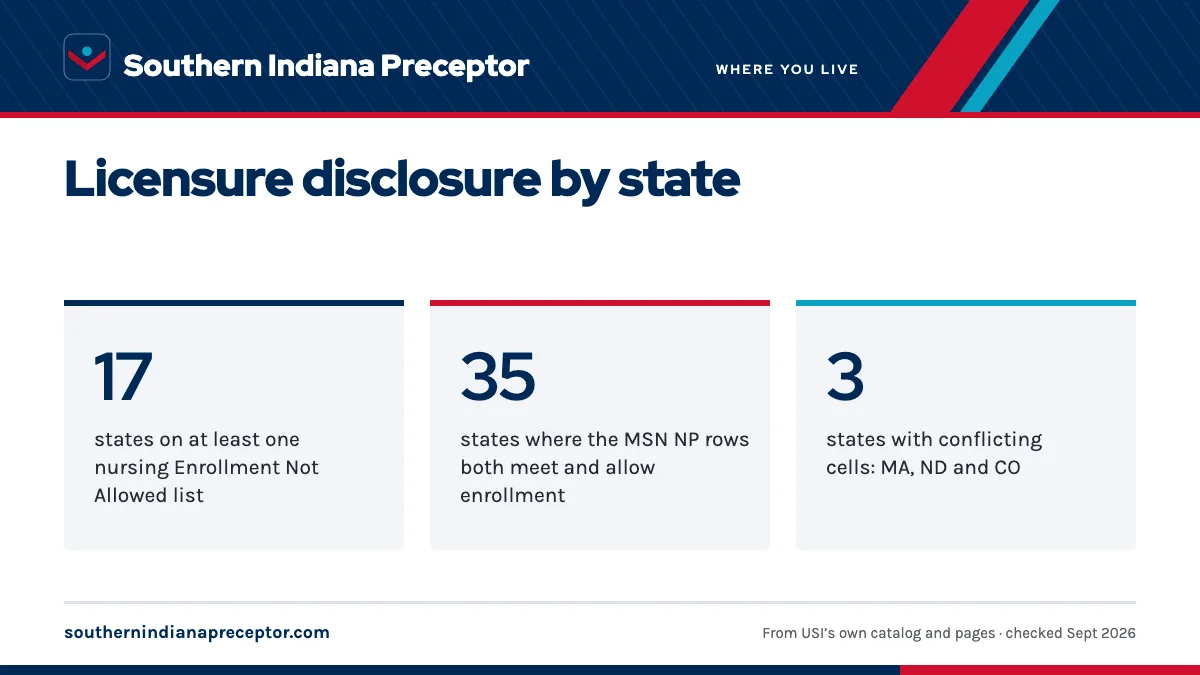
Seventeen states appear on at least one list, and Minnesota, New York, Oklahoma and Wyoming appear on all of them. The differences between rows are the trap. North Dakota bars only the MSN NP tracks and the certificates; Colorado, South Dakota and Washington bar the certificates and the BSN-to-DNP APRN routes but not the MSN NP tracks; Arizona and Mississippi bar the MSN NP tracks but not the certificates; and Oregon is absent from the post-MSN DNP row. A state that is open for one USI program may be closed for the next one you consider.
The table still carries a row for the BSN-to-DNP Adult-Gerontology Clinical Nurse Specialist, closed to new applicants since Summer 2026 and linked to the AGACNP page.
The curriculum columns: meets and does not meet
For APRN programs, the second question is whether your degree satisfies the board where you plan to be licensed, which may not be the state you live in today.
| Program row | Meets | Does not meet | Listed in both | Listed in neither | Meets and open to residents |
|---|---|---|---|---|---|
| MSN FNP, AGACNP, PMHNP (each) | 47 | LA | MA | CO | 35 |
| Post-Master's Certificates (each) | 46 | CO, LA, MA, MS | None | None | 34 |
| BSN-to-DNP FNP, AGACNP, PMHNP (each) | 48 | None | ND | CO | 33 |
| DNP Advanced Nursing Practice | 48 | None | ND | CO | 35 |
| RN-to-BSN, MSN HSL, MSN NEL, BSN-to-DNP OSL | N/A: no license | N/A | N/A | N/A | Enrollment list only |
The 35 states that both meet and admit residents for the MSN NP rows are Alaska, Arkansas, California, Connecticut, Florida, Georgia, Hawaii, Idaho, Illinois, Indiana, Iowa, Kansas, Kentucky, Maine, Maryland, Michigan, Missouri, Montana, Nebraska, New Hampshire, New Jersey, New Mexico, North Carolina, Ohio, Rhode Island, South Carolina, South Dakota, Tennessee, Texas, Utah, Vermont, Virginia, Washington, West Virginia and Wisconsin. Each has its own state guide.
Three cells where the table disagrees with itself
The conflicts, as printed
- Massachusetts, MSN NP rows: listed under both Meets Requirements and Does Not Meet Requirements. Massachusetts is also on the MSN enrollment ban, so it matters mainly to graduates who hope to be licensed there later.
- North Dakota, DNP APRN rows: listed in both columns for the three BSN-to-DNP NP routes and the post-MSN DNP. North Dakota is not on any DNP ban list, so residents can enroll without a clear licensure answer.
- Colorado, MSN NP rows: missing from both columns and absent from the MSN ban list, which leaves Colorado MSN NP applicants with no answer at all. Colorado is also blank in both columns for the DNP rows, where it is banned, and marked Does Not Meet for the certificates.
- BSN-to-DNP OSL: the certificate cell reads Advanced Practice Registered Nurse while both licensure columns say N/A.
None of these can be resolved from the page. If your program and state land on one of them, ask USI directly: the disclosure page lists online.learning@usi.edu as its contact, and the Program Chair and APRN Director is the graduate nursing role USI names for questions about where students live.
A blank or doubled cell for your program and state is a question for USI, answered in writing, before you enroll or move.
How the table has changed
The disclosure moves. An archived copy from September 2025, still labeled "Updated Fall 2024," listed 15 jurisdictions on the MSN NP ban where the current page lists 19. A February 2026 copy already carried the Fall 2025 label but still showed rows for the MSN and post-master's Adult-Gerontology Clinical Nurse Specialist, both since removed.
Earlier pages worked differently again. A 2023 state authorization page marked nearly every state as authorized through NC-SARA, then carved out nursing degrees for residents of 17 jurisdictions, and a 2023 "Nursing Licensure by State" page said USI had not determined whether its curriculum met requirements in any of the 55 jurisdictions it listed.
The practical rule for online students: reread your program's row at the start of each academic year and again before any move.
Rules that sit beside the table
USI is an NC-SARA member. Its State Authorization Process page mentions lists of states "Eligible for Online Learning" that no longer appear on it, which leaves the Enrollment Not Allowed column as the only current state-level restriction for nursing.
The graduate nursing department adds that the Kinney College offers distance enrollment only to residents of states where USI "has obtained or is seeking authorization," and that moving into a state the program does not recognize will stop your coursework, with an exception for active military status. The steps for a mid-program move are on relocating during the program.
The table covers where you live and where you will be licensed. Where you do clinicals falls under a separate rule, which asks for an unencumbered RN license covering each state you practice in as a student, explained on RN license for clinicals.
Why students check their state with us first
Every search we run starts with your program's row. We read the cells for the state where you live, the state where you plan to be licensed and any state where you might do clinical hours, and we flag a Massachusetts, North Dakota or Colorado conflict so you can put the question to USI before anything else moves.
Then we search close to home, only where your program allows you to study and your RN license lets you practice, so your Preceptor Packet reaches USI with a site in the right state and every field complete. When USI updates the table, we recheck your row before the next search. Tell us your program and state with the form below.
Questions USI students ask
Does 'Meets Requirements' mean I will be licensed in that state?
No. The column only says USI believes its curriculum meets the state's educational requirements, and its header adds that additional requirements may be needed. USI's introduction warns that states can impose residency rules or non-academic certifications it cannot assess. Always confirm the full licensure process with that state's board of nursing before you rely on the column.
Are Indiana, Kentucky and Illinois open for every USI nursing program?
Yes. None of the three appears on any Enrollment Not Allowed list, and all three are marked Meets Requirements for every row that leads to licensure. For tri-state students the table is not the obstacle; the separate rule that you hold an RN license in each state where you do clinical hours matters more, especially for Illinois sites.
Can I enroll from a banned state if I do my clinicals somewhere else?
The ban is written for residents of the listed states, and USI's admission rules make residents of a state it is not authorized to enroll ineligible. Where your clinical sites are does not change your state of residence. If you are about to move, ask the Program Chair and APRN Director how your admission will be treated.
Which states are closed to every USI nursing program that has a ban list?
Minnesota, New York, Oklahoma and Wyoming appear on every Enrollment Not Allowed list in the nursing table, from the RN-to-BSN through the doctoral rows. Delaware is on every graduate list but not the RN-to-BSN. The on-campus BSN is the only row with an empty ban cell.
Related pages
Last checked 2026-09-25
We check these pages against USI's own bulletin, program pages and Graduate Nursing Handbook. Your handbook, course faculty and the Nursing Clinical Coordinator have the final word.
USI makes the search your job. We make it the easy part.
Tell us your USI track, your city and your next clinical semester. We find preceptors who fit the NRSG course and fill the Preceptor Packet and Clinical Education Agreement request with typed, complete details, well before USI's 6-week window.
- Preceptors matched to the course: family primary care for FNP, acute care teams for AGACNP, PMHNPs and psychiatrists for PMHNP
- Preceptor license, certification, years of practice and the site's agreement signer ready for the packet
- Fall, Spring and Summer planned together, close to home in a state USI enrolls
Start your placement plan
Track, city and clinical start is all we need to begin.