USI online MSN Family Nurse Practitioner: courses, hours and preceptors
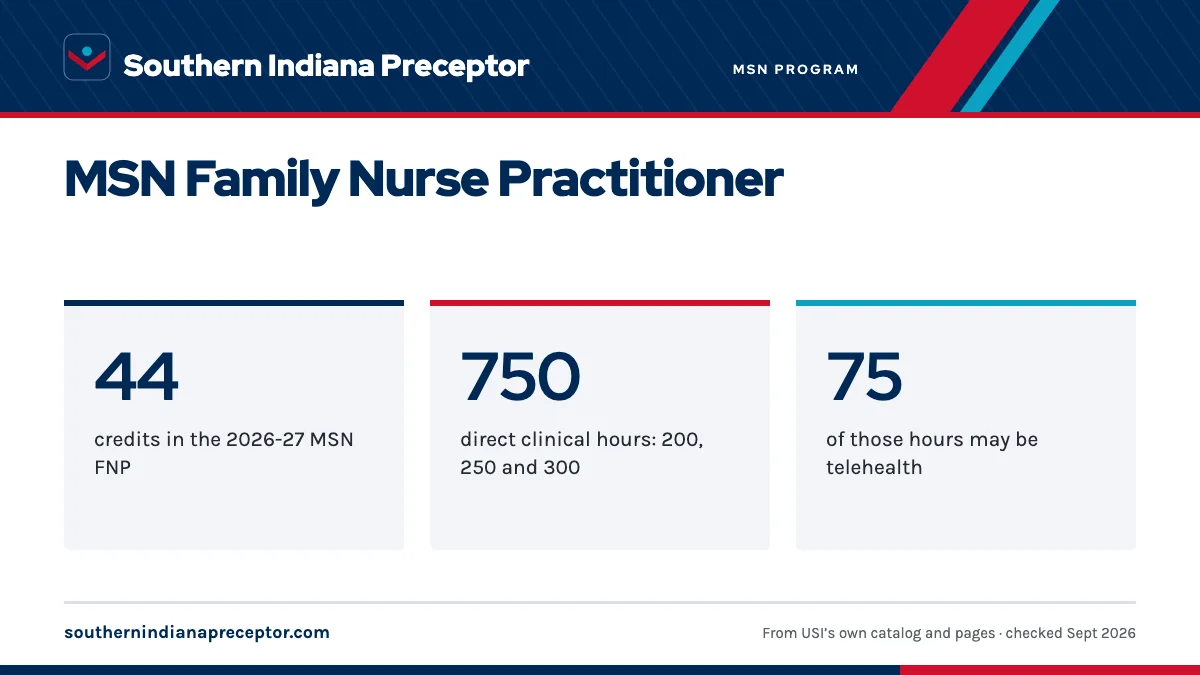
The University of Southern Indiana's online MSN Family Nurse Practitioner is 44 credits and 750 direct clinical hours, completed in three specialty courses that run Fall, Spring and Summer. You identify preceptors in your own community, USI approves each one, and the first Preceptor Packet is due six weeks before NRSG 643 begins.
Plan your FNP clinical year
Tell us your city and the Fall your clinicals start. Your placement advisor replies with family primary care options for NRSG 643 and a plan for 645 and 647.
The program in brief
Kinney College faculty teach the MSN FNP entirely online. USI's program page estimates 2.5 to 3 years of study and offers January, May and August starts, with 2027 applications closing in November 2026, April 2027 and July 2027 respectively. Of the 44 credits, 16 belong to the MSN core, 9 to the clinical core that USI nicknames the 3Ps, and 19 to the family specialty.
To be admitted you need a bachelor's in nursing from a program holding both national and regional accreditation, a GPA of at least 3.0, a statistics course passed with a C or higher, and an RN license without encumbrance in each state where you work. USI recommends, without requiring, one year of full-time nursing or 2,000 hours of RN practice in the past five years. Every course must be passed with a B or higher to earn the degree. Up to 12 graduate credits can come from elsewhere, but APRN specialty coursework from another university is not considered.
One mismatch to ignore: USI's online program finder still prints 42 credits from the previous curriculum, while the 2026-27 bulletin and the program page show 44.
Courses and where the hours fall
Nothing in the MSN core (NRSG 601 through NRSG 606) involves clinical time. Direct hours live only in the final three specialty courses.
| Course | Title | Credits | Term | Direct hours |
|---|---|---|---|---|
NRSG 621 | Advanced Pathophysiology for the APRN | 3 | Fall | None |
NRSG 622 | Advanced Clinical Pharmacology for the APRN | 3 | Spring | None |
NRSG 623 | Advanced Health Assessment for the APRN | 3 | Summer | None (i-Human indirect hours) |
NRSG 641 | Introduction to Primary Care Across the Lifespan | 2 | Summer | None |
NRSG 643 | Primary Care Across the Lifespan I | 6 | Fall | 200 |
NRSG 645 | Primary Care Across the Lifespan II | 6 | Spring | 250 |
NRSG 647 | Primary Care Across the Lifespan III | 5 | Summer | 300 |
Since 643 is a Fall-only course with 623 and 641 as prerequisites, the clinical year always opens in a Fall and then moves to Spring and Summer. There is no official MSN sample plan from USI, so ask the program to confirm the order of your terms. The BSN-to-DNP FNP route mirrors this sequence with NRSG 841, NRSG 843, NRSG 845 and NRSG 847.
Who precepts FNP students
Your preceptor options widen through the year. For NRSG 643 the approved list is family NPs, PAs and primary care physicians. In 645 and 647, NPs, PAs and physicians from specialties join in; 645 lets you add specialty sites while most hours stay in primary care, and 647 allows them once course faculty approve.
Whoever precepts you must carry a license without encumbrance in their state of practice, hold specialty certification (for an NP or PA, in an area that corresponds to your track), bring twelve months or more of advanced-provider practice, and have a signed USI agreement in place. Family members and partners are ruled out, and the preceptor stays on site with you, teaching one student at a time. PAs qualify in all three FNP courses.
Finding preceptors: USI's rule and the path to approval
The Graduate Nursing Handbook assigns the search to the student: you identify the preceptors and clinical sites, in the community where you live. The 2026-27 bulletin sounds softer, saying students are encouraged to find them with support from the university's clinical liaison. Under both versions, nothing counts until the Graduate Clinical Liaison has signed off on the preceptor and the site, and the handbook itself acknowledges that a student may end up using third-party placement organizations.
The route to approval repeats for every rotation. You meet the preceptor, hand over Form G with a one-page CV, fill in the packet and USI's agreement request together with the practice, and send both from your USI email account to usi1nursing@usi.edu as typed PDFs. The complete walk-through is on the placement process page.
Deadlines across the clinical year
Every clinical course gets its own packet, and each one is due six weeks ahead of that rotation. With the 2026-27 calendar as the example:
| Course | Term starts | Packet due (6 weeks before) |
|---|---|---|
NRSG 643 | Fall 2026: August 17 | July 6, 2026 |
NRSG 645 | Spring 2027: January 11 | November 30, 2026 |
NRSG 647 | Summer 2027: mid-May | Around the start of April 2027 |
Once a course opens, patient care has to be under way by its third week and keep going weekly; holidays and breaks between terms add nothing. A different handbook page talks about one month or 4 weeks, but the six-week date is the one printed on the packet itself, so plan to it.
Compliance, tracking and telehealth
- Criminal background check and drug screen (10-panel) on file with CastleBranch, now DISA, ahead of the first graduate nursing course; nothing there may lapse mid-semester
- BLS for every student, plus HIPAA and OSHA modules each year, where an employer's certificate is an accepted substitute
- RN licensure, unencumbered, in whichever states your clinical hours take place
- Typhon logs for every encounter, co-signed by your preceptor, with two Preceptor Feedback Forms per term
- i-Human cases during the health assessment course and the first two specialty courses; the Barkley Board Review is bought partway through 645
- Telehealth: up to 75 of the 750 hours, live, with you and your preceptor in the same room; see telehealth clinical hours
Where you can live while enrolled
USI's Professional Licensure Disclosure, marked updated Fall 2025, bars residents of 14 states from enrolling in any MSN NP track, New York, Pennsylvania, Minnesota and Arizona among them, and extends the bar to DC and several territories. Check your state against the full list on USI's licensure disclosure before you apply.
Two cells in the MSN rows need a direct answer from USI. Massachusetts is marked both as meeting and as not meeting licensure requirements, and Colorado is missing from both columns. Relocating mid-program matters too: a move into a state USI does not recognize stops your coursework, with an exception for active military service, so notify the Program Chair and APRN Director while the move is still a plan.
Why USI FNP students choose us
The FNP track asks for three approved placements in twelve months, each with its own packet, while you keep working as a nurse. That is the load our placement desk takes on.
Everything we do follows USI's own process. Your placement advisor searches family primary care practices near you for 643, lines up primary care and specialty options for 645 and 647, and collects each preceptor's license, certification, years in practice and DEA number along with the name of the site's agreement signer. Each Form G reaches USI typed, complete and weeks ahead of the deadline. We remain on call through Summer and replace a preceptor who drops. Share your city and planned start in either form on this page.
Questions USI students ask
How long is USI's online FNP program?
Plan on 2.5 to 3 years, the estimate on USI's program page. The 44 credits end with a clinical year of three specialty courses, Fall, Spring and Summer, holding the 750 direct hours. Because NRSG 643 runs once a year in Fall with two Summer prerequisites, your start term and pace decide which Fall your clinicals open.
Does USI find preceptors for FNP students?
The handbook places the search with you: you identify preceptors and sites in your community, and the Graduate Clinical Liaison approves them. When a search stalls, USI asks you to contact the Nursing Clinical Coordinator at usi1nursing@usi.edu, confirm that your workplace has no preceptor option, and share every organization you have already approached. Then keep them informed as your search goes on.
Can a physician be my FNP preceptor at USI?
Yes. Primary care physicians may precept NRSG 643, and primary care or specialty physicians may precept 645 and 647. Like every USI preceptor, a physician needs an unencumbered license in their practice state, current specialty certification, at least a year of practice experience and a signed agreement with USI.
What are the BSN-to-DNP versions of the FNP courses?
USI's BSN-to-DNP FNP route uses 800-level twins: NRSG 841 for the introduction, then NRSG 843, NRSG 845 and NRSG 847, with the same 200, 250 and 300 direct hours. The doctorate adds embedded practice hours and a project for 1,510 in total. The BSN-to-DNP page has the rest.
Can I transfer FNP specialty courses into USI's MSN?
No. USI accepts up to 12 graduate credits toward the MSN, but specialty APRN courses taken at another institution are not considered, so NRSG 641 through NRSG 647 happen at USI. That means all 750 direct hours are earned inside USI's own specialty courses, under USI-approved preceptors.
Related pages
Last checked 2026-09-25
We check these pages against USI's own bulletin, program pages and Graduate Nursing Handbook. Your handbook, course faculty and the Nursing Clinical Coordinator have the final word.
- University of Southern Indiana 2026-2027 Graduate Bulletin: MSN Family Nurse Practitioner
- USI Master of Science in Nursing: Family Nurse Practitioner (program page)
- USI Graduate Nursing Handbook: Course Requirements
- USI Graduate Nursing Handbook: University Clinical Requirements and Clinical Evaluation
- USI Professional Licensure Disclosure
USI makes the search your job. We make it the easy part.
Tell us your USI track, your city and your next clinical semester. We find preceptors who fit the NRSG course and fill the Preceptor Packet and Clinical Education Agreement request with typed, complete details, well before USI's 6-week window.
- Preceptors matched to the course: family primary care for FNP, acute care teams for AGACNP, PMHNPs and psychiatrists for PMHNP
- Preceptor license, certification, years of practice and the site's agreement signer ready for the packet
- Fall, Spring and Summer planned together, close to home in a state USI enrolls
Start your placement plan
Track, city and clinical start is all we need to begin.