NRSG 645 Primary Care Across the Lifespan II
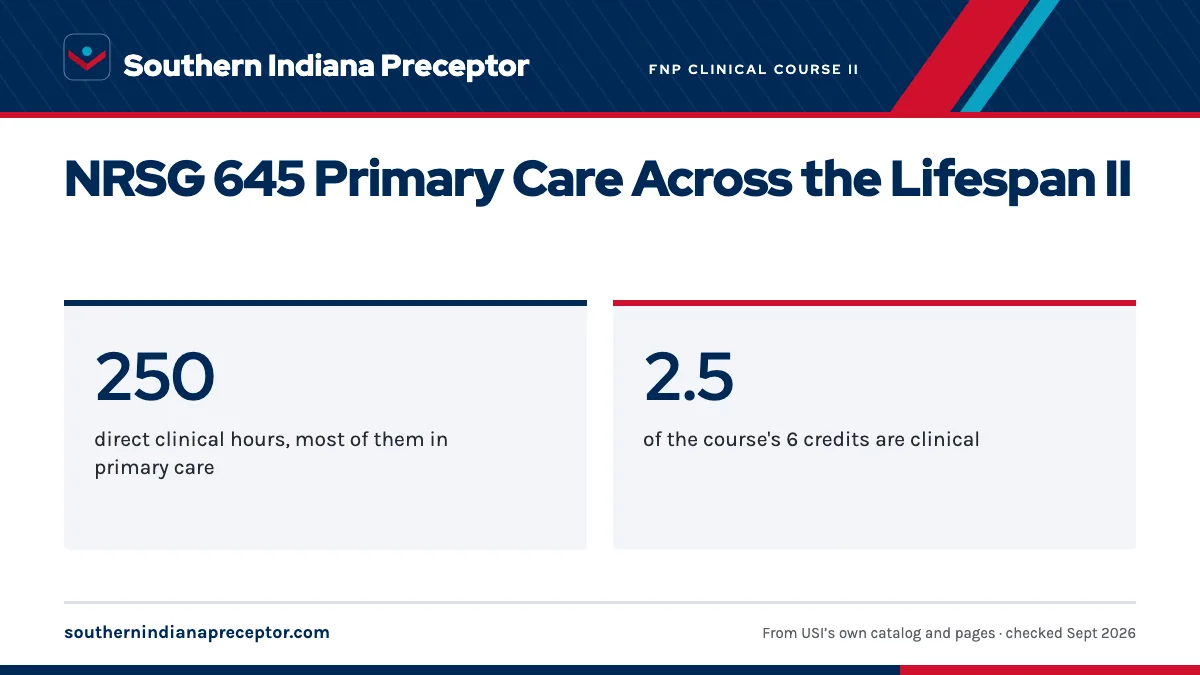
NRSG 645 Primary Care Across the Lifespan II is the Spring middle of the University of Southern Indiana's FNP clinical year: 250 direct hours, the majority in primary care, with room to add specialty sites such as pediatrics, obstetrics or dermatology. The preceptor list widens to specialty NPs, PAs and physicians, and the BSN-to-DNP equivalent, NRSG 845, asks for the identical 250.
Get your placement plan
Tell us your USI program and where you live. A placement advisor replies with the preceptor and site options that fit your course.
The course at a glance
645 sits in the middle of the FNP clinical year and is the first course where you shape part of your own clinical mix. It keeps the family primary care core from Fall and lets you spend part of the term in a specialty that fills a gap in your experience.
| Item | Detail |
|---|---|
| Title | Primary Care Across the Lifespan II |
| Credits | 6 (3.5 lecture, 2.5 clinical) |
| Term | Spring, after NRSG 643 in Fall |
| Direct clinical hours | 250 |
| Setting | Mostly primary care; additional specialty sites allowed |
| Who may precept | Family and specialty NPs and PAs; primary care and specialty physicians |
| Purchases | i-Human cases (indirect hours); Barkley Board Review in the second half |
| BSN-to-DNP twin | NRSG 845, same 250 hours |
| Next in sequence | NRSG 647 in Summer |
Dividing 250 hours between primary care and a specialty
USI's wording for 645 has two parts: most of the hours stay in primary care, and students may select additional clinical specialty sites such as pediatrics, obstetrics, dermatology or other areas of interest. The handbook puts no number on "most," so agree the split with course faculty before you promise a specialist a block of your hours.
One workable shape is a primary care preceptor for the bulk of the term and a second site for a defined stretch. Each site needs its own approval: a specialist at a different practice means a separate Preceptor Packet, and a separate Clinical Education Agreement if that practice has none with USI, submitted 6 weeks ahead like the first. A second clinician at your primary preceptor's own office still needs an additional Preceptor Agreement approved before you work with them; see additional preceptors and observation.
Who can precept 645, and one wording to check
From 645 onward USI lists family and specialty nurse practitioners and physician assistants, plus primary care and specialty physicians. The general graduate rules still apply to each: a license in good standing in their practice state, certification in their specialty, a minimum of one year practicing as an advanced provider, a signed USI agreement, and no family or romantic tie to you. PAs are covered on physician assistant preceptors.
There is one tension in the wording. The general rule asks NP and PA preceptors to be board certified in areas corresponding to your specialty track, while the 645 course wording names specialty NPs and PAs outright. If you plan to use, say, a pediatric or women's health nurse practitioner, confirm with course faculty that their certification is acceptable before the packet goes in.
Spring dates, the Barkley review and the packet deadline
Spring 2027 runs January 11 to May 7. With clinical required by week 3, your first countable day falls by the week of January 25, and no hours are allowed during Spring Recess (March 8 to 13) or on March 26, when the university is closed. That leaves about 14 working weeks, close to 18 hours a week for 250 hours.
The Preceptor Packet for a January 11 start is due 6 weeks earlier, on November 30, 2026, while you are deep in NRSG 643. Faculty evaluate you again at midterm and at the end of the term, and your preceptor completes two more feedback forms in Typhon.
USI also requires FNP students to purchase the Barkley Board Review during the second half of their Specialty II course, which is 645, and the i-Human cases continue as indirect hours. Both are explained on the i-Human and Barkley page.
NRSG 845 for BSN-to-DNP students
NRSG 845 is the 800-level twin of 645, with the same 250 hours, the same primary care majority and the same specialty options, sitting between NRSG 843 in Fall and NRSG 847 in Summer. Its hours feed the BSN-to-DNP route's 1,510-hour total, which also counts practice hours embedded in DNP courses and the three project courses.
Those embedded hours sit in courses such as NRSG 709 and NRSG 715, which run in Spring or Summer, so check your plan of study for terms where specialty hours and DNP practice hours overlap. The full breakdown is on DNP practice hours.
Why USI FNP students trust us with 645
645 is the first course where a second preceptor makes real sense, and that doubles the work: two sets of credentials, possibly two site agreements, and two schedules that both have to start by week 3.
Our placement desk finds the specialty clinician while keeping your primary care preceptor on track, checks both against USI's rules, and prepares both packets with typed, complete details well before the late-November deadline. If either preceptor steps back during Spring, we find a replacement and protect your weekly hours. We also keep Summer in view: a specialist who works well with you in Spring may suit part of NRSG 647, where specialty sites need prior faculty approval. Start with the form below.
Questions USI students ask
How many hours is NRSG 645 at USI?
250 direct clinical hours in the Spring term, most of them in primary care, with specialty sites allowed for part of the total. Together with 200 hours in NRSG 643 and 300 in NRSG 647, they make up the FNP track's 750 direct hours. Telehealth can supply some of them, within the track's 75-hour cap.
Can I do NRSG 645 hours in pediatrics or women's health?
Yes, for part of the course. USI allows additional specialty sites in 645 and names pediatrics, obstetrics and dermatology as examples, along with other areas of interest. The majority of the 250 hours stay in primary care, and each specialty site needs its own approved packet before your first hour there.
When do USI FNP students take the Barkley review?
USI requires FNP, AGACNP and PMHNP students to purchase the Barkley Board Review during the second half of their Specialty II course, which for FNP students is NRSG 645 in Spring. The Specialty III course page refers to it again, so expect it to carry into NRSG 647 in Summer.
Do I need a new Preceptor Packet for NRSG 645 if I keep my 643 preceptor?
Yes. The current Form G says the Preceptor Agreement is valid only for the course, semester and year listed in Part One. The 2019 version allowed one year with an option to renew for a second, but the 2026 form replaced it, so each course needs its own signed packet.
What is NRSG 845?
The BSN-to-DNP twin of NRSG 645: Primary Care Across the Lifespan II at the 800 level, with the same 250 direct hours, the same primary care majority and the same specialty options. It follows NRSG 843 in Fall and comes before NRSG 847 in Summer, and its hours count toward the 1,510 total.
Related pages
Last checked 2026-09-25
We check these pages against USI's own bulletin, program pages and Graduate Nursing Handbook. Your handbook, course faculty and the Nursing Clinical Coordinator have the final word.
USI makes the search your job. We make it the easy part.
Tell us your USI track, your city and your next clinical semester. We find preceptors who fit the NRSG course and fill the Preceptor Packet and Clinical Education Agreement request with typed, complete details, well before USI's 6-week window.
- Preceptors matched to the course: family primary care for FNP, acute care teams for AGACNP, PMHNPs and psychiatrists for PMHNP
- Preceptor license, certification, years of practice and the site's agreement signer ready for the packet
- Fall, Spring and Summer planned together, close to home in a state USI enrolls
Start your placement plan
Track, city and clinical start is all we need to begin.