NRSG 647 Primary Care Across the Lifespan III
NRSG 647 Primary Care Across the Lifespan III closes out the University of Southern Indiana's FNP clinical sequence and carries its heaviest load: 300 direct hours in Summer, at 30 or more hours a week and never more than 40. Specialty sites are possible with prior approval from course faculty, and NRSG 847 holds BSN-to-DNP students to the same 300.
Get your placement plan
Tell us your USI program and where you live. A placement advisor replies with the preceptor and site options that fit your course.
NRSG 647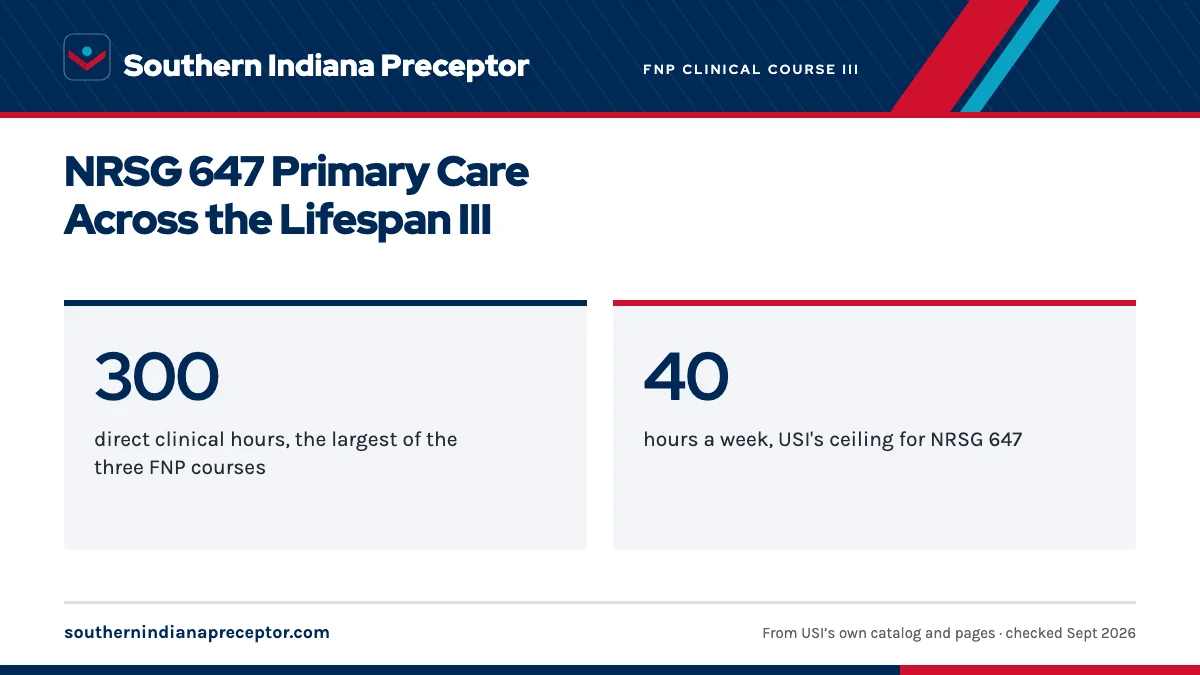
The course at a glance
Three of the five credits are clinical, the highest share in the FNP sequence. 647 carries 300 of the track's 750 hours, so it is where the 2026-27 move to 750 direct hours is felt most.
| Item | Detail |
|---|---|
| Title | Primary Care Across the Lifespan III |
| Credits | 5 (2 lecture, 3 clinical) |
| Term | Summer, after NRSG 645 in Spring |
| Direct clinical hours | 300 |
| Weekly pace | 30 or more hours a week, never above 40 |
| Setting | Primary care; specialty sites with prior approval of course faculty |
| Who may precept | Family and specialty NPs and PAs; primary care and specialty physicians |
| Also required | Barkley Board Review, purchased through the University |
| BSN-to-DNP twin | NRSG 847, same 300 hours |
What 30 to 40 hours a week asks of a preceptor
The handbook allows 30 or more hours a week during the semester and caps it at 40. At 30 a week, 300 hours takes ten weeks; at the 40-hour ceiling, seven and a half. Either way you are in the clinic close to full time for most of the term.
That changes the preceptor question. Someone who hosted you one or two days a week in Fall may have no room for three or four days a week in Summer, and a small practice may simply run fewer clinic days than you need. Ask early how many days the preceptor works, and plan around the Summer 2027 holidays, when no hours are allowed: Memorial Day (May 31), Juneteenth (June 18) and the observed Independence Day (July 5).
It changes your job schedule too. USI warns that courses and clinical assignments may be scheduled on fairly short notice and that it cannot promise they will avoid your work hours, so settle Summer time off with your employer well before May.
Specialty sites in the final course
647 allows specialty sites, but only with prior approval of course faculty. That is a firmer condition than in 645, where specialty sites are simply permitted alongside a primary care majority. If you want a closing block in a field such as dermatology or women's health, clear it with faculty before you ask the specialist to sign anything.
Any second clinician needs paperwork of their own. A specialist at another practice means a new Preceptor Packet and, if that practice has no agreement with USI, a Request for USI Clinical Education Agreement. A second provider inside your main preceptor's office needs an additional Preceptor Agreement approved before you start. Observation with anyone else is allowed, but observation time never counts toward the 300.
Deadlines and evaluation in a Summer course
Summer courses begin in May, so count back six weeks from the first day of your Summer section: for a mid-May start, the Preceptor Packet is due around the start of April, in the second half of NRSG 645. Another handbook page mentions surveys finalized one month ahead and a 4-week warning if you have no placement; treat the 6-week packet date as the one that matters. See clinical deadlines.
Clinical still has to begin by week 3 and continue weekly, and your schedule goes to clinical faculty before the first day. Faculty evaluate you at midterm and at the end of the course; a final rating of Does not meet in any area fails the course, and a clinical component without a Pass means an F regardless of your didactic grade. The ratings are explained on clinical evaluations.
NRSG 847 and finishing the FNP sequence
NRSG 847 is the BSN-to-DNP version of 647, with the same 300 hours and the same weekly limits. For BSN-to-DNP students it completes the 750 specialty hours inside the 1,510-hour doctoral total; the project courses NRSG 801, NRSG 803 and NRSG 805 carry their own practice hours, explained on DNP practice hours.
For MSN and post-master's students, 647 is the final specialty course. Before the term closes, make sure every encounter is logged in Typhon, your preceptor has co-signed the entries, and both Preceptor Feedback Forms are complete. Typhon access runs for up to five years after graduation, so your case log stays available after you finish.
Why FNP students plan 647 with us from day one
The Summer course is the one most likely to break a plan built a term at a time. Our placement desk looks at 647 when you first contact us, not in March: we search for preceptors whose clinic days can absorb 30 or more hours a week, confirm licenses, board certification and years of practice, and have the site details and agreement signer ready so your packet is typed, complete and early.
If a preceptor's schedule changes mid-Summer, your placement advisor lines up a replacement quickly so your weekly total keeps moving toward graduation. Tell us your city and expected graduation term in the form below.
Questions USI students ask
How many hours a week is NRSG 647?
USI allows 30 or more hours a week in NRSG 647 and caps it at 40. At 30 hours a week, the 300 required hours take about ten weeks; at 40, about seven and a half. University holidays and any stretch when the course is not in session cannot be used for hours.
Can I do NRSG 647 at a specialty clinic?
Yes, with prior approval from course faculty. USI allows specialty sites in the final FNP course, and specialty NPs, PAs and physicians may precept it. Get faculty approval before the specialist signs the Preceptor Packet, then submit the packet 6 weeks before the rotation, the same as for any other site.
Is NRSG 647 the last clinical course in the USI FNP program?
Yes. It follows NRSG 643 in Fall and NRSG 645 in Spring and completes the 750 direct hours. BSN-to-DNP FNP students take the 800-level version, NRSG 847, and also have DNP practice hours in the project courses NRSG 801, NRSG 803 and NRSG 805.
Can I go over 40 clinical hours a week to finish early?
No. The Course Requirements page sets 40 hours as the weekly maximum for 647, and clinical must continue weekly through the term rather than end in a burst. If you fall behind, speak with course faculty early, since rescheduled hours need their approval. See behind on clinical hours.
Does the Barkley review happen in NRSG 647?
The purchase is required during the second half of Specialty II, which for FNP students is NRSG 645, and the Specialty III course page lists it again as bought through the University. Check the 647 syllabus for how the review is used during the Summer term.
Related pages
Last checked 2026-09-25
We check these pages against USI's own bulletin, program pages and Graduate Nursing Handbook. Your handbook, course faculty and the Nursing Clinical Coordinator have the final word.
- University of Southern Indiana Graduate Nursing Handbook: Course Requirements
- USI 2026-2027 Graduate Bulletin: NRSG 647 course description
- USI Graduate Nursing Handbook: University Clinical Requirements and Clinical Evaluation
- USI Graduate Nursing Handbook: Clinical Practice Requirements FAQs
- USI academic calendar
USI makes the search your job. We make it the easy part.
Tell us your USI track, your city and your next clinical semester. We find preceptors who fit the NRSG course and fill the Preceptor Packet and Clinical Education Agreement request with typed, complete details, well before USI's 6-week window.
- Preceptors matched to the course: family primary care for FNP, acute care teams for AGACNP, PMHNPs and psychiatrists for PMHNP
- Preceptor license, certification, years of practice and the site's agreement signer ready for the packet
- Fall, Spring and Summer planned together, close to home in a state USI enrolls
Start your placement plan
Track, city and clinical start is all we need to begin.