750 direct clinical hours: USI's 2026-27 NP rebuild
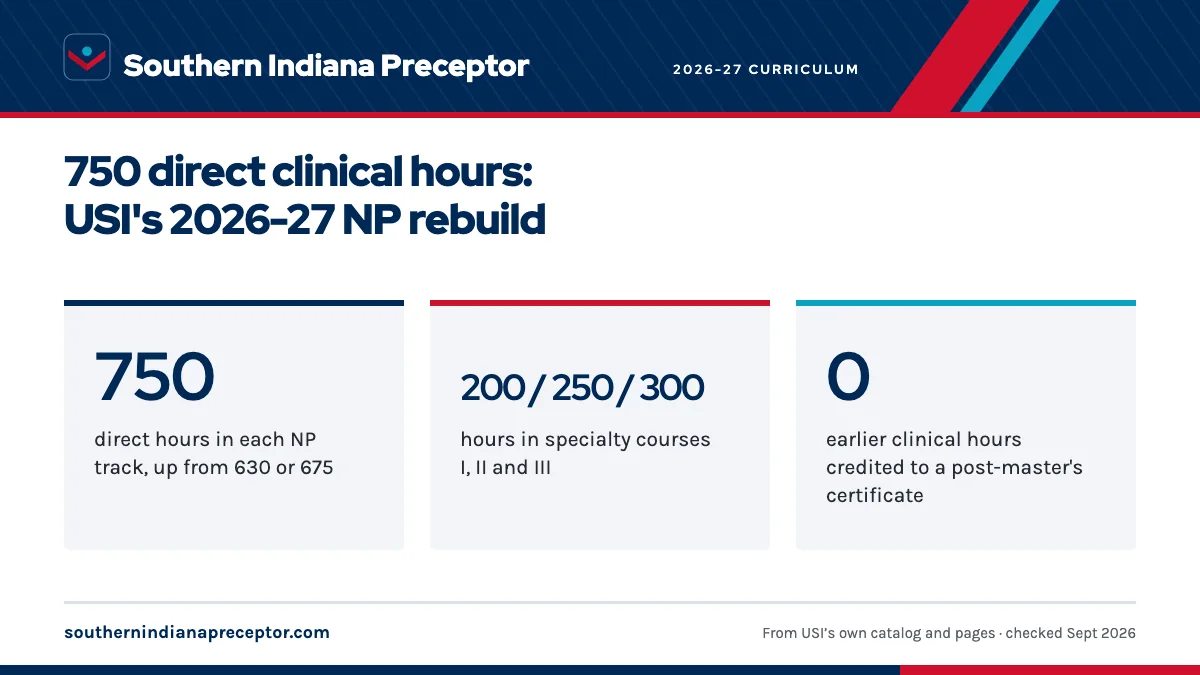
For 2026-27 the University of Southern Indiana raised all three nurse practitioner tracks to 750 direct clinical hours, up from 630 for FNP and PMHNP and 675 for AGACNP, and renumbered its graduate courses from NURS to NRSG. Each track now climbs 200, 250 and 300 hours across three specialty courses, and post-master's certificate students complete the same 750 with no credit for earlier clinical work.
Get your placement plan
Tell us your USI program and where you live. A placement advisor replies with the preceptor and site options that fit your course.
What changed between 2025-26 and 2026-27
Three changes landed together. The course prefix moved from NURS to NRSG. Each specialty gained a two-credit introduction course with no direct hours (NRSG 641 for FNP, NRSG 631 for AGACNP, NRSG 651 for PMHNP). And the three clinical courses were rebuilt with hour counts that rise by 50 each term instead of the old uneven steps.
| Track | 2025-26 (NURS courses) | 2026-27 (NRSG courses) |
|---|---|---|
| FNP | NURS 654 180, NURS 655 180, NURS 656 270: 630 | NRSG 643 200, NRSG 645 250, NRSG 647 300: 750 |
| AGACNP | NURS 674 180, NURS 675 225, NURS 676 270: 675 | NRSG 633 200, NRSG 635 250, NRSG 637 300: 750 (each a minimum) |
| PMHNP | NURS 662 135, NURS 663 225, NURS 664 270: 630 | NRSG 653 200, NRSG 655 250, NRSG 657 300: 750 |
The 2025-26 column comes from an archived January 2026 copy of the handbook's Course Requirements page, the 2026-27 column from the live page. The pairing of old and new courses follows title and position in the sequence; USI has not posted an official crosswalk.
A number that has moved almost every year
750 is the latest in a run of revisions. The graduate bulletins list the FNP at 665 clinical hours in 2022-23 and 2023-24 and at 630 direct hours in 2024-25. The acute care track showed 705 hours in 2023-24 and 675 in 2024-25, and the psychiatric track 645 and then 630.
Go back a little further and the courses were measured differently. The 2023 handbook gave each FNP course a range rather than a single figure, 120 to 144 hours in the first course for example, and the old advanced health assessment course, N618, carried a minimum of 45 clinical hours. Its successor, NRSG 623, has no direct hours at all, so every direct hour now sits inside the three specialty courses.
The practical point: if a classmate, an old syllabus or a preceptor quotes a different number, check which year it came from before you plan around it.
Inside the 200, 250, 300 split
Every track adds 50 hours per term, Fall to Spring to Summer, and the credit split tilts the same way. In the FNP sequence NRSG 643 is six credits with two of them clinical, NRSG 645 is six with two and a half clinical, and NRSG 647 is five with three clinical. USI publishes no hours-per-credit rule for graduate courses, but each new split works out to 100 clock hours per clinical credit in all three tracks.
The Summer course is where the change bites. The handbook lets FNP students work 30 or more clinical hours a week in NRSG 647 with a ceiling of 40, and acute care students up to 36 a week in their second and third courses. A preceptor who hosted you one or two days a week in Fall may need to give you three or four days a week by Summer. Each course's own page is linked from the clinical hours overview.
Post-master's certificates: all 750, nothing carried over
The certificate rule survived the rebuild unchanged. USI completes a gap analysis for every post-master's APRN applicant and credits no clinical hours toward the certificate, so a nurse educator with an MSN and an experienced APRN adding a second specialty both complete all three specialty courses and the full 750 hours.
Transfer is possible only on the didactic side: graduate pathophysiology, pharmacology and advanced health assessment, taken within the last five years or backed by current advanced clinical practice, with pharmacology also requiring current prescriptive authority. The certificates themselves grew from 24 credits (26 for PMHNP) to 28. The FNP version is covered on the post-master's FNP certificate page.
A national board certification or a completed NP program does not shorten a USI certificate's 750 direct hours.
Other rules that moved with the hours
- Telehealth. In January 2026 only PMHNP students could count telehealth, up to 126 of 630 hours. The live page allows PMHNP up to 150 and, for the first time, FNP up to 75. Acute care counts none. Details on telehealth clinical hours.
- Course levels. The handbook note now reads 600-level for the MSN and 800-level for the DNP; the January 2026 copy said 700-level for the DNP under the old numbering.
- BSN-to-DNP specialty courses moved from 7xx to 8xx numbers (
NURS 754becameNRSG 843, for example) and carry the same 200, 250 and 300 hours as the MSN courses. - Credits. The MSN FNP and AGACNP rose from 42 to 44 credits and the PMHNP stayed at 44. USI's online program finder still shows some of the older totals.
- Leftovers. The Course Requirements page still lists the closed clinical nurse specialist courses under their NURS numbers, a sign the page is mid-transition.
If you started on the NURS courses
The handbook pages describe the 2026-27 curriculum; they say nothing about how students admitted under the NURS sequence finish. If you took NURS courses, ask the Graduate Chair and APRN Director, in writing, which hour total and course list govern your remaining terms, and keep the reply with your plan of study. Your Typhon totals should line up with that answer, not with a classmate's.
More hours means more preceptor days, and more preceptors willing to commit to them. USI students bring us the whole sequence at once: our placement desk plans all three terms together, looks for preceptors whose clinic schedules can absorb the heavier Summer load, and prepares each Preceptor Packet with typed, complete details well inside USI's 6-week window. Tell us your track and start term in the form below.
Questions USI students ask
Did USI increase clinical hours for nurse practitioner students?
Yes. Under the 2026-27 handbook the FNP, AGACNP and PMHNP tracks each require 750 direct clinical hours. In 2025-26 the FNP and PMHNP tracks required 630 and the AGACNP track 675. The increase arrived with the switch from NURS to NRSG course numbers and a new three-course split of 200, 250 and 300.
Which NRSG course replaced my old NURS course?
By title and sequence, FNP NURS 654, NURS 655 and NURS 656 line up with NRSG 643, NRSG 645 and NRSG 647, with NRSG 641 added as an introduction. Acute care NURS 674 to NURS 676 match NRSG 633 to NRSG 637, and psychiatric NURS 662 to NURS 664 match NRSG 653 to NRSG 657. Confirm with course faculty, since USI has posted no official crosswalk.
Is the AGACNP total exactly 750 hours?
The acute care courses are written as minimums: at least 200, 250 and 300 hours in NRSG 633, NRSG 635 and NRSG 637. The Specialty Track Overview states the track total as 750 direct hours. Treat 750 as the floor, and track each course against its own minimum in Typhon.
Do post-master's students get credit for hours from their first NP program?
No. USI's admission rules state that no clinical hours are credited toward a post-master's APRN certificate, even after the gap analysis. Transfer is limited to pathophysiology, pharmacology and advanced health assessment under set conditions. Plan on the full 750 hours in the three specialty courses.
Does USI still give clinical hours as ranges?
No. The 2023 handbook listed ranges, such as 120 to 144 hours for the first FNP course. The current Course Requirements page gives single figures: 200, 250 and 300 for FNP and PMHNP, and the same numbers as minimums for AGACNP. Your preceptor should see the exact weekly hours for your course before signing.
Related pages
Last checked 2026-09-25
We check these pages against USI's own bulletin, program pages and Graduate Nursing Handbook. Your handbook, course faculty and the Nursing Clinical Coordinator have the final word.
- University of Southern Indiana Graduate Nursing Handbook: Course Requirements
- USI Graduate Nursing Handbook: Specialty Track Overview
- USI Graduate Nursing Handbook: Full Admission Requirements
- USI 2026-2027 Graduate Bulletin: MSN Family Nurse Practitioner
- Archived USI Course Requirements page, January 2026 (Wayback Machine)
USI makes the search your job. We make it the easy part.
Tell us your USI track, your city and your next clinical semester. We find preceptors who fit the NRSG course and fill the Preceptor Packet and Clinical Education Agreement request with typed, complete details, well before USI's 6-week window.
- Preceptors matched to the course: family primary care for FNP, acute care teams for AGACNP, PMHNPs and psychiatrists for PMHNP
- Preceptor license, certification, years of practice and the site's agreement signer ready for the packet
- Fall, Spring and Summer planned together, close to home in a state USI enrolls
Start your placement plan
Track, city and clinical start is all we need to begin.