Telehealth clinical hours at USI: who can count them and how
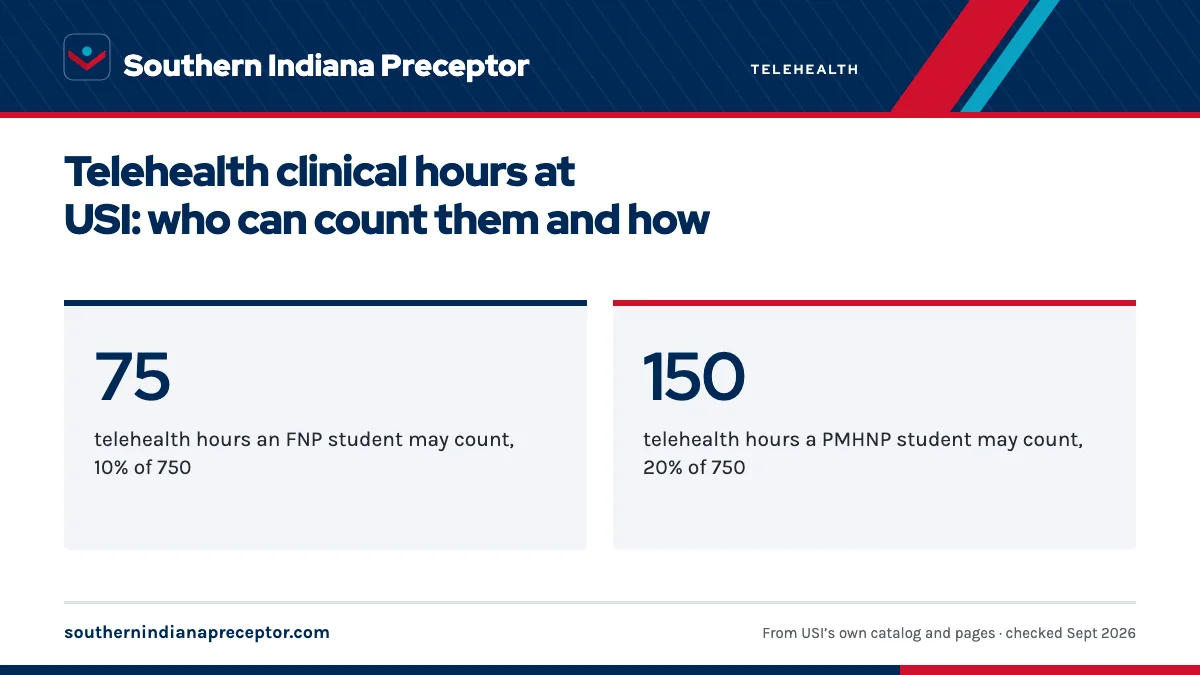
At the University of Southern Indiana, only FNP and PMHNP students may count telehealth toward their 750 direct clinical hours: up to 75 hours in the FNP track and up to 150 in the PMHNP track. A visit counts only when it is live, when you and your preceptor sit together at the approved clinical site with the patient joining remotely, and when you are licensed in the state where the patient is.
Get your placement plan
Tell us your USI program and where you live. A placement advisor replies with the preceptor and site options that fit your course.
The caps, track by track
The Graduate Nursing Handbook's Course Requirements page sets the ceilings against the whole 750-hour requirement, not course by course. It permits telehealth hours only for students in the Psychiatric-Mental Health Nurse Practitioner and Family Nurse Practitioner tracks.
| Track | Telehealth counted? | Maximum hours | Share of the 750 |
|---|---|---|---|
Psychiatric Mental Health NP (NRSG 653, NRSG 655, NRSG 657) | Yes | 150 | No more than 20% |
Family Nurse Practitioner (NRSG 643, NRSG 645, NRSG 647) | Yes | 75 | No more than 10% |
Adult-Gerontology Acute Care NP (NRSG 633, NRSG 635, NRSG 637) | No | None | All hours in person |
Because the page gives one cap for the whole track, it leaves the split between courses open. Agree with each course coordinator how many telehealth hours that course will accept before you plan them. The rule is worded by specialty, so BSN-to-DNP students in the matching 800-level courses (NRSG 853 or NRSG 843, for example) should confirm that the same caps apply to them.
What makes a telehealth encounter count
USI's definition is narrow, and each part of it has to be true for the hour to go in your total.
- Live. The encounter is synchronous, with the patient taking part in real time.
- Side by side. You and your preceptor are physically together at the same approved clinical site, the one named in your Preceptor Packet.
- Remote patient only. The patient is the one who is off site.
- No phone-only visits. Telephone-only visits earn no clinical hour credit.
- No asynchronous work. Email, recorded messages and similar delayed communication do not qualify.
- No remote student. You may not join from home, from another clinic or from any other off-site location.
In practice, telehealth is part of an ordinary clinic day with your preceptor rather than a way to precept at a distance. A preceptor who sees video patients from the clinic can have you beside them for those visits. A preceptor who does telehealth from a home office is a question for your course coordinator before you schedule a single hour.
Your license has to match the patient's state
USI requires you to be licensed in the state where the patient is located during the encounter. That sits on top of its standing rule tying your clinicals to states where your RN license is held and unencumbered, and it matters most for practices near a state line.
Evansville is a good example. Indiana and Kentucky both participate in the Nurse Licensure Compact, while Illinois is not a member, so a multistate compact license does not reach a patient sitting in Illinois; you would need an Illinois RN license to count that visit. Before you rely on a preceptor's video panel, ask where those patients live. The general licensing rule is covered on RN licenses for clinicals.
USI's wording speaks only to the student's license. Whether your preceptor also needs a license in the patient's state is a question for the course coordinator and the practice itself.
Who says yes to telehealth hours
Two handbook pages describe the approval differently. The Course Requirements page fixes the eligible tracks and the caps. The University Clinical Requirements page adds that telehealth hours must be discussed with the course coordinator and that accepting them is each course coordinator's decision. Read together: the caps are the most you can count, and a coordinator may accept fewer.
The paperwork asks the question up front. Part Three of the Preceptor Packet (Form G), the site information section, asks whether the site is a telemedicine site. Answer it accurately so faculty approve the site knowing how it sees patients.
As you log encounters in Typhon, keep your own running count of telehealth hours, so you always know how close you are to the cap before the term's final weeks.
How the rule changed in 2026
Telehealth at USI is newer than many students assume. The January 2026 copy of the Course Requirements page labeled telehealth for the PMHNP specialty only, with a maximum of 126 hours against a 630-hour total, the same 20% share used today. The PMHNP ceiling grew only because the total did.
The live page raised the PMHNP ceiling to 150 hours when the track moved to 750, and opened telehealth to FNP students for the first time, at 75 hours or 10%. Acute care remained in person only. If a classmate who started earlier quotes a different figure, the current handbook governs; the wider set of changes is on the 750-hour page.
Finding a preceptor whose telehealth hours will count
For PMHNP students in particular, a preceptor with a mixed office and video schedule can make a placement work, since USI accepts only a PMHNP or a licensed psychiatrist in that track. The value depends on the fine print: live visits, the same room, patients in states where you hold a license, and a coordinator who agrees.
Our placement desk checks all of that before you meet the preceptor. Your placement advisor confirms that video visits happen from the clinic itself, notes the states the practice's remote patients are in, and records the site's telemedicine status for the packet, so the course coordinator sees the full picture the first time. PMHNP students can read the rest of the track's preceptor rules on the MSN PMHNP page. Use the form below to get started.
Questions USI students ask
Can AGACNP students at USI count telehealth hours?
No. USI's Course Requirements page permits telehealth hours only in the PMHNP and FNP tracks. Acute care students complete all 750 direct hours in person, in the acute care settings their courses require, with NPs, PAs, MDs or DOs who work in acute care as preceptors.
Do phone visits count as telehealth clinical hours at USI?
No. Telephone-only visits earn no clinical hour credit, and neither does asynchronous contact such as email or recorded messages. Only live encounters count, with you and your preceptor together at the approved site and the patient joining remotely. If your preceptor's remote work is mostly phone follow-up, plan those days as in-person clinic time.
Can I do telehealth clinical hours from home?
No. USI states that students may not take part remotely from home, from another clinic or from any off-site location. You belong at the approved site listed in your Preceptor Packet, next to your preceptor, even when the patient is on a screen in another town or state.
Are the telehealth caps per course or for the whole track?
The handbook states them against the full 750 direct hours: 150 for PMHNP and 75 for FNP. It sets no per-course limit, and each course coordinator decides whether to accept telehealth hours in that course, so settle the number with the coordinator at the start of each term rather than assuming the full cap is available.
Does the telehealth rule apply to BSN-to-DNP students?
The rule is written by specialty, PMHNP and FNP, and the handbook pairs each 600-level MSN course with an 800-level DNP twin carrying the same hours, such as NRSG 653 and NRSG 853. Confirm with your course coordinator that the same caps apply to your 800-level course before you plan any telehealth time.
Related pages
Last checked 2026-09-25
We check these pages against USI's own bulletin, program pages and Graduate Nursing Handbook. Your handbook, course faculty and the Nursing Clinical Coordinator have the final word.
- University of Southern Indiana Graduate Nursing Handbook: Course Requirements
- USI Graduate Nursing Handbook: University Clinical Requirements and Clinical Evaluation
- USI Preceptor Packet (Form G, updated 07/2026)
- Archived USI Course Requirements page, January 2026 (Wayback Machine)
- NCSBN Nurse Licensure Compact map
USI makes the search your job. We make it the easy part.
Tell us your USI track, your city and your next clinical semester. We find preceptors who fit the NRSG course and fill the Preceptor Packet and Clinical Education Agreement request with typed, complete details, well before USI's 6-week window.
- Preceptors matched to the course: family primary care for FNP, acute care teams for AGACNP, PMHNPs and psychiatrists for PMHNP
- Preceptor license, certification, years of practice and the site's agreement signer ready for the packet
- Fall, Spring and Summer planned together, close to home in a state USI enrolls
Start your placement plan
Track, city and clinical start is all we need to begin.