USI post-master's FNP certificate: the full 750 hours, planned
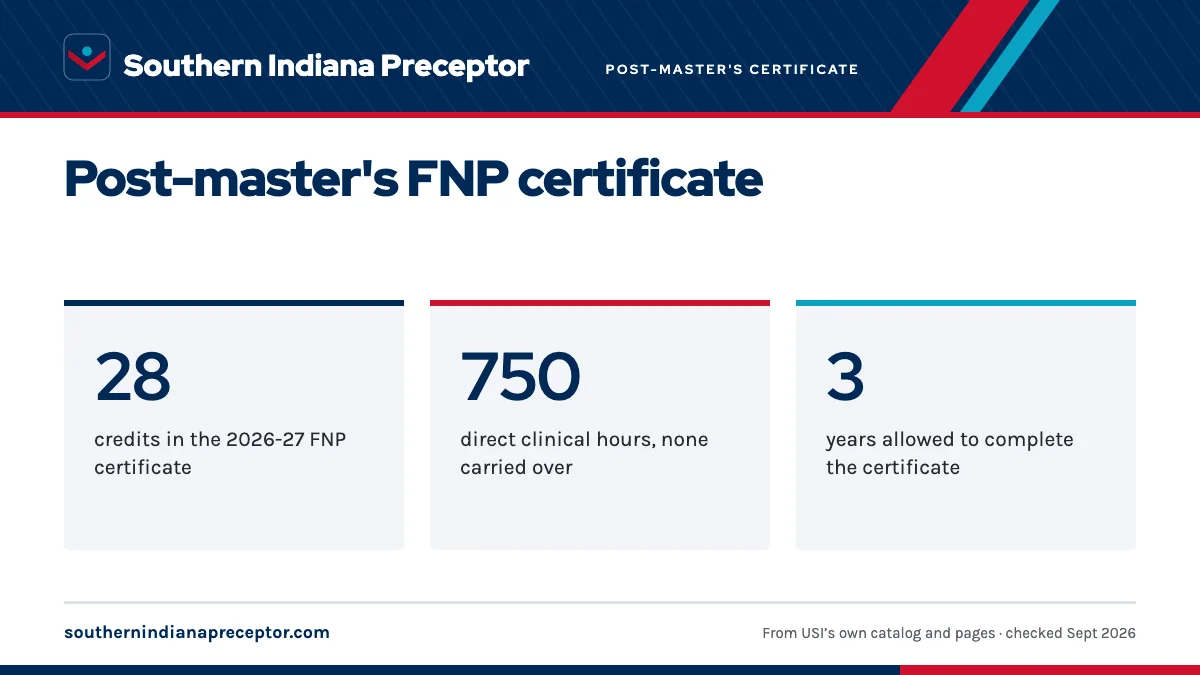
Offered online by the University of Southern Indiana, the post-master's Family Nurse Practitioner certificate packs 28 credits and the MSN's full 750 direct clinical hours into NRSG 643, NRSG 645 and NRSG 647. USI credits no clinical hours from your earlier degree, admits certificate students in May only, and expects you to identify and propose your own preceptors.
Plan your FNP certificate clinicals
Tell us your city and when your first Fall clinical term begins. Your placement advisor replies with family primary care options and a plan for all three courses.
What the certificate includes
Think of the certificate as the MSN FNP's clinical content without the MSN core. The 2026-27 bulletin pairs the three clinical core courses (9 credits) with the MSN's own family specialty block (19 credits), all taught 100% online, and the hour counts are identical to the degree's.
| Block | Courses | Credits | Direct hours |
|---|---|---|---|
| Clinical core (the 3Ps) | NRSG 621, NRSG 622, NRSG 623 | 9 | None (i-Human indirect hours in 623) |
| Specialty introduction | NRSG 641 | 2 | None |
| Specialty clinical courses | NRSG 643, NRSG 645, NRSG 647 | 17 | 200, 250, 300 |
USI's program finder still lists 24 credits from the older curriculum; the bulletin and the program page both give 28. Whatever transfers in, the family specialty block is taken at USI.
No credit for the clinical hours you already have
Read this rule before anything else. Each applicant receives a gap analysis, and USI's admission requirements say plainly that clinical hours from earlier study earn no credit in the certificate. That holds whether your first master's was in education or leadership or in another APRN specialty with hundreds of supervised hours behind it. Every one of the 750 is completed in USI's three FNP courses, with USI-approved preceptors, logged in Typhon.
The gap analysis can shorten the didactic side instead. Graduate courses in pathophysiology, pharmacology and advanced health assessment taken at an accredited school are considered for transfer when they are under five years old, or older if you are practicing at an advanced level now. A pharmacology course needs one more thing: prescriptive authority that is current and active in your state. The program page sets a 9-credit transfer ceiling, and specialty APRN courses from other schools are not considered.
Plan for all 750 hours. An earlier NP program or a national board certification does not reduce the certificate's clinical requirement.
Timing: May starts and your first clinical Fall
There is one entry point a year, in May. The program page shows a May 2027 start with an April 2027 application deadline, then May 2028. You need a master's in nursing from a program with national and regional accreditation, a GPA of at least 3.00 and a clear RN license, and you supply three references with their contact details.
Your plan of study comes out of the gap analysis, but the course calendar sets its outline. The first clinical course, NRSG 643, is a Fall course that expects NRSG 623 and NRSG 641 to be finished over the Summer before, and 641 itself follows pharmacology. Applicants who transfer the 3Ps may reach the specialty sequence sooner than those who take them at USI. Since USI posts no certificate sample plan, get your term-by-term sequence in writing from the program. Whatever the route, the clock is three years from start to finish, and progression rules tolerate a single course withdrawal at most.
Preceptors for certificate students
Certificate students follow the MSN's preceptor rules course by course. In 643 you work with a family NP, a PA or a physician in primary care; in 645 and 647 specialists from all three professions are also eligible. Every preceptor needs a clean license, current specialty certification (NP and PA certification must correspond to the family track), no less than a year of advanced-provider practice and a USI agreement they have signed, and none may be a relative or someone you are in a relationship with.
If you already work as an APRN or in a large health system, colleagues are a natural first call. Keep two points in mind: USI does not want a clinical site used as job orientation, and your employer may set its own terms for hosting students. USI publishes no specific rule against precepting where you work; see clinicals where you work for how students make it work.
Before your first clinical day
Certificate students clear the same graduate requirements as MSN students, and several have to be in place well before NRSG 643. Work through this list during your first terms:
- Background check (national) and drug screen (10 panels) completed and uploaded to CastleBranch, now DISA, ahead of your first graduate nursing course
- Vaccine records and TB screening that satisfy the college's Infection Control Policy, each one valid through the end of the semester
- A current BLS card, with yearly HIPAA and OSHA modules (your employer's versions are accepted)
- RN licensure without encumbrance for every state that will host your clinical hours
- Three purchases: Typhon for your case log, i-Human for the health assessment course and the first two specialty courses, and the Barkley Board Review during 645
Then comes the packet: for a Fall 643 start on August 17, as in 2026, the Preceptor Packet and the agreement request were due by July 6. Hours begin only once USI's approval email is in your inbox.
Where certificate students can enroll
USI's Professional Licensure Disclosure treats certificates separately from the MSN, and the lists do not match. Residents of 15 states cannot enroll in the certificate, plus DC and several territories. Set beside the MSN FNP list, the certificate list adds Colorado, South Dakota and Washington and drops Arizona and Mississippi.
The same row lists Colorado, Louisiana, Massachusetts and Mississippi under does not meet licensure requirements. Mississippi is therefore not barred from enrolling, yet USI says the curriculum does not meet that state's requirements: a Mississippi resident should resolve that with USI before applying. The table and its conflicts are on USI's licensure disclosure. If you plan to move during the certificate, tell the Program Chair and APRN Director first; see relocating during the program.
Why certificate students choose us
Certificate students arrive with a master's degree and a job that keeps going, and the 750 hours land on top of both. The courses are the same as the MSN, but the calendar is tighter, with a May start and a three-year limit.
Our placement desk treats the certificate as one clinical year planned in advance. We find family primary care preceptors for 643 and line up 645 and 647 at the same time, collect each preceptor's license, certification, practice years and DEA details and the site's agreement signer, and hand you packet details ready to submit weeks before USI's six-week cutoff. If a preceptor withdraws, your placement advisor lines up a successor. Start with the form above or below.
Questions USI students ask
How many clinical hours is USI's post-master's FNP certificate?
750 direct clinical hours, matching the MSN FNP: NRSG 643 (200), NRSG 645 (250) and NRSG 647 (300). USI credits no hours from a previous program, so every one of the 750 is completed during the certificate with a USI-approved preceptor and logged in Typhon.
Can I transfer pharmacology into the USI FNP certificate?
Possibly. The gap analysis looks at graduate pharmacology, pathophysiology and health assessment from accredited schools, generally from the last five years unless your current advanced practice bridges the gap. Pharmacology is accepted only from applicants who hold prescriptive authority today. None of the FNP specialty courses can come from elsewhere.
When does the USI FNP certificate start?
Once a year, in May. The next listed starts are May 2027 (apply by April 2027) and May 2028. Because the first FNP clinical course runs in Fall, your plan of study, built from the gap analysis, sets how many terms pass before your first direct hours.
I'm already an AGACNP or PMHNP. Do my hours count toward the FNP certificate?
No. The rule is the same for every applicant: no clinical hours are credited toward a USI post-master's APRN certificate. Your existing prescriptive authority may help with pharmacology transfer, but you still complete all three FNP clinical courses and all 750 direct hours under family-track preceptors.
What is the time limit for USI's post-master's FNP certificate?
Three years. The progression policy gives post-master's APRN certificate students that long to complete everything, requires a B or higher in each course, and allows one withdrawal at most. A missed Fall clinical start can therefore put real pressure on the timeline, which is why the first preceptor matters. See the 750-hour page for how the hours are spread.
Related pages
Last checked 2026-09-25
We check these pages against USI's own bulletin, program pages and Graduate Nursing Handbook. Your handbook, course faculty and the Nursing Clinical Coordinator have the final word.
- University of Southern Indiana 2026-2027 Graduate Bulletin: Post-Master's Certificate, Family Nurse Practitioner
- USI Post-Master's Certificate in Family Nurse Practitioner (program page)
- USI Graduate Nursing Handbook: Full Admission Requirements
- USI Graduate Nursing Handbook: Course Requirements
- USI Professional Licensure Disclosure
USI makes the search your job. We make it the easy part.
Tell us your USI track, your city and your next clinical semester. We find preceptors who fit the NRSG course and fill the Preceptor Packet and Clinical Education Agreement request with typed, complete details, well before USI's 6-week window.
- Preceptors matched to the course: family primary care for FNP, acute care teams for AGACNP, PMHNPs and psychiatrists for PMHNP
- Preceptor license, certification, years of practice and the site's agreement signer ready for the packet
- Fall, Spring and Summer planned together, close to home in a state USI enrolls
Start your placement plan
Track, city and clinical start is all we need to begin.