NRSG 643 Primary Care Across the Lifespan I
NRSG 643 Primary Care Across the Lifespan I opens the family nurse practitioner clinical year at the University of Southern Indiana: 200 direct hours in a primary care setting that cares for families, taken in Fall. Your preceptor can be a family nurse practitioner, a physician assistant or a primary care physician, while the BSN-to-DNP route logs its identical 200 hours under NRSG 843.
Get your placement plan
Tell us your USI program and where you live. A placement advisor replies with the preceptor and site options that fit your course.
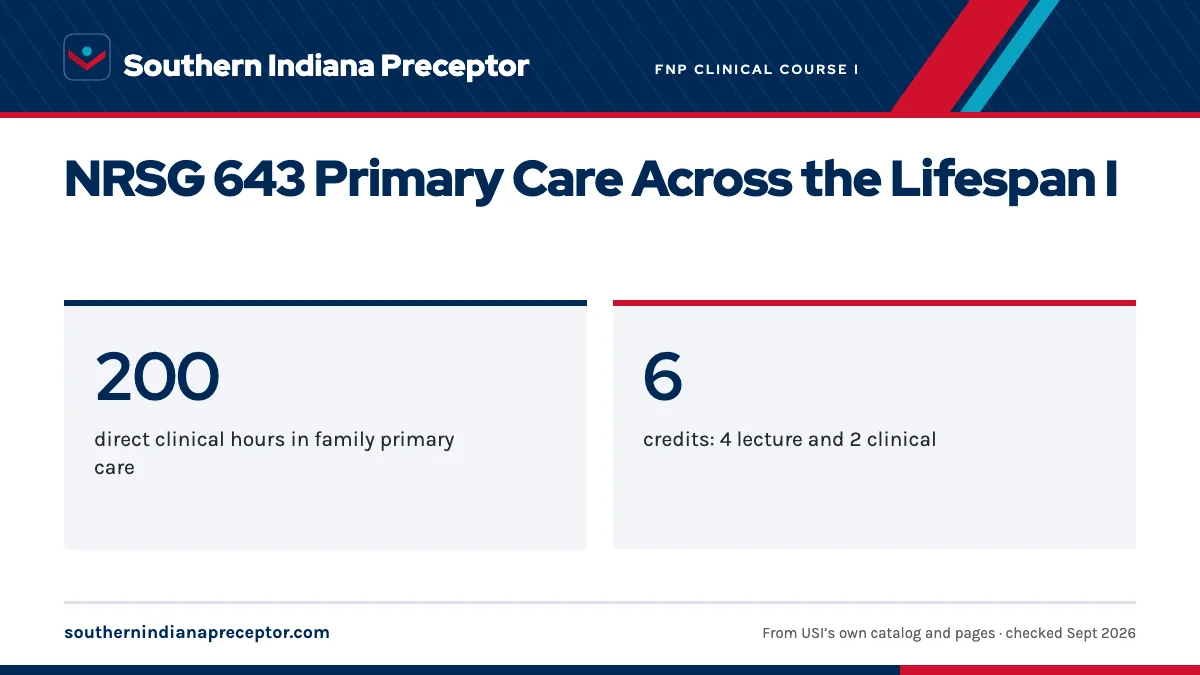
The course at a glance
| Item | Detail |
|---|---|
| Title | Primary Care Across the Lifespan I |
| Credits | 6 (4 lecture, 2 clinical) |
| Term | Fall only |
| Prerequisites | NRSG 623 and NRSG 641, each with a B or better |
| Direct clinical hours | 200 |
| Setting | Primary care that provides care to families |
| Who may precept | Family nurse practitioners, physician assistants, primary care physicians |
| Also required | i-Human simulation cases (indirect hours) |
| BSN-to-DNP twin | NRSG 843, same 200 hours |
| Next in sequence | NRSG 645 in Spring |
The grade has two halves. The clinical side is graded Pass or not, the classroom side needs a B or higher, and falling short on the clinical side turns the course grade into an F regardless of exams.
Who can precept you in 643
643 has the tightest preceptor list of the three FNP courses. USI's Course Requirements page allows three kinds of clinician here: a family NP, a PA, or a physician practicing primary care. Specialists become eligible only from 645 onward. On top of that, every USI graduate preceptor must meet the general rules below.
- A license with no encumbrance, held where they see patients
- Specialty certification; for NPs and PAs, board certification that lines up with the family track
- Twelve months or more of practice as an advanced provider
- A signed and approved agreement with USI to teach graduate nursing students
- No family tie or personal relationship with you
The preceptor is physically present in the clinic while you see patients and teaches you one to one. More on each rule, and on PAs as preceptors, is on USI preceptor requirements.
Choosing a site that fits "care to families"
USI asks for the 643 hours in a primary care setting that provides care to families, and the course title adds across the lifespan. A family practice or community clinic whose panel runs from children to older adults matches that wording more closely than a clinic limited to one age group. Pediatrics, obstetrics and dermatology are named as specialty options only for NRSG 645, so check with course faculty before proposing a narrower site for 643.
The site survey inside the Preceptor Packet asks about patient volume, exam rooms, the mix of patients and whether you may document in, enter or dictate to the electronic record. Faculty use those answers to judge whether the practice suits the course, so a clinic with a broad family panel and room for a student makes the approval easier.
Planning 200 hours across the Fall term
Clinical must begin by week 3 and run every week you are enrolled, with no hours on university holidays. In Fall 2026, with classes from August 17 to December 11, that meant a first clinical day by the week of August 31 and a schedule built around Labor Day (September 7), Fall Break (October 5 and 6) and Thanksgiving (November 25 to 29).
That leaves roughly 14 working weeks, or 14 to 15 hours a week to reach 200; roughly two clinic days a week, or one long day plus a half day. Your clinical faculty see the schedule before you set foot in the clinic, and every encounter goes into Typhon for your preceptor to review and co-sign.
Build the evaluation contacts into the preceptor's calendar at the first meeting. Faculty complete formal evaluations twice, once around midterm and once as the course closes. Across the term there are at least seven contacts between your preceptor and faculty: two phone calls you schedule, three faculty emails and a pair of Preceptor Feedback Forms. The ratings are explained on clinical evaluations.
Paperwork for a Fall start
Six weeks before the rotation starts, USI expects your completed Preceptor Packet (Form G) and, for a practice without an existing agreement, the agreement request form; usi1nursing@usi.edu can tell you whether one is already on file. Counting back from an August 17 start gives July 6, when you are still in NRSG 623 and NRSG 641. If six weeks out you still have no preceptor or no agreement contact, USI wants to hear it from you then, through course faculty or the Nursing Clinical Coordinator.
The practice, not you, signs the Clinical Education Agreement, and USI verifies both licenses and signs off on the preceptor before a green light email arrives. No hour counts until that email does. The agreement's path is described on the Clinical Education Agreement page.
NRSG 843: the BSN-to-DNP version
USI numbers its MSN specialty courses at the 600 level and the DNP versions at the 800 level, and the handbook gives each pair the same hours and preceptor rules. NRSG 843 is the BSN-to-DNP FNP equivalent of 643, with 200 direct hours in family primary care that count toward the doctoral route's 1,510 practice hours.
One catalog quirk is worth knowing. The 2026-27 bulletin lists NRSG 641, the MSN introduction course, as a prerequisite for 843, where the DNP introduction course NRSG 841 would be expected. If your registration stalls on it, raise it with the program early rather than in August.
Why FNP students bring 643 to us first
643 sets the tone for the whole clinical year. A preceptor who works well in Fall may take you again in Spring, while a poor fit in Fall costs weeks that are hard to win back under a week-3 start rule.
Our placement desk searches family practices and community clinics close to you, verifies credentials and practice history for each preceptor, and assembles the site details, the survey answers and the agreement signer your packet needs. We plan all three FNP courses in one pass and remain available if a preceptor leaves mid-term. Send us your town and your first clinical Fall through the form below.
Questions USI students ask
How many clinical hours is NRSG 643?
200 direct clinical hours, completed during the Fall term in a primary care setting that provides care to families. They open the FNP track's 750; NRSG 645 adds 250 and NRSG 647 adds 300. Observation time and i-Human cases do not count toward the 200.
Can a physician assistant precept me in NRSG 643?
Yes. USI lists physician assistants alongside family nurse practitioners and primary care physicians for 643. A PA preceptor needs board certification corresponding to your family track, a license in good standing and a year or more of practice as an advanced provider.
Can I start NRSG 643 hours in the summer?
No. Hours count only while you are registered in the course, only while it is in session, and only after the approval email. Because 643 runs in Fall, your first countable day falls within the first three weeks of that term. Use the Summer for paperwork: the packet deadline falls six weeks before the rotation.
What is NRSG 843 at USI?
NRSG 843 is the BSN-to-DNP version of Primary Care Across the Lifespan I. It carries the 200 direct hours and the preceptor rules of NRSG 643 unchanged, and it counts toward the BSN-to-DNP route's 1,510 practice hours. See the BSN-to-DNP page for the rest of that plan.
Can my NRSG 643 preceptor precept me again in NRSG 645?
USI's published rules do not require a new preceptor each term, but a Form G agreement covers just the course, semester and year written on it, so a fresh packet goes in for 645. That course also allows specialty sites, so you may add a second preceptor for part of its 250 hours.
Related pages
Last checked 2026-09-25
We check these pages against USI's own bulletin, program pages and Graduate Nursing Handbook. Your handbook, course faculty and the Nursing Clinical Coordinator have the final word.
USI makes the search your job. We make it the easy part.
Tell us your USI track, your city and your next clinical semester. We find preceptors who fit the NRSG course and fill the Preceptor Packet and Clinical Education Agreement request with typed, complete details, well before USI's 6-week window.
- Preceptors matched to the course: family primary care for FNP, acute care teams for AGACNP, PMHNPs and psychiatrists for PMHNP
- Preceptor license, certification, years of practice and the site's agreement signer ready for the packet
- Fall, Spring and Summer planned together, close to home in a state USI enrolls
Start your placement plan
Track, city and clinical start is all we need to begin.