Who can precept a University of Southern Indiana graduate nursing student
A preceptor for the University of Southern Indiana has to clear five bars: a license in good standing in the state they practice in, specialty certification, a full year or more of advanced practice in that specialty, a USI agreement they have signed and USI has approved, and no family or romantic link to you. NPs and PAs must also be board-certified in the specialty your track covers, and the Graduate Clinical Liaison signs off on each preceptor before your first hour counts.
Get your placement plan
Tell us your USI program and where you live. A placement advisor replies with the preceptor and site options that fit your course.
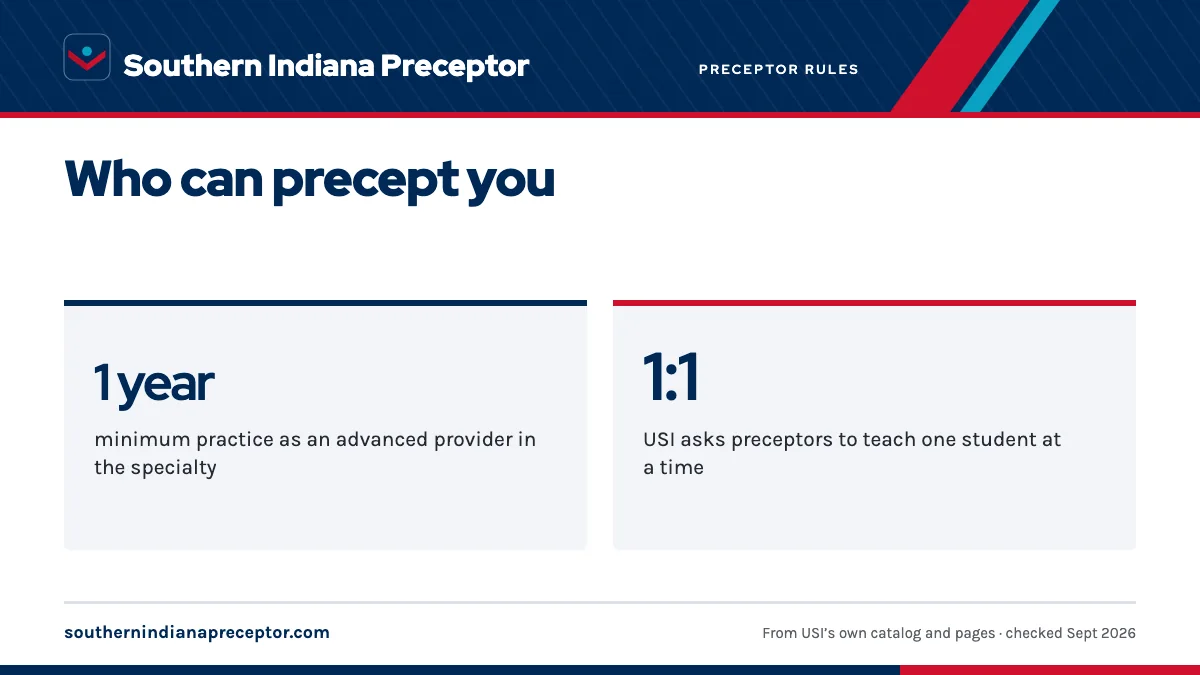
The five conditions in USI's handbook
USI's Graduate Nursing Handbook holds every preceptor in the graduate APRN tracks to one standard, whatever the setting. The list below comes from the University Clinical Requirements and Clinical Evaluation page (modified August 2026) and the clinical FAQ. A clinician who misses any single item cannot be approved, however generous the offer.
Every preceptor must
- Keep an unencumbered license, issued by the U.S. state or territory of their practice, from approval through your last clinical day.
- Be certified in their specialty area; for NPs and PAs, USI requires the board certification to line up with your track.
- Bring a year or more of experience working as an advanced provider in that same specialty.
- Sign an agreement with USI that is approved before you start: the Preceptor Agreement in Part Five of the Preceptor Packet.
- Have no family or romantic relationship with you.
Beyond the five, USI's roles page expects one-to-one teaching and a preceptor who is in the building, in person, whenever you are with patients. Any procedure you perform needs direct supervision from a privileged clinical preceptor.
An unencumbered license, in the preceptor's own state
The license rule follows the preceptor, not the university. A nurse practitioner in Louisville needs a clean Kentucky license; a psychiatrist in Springfield, Illinois needs a clean Illinois one. Nothing in the handbook asks a preceptor outside Indiana to hold an Indiana license.
USI glosses "unencumbered" on another nursing page as "No action or pending action against license", and it checks for itself: the office box on page two of the packet has one line for "License Verified (S)" and one for "License Verified (P)", the student and the preceptor. If a board lookup shows any action on a preceptor's record, flag it to the Nursing Clinical Coordinator before you submit anything.
Your own license has to line up as well. USI wants your RN license unencumbered in each state where your clinical hours take place, so a preceptor across a state line works only if you hold a license there too. The RN license page covers the compact and telehealth.
Board certification that matches your track
Certification is where a willing clinician can turn out to be the wrong fit. USI requires NP and PA preceptors to hold board certification in the specialty that corresponds to your track, so a family nurse practitioner suits the FNP courses but not the psychiatric ones. Physicians fall under the general rule that every preceptor be certified in their specialty area.
The Course Requirements page then spells out, track by track, which professions may teach you:
| Track and courses | Who USI lists | Setting |
|---|---|---|
FNP NRSG 643 | Family NPs, physician assistants, primary care physicians | Primary care serving families |
FNP NRSG 645 and NRSG 647 | Family and specialty NPs and PAs; primary care and specialty physicians | Mostly primary care; specialty time in NRSG 647 needs faculty approval first |
AGACNP NRSG 633, NRSG 635, NRSG 637 | NPs, PAs, MDs or DOs | Acute care; critical care or hospitalist preferred for NRSG 637 |
PMHNP NRSG 653, NRSG 655, NRSG 657 | A PMHNP or a licensed psychiatrist, nobody else | Outpatient mental health |
The BSN-to-DNP twins of these courses (NRSG 843 and the other 800-level numbers) share the same lists. The reasoning behind the PA and physician rows, and the PMHNP exception, is on PA and physician preceptors.
One year as an advanced provider, counted the right way
The experience rule asks for one full year of work as an advanced provider in the specialty. An NP who passed boards eight months ago does not qualify yet, even after a decade as an RN on the same unit, because the count starts with advanced practice.
Part Two of the packet asks for "Preceptor Years at Current Practice", a narrower figure than the rule itself. A psychiatrist who joined a new clinic last spring may show only months there but many years in the specialty. Enter the current-practice number as the form asks, and if it looks short beside the one-year rule, note the total experience in your email to the Nursing Clinical Coordinator so nobody has to ask.
The same part asks whether the preceptor is board certified, by which board, their license number and state, and their DEA. Collect it all in the first meeting. USI asks for every field to be typed to avoid processing delays, and the 6-week window keeps running while a gap gets filled.
The signed agreement and what it covers
The agreement USI means is the Preceptor Agreement on page two of Form G, signed by the preceptor. With that signature the preceptor also confirms reading the Preceptor Orientation Packet, a document USI sends only on request through usi1nursing@usi.edu, which you pass on with the packet. The practice signs a separate document, the Clinical Education Agreement, through the person named on the request form, and students are not permitted to sign it.
Today's Form G limits the Preceptor Agreement to whatever course, term and year appear in Part One. Its 2019 edition lasted one year and could be renewed for a second, so older advice that one signature covers the whole program no longer applies. If the same preceptor will teach you again later, ask the Nursing Clinical Coordinator whether to list both courses now or file again next term.
Every clinician who teaches you needs a signature of their own. A second NP or physician in your preceptor's office can take you only after an additional Preceptor Agreement for them is approved, as the additional preceptors page explains.
Who cannot precept you
USI rules out anyone who is your relative or in a relationship with you. A spouse, partner, parent or sibling who practices is out, and if a clinician is a close friend or a former partner, ask before their name goes on the form.
Two other limits sit alongside it. Graduate students who live in Alaska do not choose preceptors at all: the program selects them, and each must hold at least a graduate degree with appropriate credentials (the Alaska rule). And a clinical placement is not a way to be oriented for a job, which matters if you plan hours at your employer (clinicals where you work).
Leadership and education students follow the same handbook, but their practicum courses describe a "faculty or clinical educator preceptor" for Nursing Education Leadership and "mentors" for Healthcare Systems Leadership, without a separate credential list. Course faculty confirm what those supervisors need.
Why USI students choose us to find a qualifying preceptor
Every preceptor we bring you has been checked against this page first. Before a name reaches you, the placement desk confirms license status in the preceptor's state, board certification and certifying board, years in advanced practice and the fit with your exact NRSG course, so a PMHNP student hears only from PMHNPs and psychiatrists and an AGACNP student only from acute care teams.
Then we gather what Parts Two, Three and Four of the packet ask for, plus the site's authorized agreement signer, so your paperwork reaches USI typed, complete and early. Approval and the agreement itself stay with USI; what we control is that everything it receives already fits its rules. Tell us your track and home city in the form below, or read how it works.
Questions USI students ask
Can a newly certified nurse practitioner precept a USI student?
Not until they have a year of practice behind them. USI requires at least one year of experience as an advanced provider in the specialty, and the count starts with advanced practice, not RN years. A new graduate can still be a useful contact: note when they reach their first anniversary and ask them about a later semester.
Does my USI preceptor need an Indiana license?
Only if they practice in Indiana. USI's rule is an unencumbered license in the state or territory where the preceptor practices. The license that has to match the site is yours: USI expects your RN license to be unencumbered wherever your clinical hours happen, so check both before committing to a site across a state line.
Can a physician be my preceptor at USI?
Yes for FNP and AGACNP. FNP students may learn from primary care physicians in NRSG 643 and from specialty physicians in the later two courses, and the AGACNP courses list MDs and DOs in acute care. PMHNP is stricter: the only physician USI accepts there is a licensed psychiatrist, alongside PMHNPs.
Does my USI preceptor need a DEA number?
Part Two of the Preceptor Packet has a field for the preceptor's DEA next to the license and board details, so collect it if they have one. USI's written preceptor rules list license, certification, experience, the agreement and the relationship bar, not a DEA. If a qualified preceptor has none, ask the Nursing Clinical Coordinator how to complete the field.
Can a relative who is an NP precept me if she works at another clinic?
No. USI's handbook bars preceptors who are relatives of the student or in a relationship with the student, and the rule does not depend on the workplace. A colleague of hers who meets the license, certification and experience rules is a separate question for the Graduate Clinical Liaison, who approves every preceptor.
Related pages
Last checked 2026-09-25
We check these pages against USI's own bulletin, program pages and Graduate Nursing Handbook. Your handbook, course faculty and the Nursing Clinical Coordinator have the final word.
- University of Southern Indiana Graduate Nursing Handbook: University Clinical Requirements and Clinical Evaluation
- University of Southern Indiana Graduate Nursing Handbook: Course Requirements
- University of Southern Indiana Graduate Nursing Handbook: Clinical FAQs
- University of Southern Indiana Preceptor Packet (Form G, updated 07/2026)
USI makes the search your job. We make it the easy part.
Tell us your USI track, your city and your next clinical semester. We find preceptors who fit the NRSG course and fill the Preceptor Packet and Clinical Education Agreement request with typed, complete details, well before USI's 6-week window.
- Preceptors matched to the course: family primary care for FNP, acute care teams for AGACNP, PMHNPs and psychiatrists for PMHNP
- Preceptor license, certification, years of practice and the site's agreement signer ready for the packet
- Fall, Spring and Summer planned together, close to home in a state USI enrolls
Start your placement plan
Track, city and clinical start is all we need to begin.