The Graduate Clinical Liaison and the other people behind your USI placement
At the University of Southern Indiana, the Graduate Clinical Liaison approves every graduate preceptor and clinical site before hours begin. Day to day, though, most placement email goes to the Nursing Clinical Coordinator at usi1nursing@usi.edu, course faculty run the rotation itself, and the Graduate Chair and APRN Director handles program-level changes. This page maps who does what, so each question reaches the right desk the first time.
Get your placement plan
Tell us your USI program and where you live. A placement advisor replies with the preceptor and site options that fit your course.
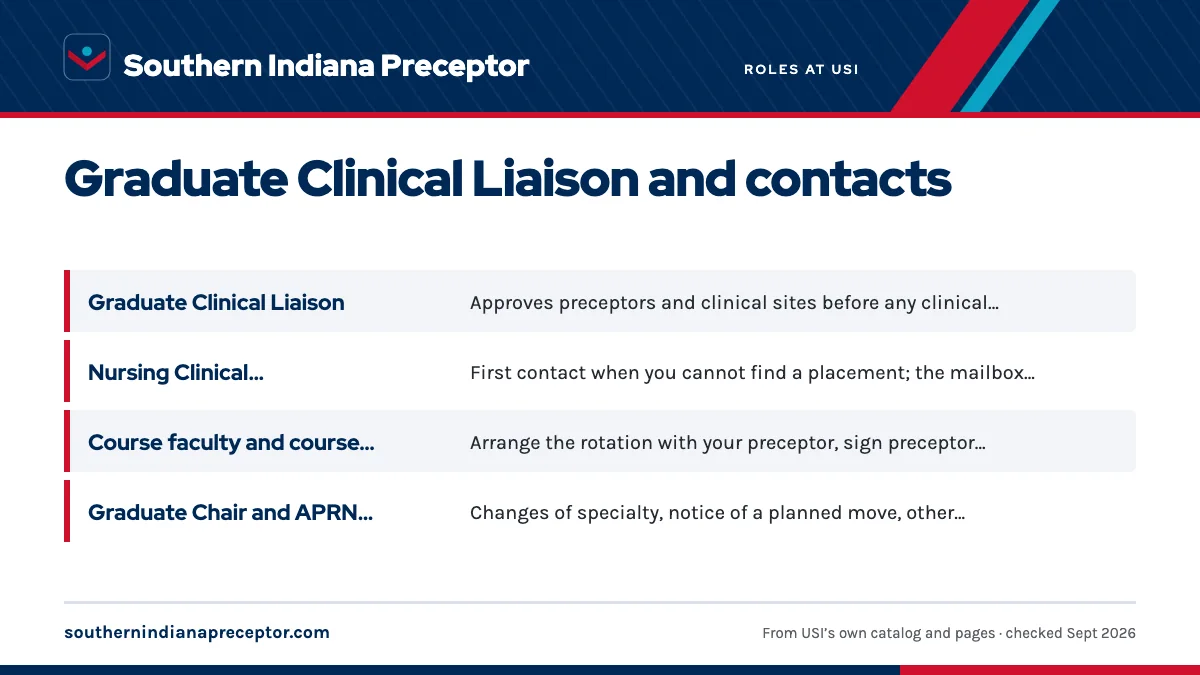
Who does what, at a glance
USI's handbook, catalog and forms name four roles that touch your clinical placement. The titles shift a little from document to document, but the division of labor holds steady.
| Role | What it handles | How students reach it |
|---|---|---|
| Graduate Clinical Liaison | Approves preceptors and clinical sites before any clinical hours; the catalog also names the liaison as a source of help identifying them | Through the paperwork you submit; questions start at usi1nursing@usi.edu |
| Nursing Clinical Coordinator | First contact when you cannot find a placement; the mailbox also takes your packet and Orientation Packet requests | usi1nursing@usi.edu, a program mailbox |
| Course faculty and course coordinators | Arrange the rotation with your preceptor, sign preceptor approvals, evaluate you, approve rescheduled hours, rule on telehealth and specialty sites | Your course in Blackboard and your USI email |
| Graduate Chair and APRN Director | Changes of specialty, notice of a planned move, other program-level matters | A written request from your USI email |
The Graduate Clinical Liaison: the approval
The handbook's University Clinical Requirements page puts approval in one place: preceptors and clinical sites must be approved by the Graduate Clinical Liaison before you begin clinical hours. The catalog says the same in its own words, naming the CNHP graduate nursing clinical liaison, and adds that students are encouraged to identify preceptors and sites with assistance from the university clinical liaison.
Those two sentences differ in tone, and it helps to know both. The handbook makes identifying a preceptor the student's responsibility; the catalog frames it as encouragement with the liaison's help. The handbook is the more detailed operating document, but if the difference matters to your plan, ask the Nursing Clinical Coordinator which reading applies (finding your own preceptor).
The liaison turns up in the deadline rules as well. The same handbook page asks you to tell the course coordinator or the university graduate clinical liaison at least 4 weeks before the semester if you cannot obtain a rotation, a different figure from the 6 weeks printed elsewhere (the deadline conflict).
The Nursing Clinical Coordinator and usi1nursing@usi.edu
Most of the traffic in a USI placement runs through a single address. The handbook lists usi1nursing@usi.edu for the Nursing Clinical Coordinator, and it is also the graduate nursing program's contact mailbox. You use it to:
- Submit the Preceptor Packet and the agreement request from your USI email, with your first and last name and the words Preceptor Packet as the subject
- Request the Preceptor Orientation Packet for your preceptor
- Ask whether a facility already has an agreement with USI
- Report, at least 6 weeks before the course, that you have no preceptor or no agreement contact
- Ask for help when a placement will not come together
For that last case, the handbook asks three things of you: confirm you have no opportunity to work with a preceptor at your place of employment, send the list of organizations you have already contacted so the program does not repeat your calls, and keep communicating, including when you succeed. The stuck-student page takes each in turn.
Course faculty and course coordinators
Once a placement exists, course faculty become your main contact. The Roles page has faculty arranging clinical experiences in collaboration with the preceptor, making sure agreements are signed, assessing the space and patients at the site, and scheduling site visits as needed. Form G's approval line carries a faculty signature, so faculty take part in the approval as well.
Several specific calls rest with them:
- Rescheduling hours after unforeseen events, which requires course faculty approval
- Specialty sites in
NRSG 647, allowed with prior approval of course faculty - Telehealth hours, which the handbook leaves to the individual course coordinator's decision
- Your midterm and final clinical evaluations and the seven touchpoints with your preceptor
- Your clinical schedule, which goes to clinical faculty before you attend
The Graduate Chair and APRN Director
Program-level questions go higher. To change specialty, the Progression and Withdrawal Policies page has you write to the Graduate Chair and APRN Director. If you intend to move to another state, the Academic Advising page makes it your job to notify the Program Chair and APRN Director first. USI's online graduate nursing programs work only with certain states, and moving to one the program does not recognize ends your ability to continue in coursework, active military status excepted (relocating mid-program).
Two more items reach program leadership. Under the Kinney College policy, new criminal charges after your initial background check must be disclosed immediately to the Program Chair. In the DNP, the Chair of Graduate Nursing receives the national board certification that APRNs submit to validate up to 500 practice hours carried over from the MSN.
Why the titles keep changing
If a classmate from an earlier cohort tells you to email someone else, they may be right about their year. USI's contact for placement trouble has moved several times:
- 2023: the BSN to DNP APRN Director for doctoral students, or the Clinical Liaison and Director of APRN Students for the MSN
- Late 2024 to early 2026: the Graduate Clinical Liaison and Director of Graduate Nursing Students, through a named faculty email
- Now: the Nursing Clinical Coordinator at usi1nursing@usi.edu
Approval has moved around the documents too: faculty in the 2021 to 2024 handbooks, the Graduate Clinical Liaison in the current handbook, the CNHP graduate nursing clinical liaison in the catalog, and a faculty signature on Form G. The current handbook page governs. When in doubt, write to the program mailbox, which reaches the program whoever holds each title this year.
Where we fit alongside USI's roles
Every role above belongs to USI, and each keeps its job when a student works with us. The Graduate Clinical Liaison approves, course faculty arrange and evaluate, and usi1nursing@usi.edu receives your packet. What improves is what you bring to them.
Our placement desk carries out the search USI's handbook assigns to the student: preceptors near you who fit your track, checked against USI's rules, with the Form G details and the agreement signer ready. We keep a record of every practice approached, which is exactly the list USI asks for if a search stalls. By the time faculty want your schedule, your preceptor has already agreed one. If a preceptor leaves partway through, we start on a replacement at once, so your message to faculty carries a plan as well as the problem (when a preceptor drops out). See how it works.
Questions USI students ask
Who approves my preceptor at USI?
The Graduate Nursing Handbook says preceptors and clinical sites must be approved by the Graduate Clinical Liaison before clinical hours begin. The catalog names the CNHP graduate nursing clinical liaison, and Form G's approval line carries a faculty signature. In practice you send your paperwork to usi1nursing@usi.edu and wait for the approval email before any clinical practice.
What is usi1nursing@usi.edu?
It is a USI program mailbox. The handbook lists it for the Nursing Clinical Coordinator, and it is the graduate nursing program's contact address. It receives the Preceptor Packet and the Clinical Education Agreement request, handles Orientation Packet requests, answers questions about existing site agreements, and is where you report trouble finding a placement. Always write from your USI email.
Can the Graduate Clinical Liaison find a preceptor for me?
The catalog encourages students to identify preceptors with assistance from the clinical liaison, while the handbook makes it the student's responsibility, except in states that require the university to secure preceptors, such as Alaska. When a student is stuck, the handbook says faculty and staff will collaborate, that travel may be needed, and that some students use outside placement organizations at their own expense (USI's third-party note).
Who do I tell at USI if I am moving to another state?
The Program Chair and APRN Director, before you move. USI's online graduate nursing programs work only with certain states, and moving to one the program does not recognize ends your ability to continue in coursework, with an exception for active military status. You also need an unencumbered RN license in any state where you will do clinicals.
Should I email my course faculty or usi1nursing@usi.edu?
Paperwork goes to usi1nursing@usi.edu: the Preceptor Packet, the agreement request, Orientation Packet requests and placement trouble. Matters inside a running rotation go to course faculty: your schedule, rescheduled hours, specialty sites, telehealth, and anything about evaluations. When a problem touches both, such as losing a preceptor mid-course, tell both at once.
Related pages
Last checked 2026-09-25
We check these pages against USI's own bulletin, program pages and Graduate Nursing Handbook. Your handbook, course faculty and the Nursing Clinical Coordinator have the final word.
- University of Southern Indiana Graduate Nursing Handbook: University Clinical Requirements and Clinical Evaluation
- University of Southern Indiana Graduate Nursing Handbook: Clinical Experience
- University of Southern Indiana Graduate Nursing Handbook: Progression and Withdrawal Policies
- University of Southern Indiana Graduate Nursing Handbook: Academic Advising and Graduate Nursing Policies
- University of Southern Indiana 2026-2027 Graduate Bulletin: MSN Family Nurse Practitioner
USI makes the search your job. We make it the easy part.
Tell us your USI track, your city and your next clinical semester. We find preceptors who fit the NRSG course and fill the Preceptor Packet and Clinical Education Agreement request with typed, complete details, well before USI's 6-week window.
- Preceptors matched to the course: family primary care for FNP, acute care teams for AGACNP, PMHNPs and psychiatrists for PMHNP
- Preceptor license, certification, years of practice and the site's agreement signer ready for the packet
- Fall, Spring and Summer planned together, close to home in a state USI enrolls
Start your placement plan
Track, city and clinical start is all we need to begin.