Finding your own preceptor as a USI graduate student
The University of Southern Indiana expects you to find your own preceptors and clinical sites, then approves them once you do. The handbook states it firmly, the catalog phrases it more gently, and archived USI pages show the search has rested with the student since at least 2014. Here is what the rule means and how to run a search where you live.
Get your placement plan
Tell us your USI program and where you live. A placement advisor replies with the preceptor and site options that fit your course.
The sentence that sets the rule
The Graduate Nursing Handbook's University Clinical Requirements page (modified August 6, 2026) says: "The student is responsible for identifying preceptors and clinical sites in their own community with the exception of states requiring university responsibility for securing preceptors." Two lines follow it. Preceptors may not be relatives or in a relationship with you, and the Graduate Clinical Liaison must approve each preceptor and site before your hours begin.
Read together, the division of labor is plain. You do the identifying: the names, the outreach, the first meeting. USI does the approving, the contracting and the compliance checks, and the clinical placement process shows where the two halves meet.
The exception clause lists no states. The only one USI spells out is Alaska, where USI's graduate program does the choosing for every preceptor and students may not pick their own, as the Alaska rule explains. If you think your state requires the university to secure preceptors, ask the Nursing Clinical Coordinator before you start calling.
How USI's wording has moved since 2014
Archived copies of USI's own pages show the expectation has sat with the student for more than a decade. What has shifted is the tone, and what USI adds after the rule.
| When | USI source | What it said |
|---|---|---|
| 2014 and 2018 | MSN "About the Clinical Experience" page | Students "are expected to locate a preceptor"; USI helps set up contracts and communication with faculty |
| 2021 | MSN and post-master's handbook | The same "responsible" sentence used today, with faculty giving approval |
| 2022-23 | Graduate Bulletin | Each student is "responsible for identifying preceptors and clinical sites" |
| 2023 | MSN and BSN-to-DNP handbooks | USI will "work with you to obtain a clinical placement," though reaching a site may mean travel |
| 2023 to Oct 2024 | Graduate "About the Clinical Experience" page | Students "are asked to locate a preceptor" and contact faculty or the graduate chair if they struggle |
| Late 2024 to now | Graduate Nursing Handbook | Student responsible, plus a note on third-party placement organizations |
| 2026-27 | Graduate Bulletin | Each student is "encouraged to identify preceptors and clinical sites with assistance from the university clinical liaison" |
The two sources that govern 2026-27, the handbook and the bulletin, read differently. The next section deals with that.
Handbook or catalog: which one to plan by
The 2026-2027 Graduate Bulletin prints a softer paragraph on each NP, certificate, NEL and HSL program page. Students are encouraged to find preceptors with the clinical liaison's assistance, and clinical requirements "may be completed in the student's own geographic area." It is silent on outside placement organizations.
The handbook is firmer and more detailed, and it is where the step-by-step process and the forms live. Both are current USI documents, so treat the gap as a conflict to clarify rather than a loophole.
The workable answer is to plan as though the search is yours, which fits both versions, and to treat the liaison's help as backup rather than a substitute. If the difference matters for your situation, ask the Nursing Clinical Coordinator at usi1nursing@usi.edu which wording applies to you and keep the reply.
What "your own community" means for an online student
USI's graduate nursing programs run online, so your community is wherever you live and hold an RN license. Clinical hours can happen there, with a few conditions attached.
- Your RN license must be unencumbered in each state that hosts your clinicals, which means holding a license wherever a site sits, not just at home.
- Your home state has to be one where USI enrolls students in your program. The licensure disclosure lists the states where enrollment is not allowed, and the lists differ by program.
- Distance may be part of it. The handbook says a placement "may require travel," and USI expects students to travel on their own for clinical courses.
- Moving mid-program means notifying the Program Chair and APRN Director first. Relocating outside the states the program recognizes ends your coursework unless you are on active military status.
Running the search close to home
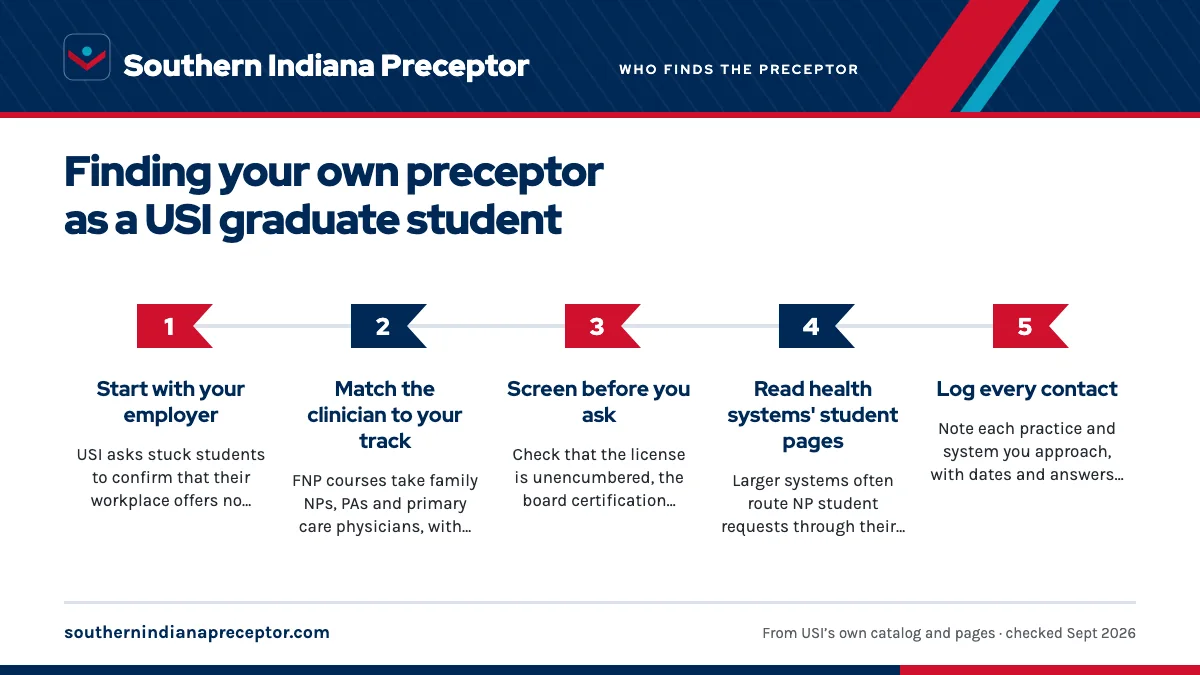
A short, well-screened list gets further than a long list of cold calls. Work through it in this order.
- Start with your employerUSI asks stuck students to confirm that their workplace offers no preceptor, so look there first. The workplace guide covers the one limit USI states: clinical sites are not for workplace orientation.
- Match the clinician to your trackFNP courses take family NPs, PAs and primary care physicians, with specialty clinicians added in the later courses. AGACNP takes NPs, PAs, MDs or DOs in acute care. PMHNP takes only a PMHNP or a licensed psychiatrist.
- Screen before you askCheck that the license is unencumbered, the board certification matches your specialty and the clinician has spent a year or more as an advanced provider, all before you request a meeting, so nobody's time goes to a preceptor USI would turn down.
- Read health systems' student pagesLarger systems often route NP student requests through their own application, with their own deadlines, and some ask students to stay away from direct approaches to clinicians. The Evansville guide covers the tri-state systems.
- Log every contactNote each practice and system you approach, with dates and answers. If you later ask USI for help, it wants that list.
- Arrive ready to signBring the Preceptor Packet, a one-page CV with your photo and your course's weekly hours, so a yes can become signed forms at the same visit.
If your search stalls
Tell USI early. The handbook asks struggling students to write to usi1nursing@usi.edu, the Nursing Clinical Coordinator's mailbox, confirm there is no preceptor option where they work, send the list of organizations already contacted so USI's effort goes somewhere new, and stay in touch, including with the good news when a placement comes through. The can't find a preceptor guide walks through that email.
The same page is candid about what that help looks like. Faculty and staff will work alongside you to secure a placement, the answer may involve travel, and USI adds that students might need to use third-party clinical placement organizations, with any fees resting on the student. The third-party placement page reads that paragraph line by line.
Why USI students hand the search to us
The search is the slowest part of USI's process, and it is the part we do best. Our placement desk works your community for preceptors who fit your NRSG course and USI's rules, checks every credential before a meeting is booked, and collects what Form G and the agreement request need, typed and ready.
We plan Fall, Spring and Summer together, so your second and third courses start from a plan instead of a blank page, and if a preceptor bows out partway through a course we restart the search for a replacement right away. The packet still leaves from your USI account, and every name still goes through USI's approval. The how it works page lays out our process, and the form below gets it moving.
Questions USI students ask
Will USI choose a preceptor for me?
Not as a general rule. The Graduate Nursing Handbook makes identifying preceptors and sites the student's job, with USI approving them and faculty and staff helping when a student reports difficulty. The one state USI names as an exception is Alaska, where the graduate program chooses each preceptor and APRN students also file a preceptorship application with Alaska's Board of Nursing.
Can a family member or my partner be my preceptor?
No. The handbook says preceptors may not be relatives or in a relationship with a student, and the rule applies across the NP tracks, the certificate programs and the doctoral NP routes. A colleague who is not related to you can precept, provided they meet USI's license, certification and experience requirements and sign the agreement.
Can my clinical site be in another state?
Possibly. You need an unencumbered RN license in that state, since USI requires one wherever you do clinicals, and while there you practice under that state's Nurse Practice Act. Check how USI treats the state for your program, and ask the Nursing Clinical Coordinator before you lock in a site over the border.
When should I begin my preceptor search?
Months before the 6-week packet deadline. Back in 2023, USI's handbooks named January and February as the months to line up a likely preceptor for Summer and Fall rotations, and the MSN NP sequence opens in Fall with NRSG 643, NRSG 633 or NRSG 653. Starting in spring leaves time to screen, meet and finish the packet.
Is there a USI list of sites with existing agreements?
USI's public pages show no partner-site list for graduate students. What you can do is ask usi1nursing@usi.edu whether a particular facility already has an agreement with the university, which the Preceptor Packet Instructions suggest before you send the agreement request. An existing agreement saves a step, though the preceptor still needs approval.
Related pages
Last checked 2026-09-25
We check these pages against USI's own bulletin, program pages and Graduate Nursing Handbook. Your handbook, course faculty and the Nursing Clinical Coordinator have the final word.
- University of Southern Indiana Graduate Nursing Handbook: University Clinical Requirements and Clinical Evaluation
- University of Southern Indiana 2026-2027 Graduate Bulletin: MSN Family Nurse Practitioner
- University of Southern Indiana Graduate Nursing Handbook: Course Requirements
- University of Southern Indiana MSN handbook, clinical requirements (archived 2021)
USI makes the search your job. We make it the easy part.
Tell us your USI track, your city and your next clinical semester. We find preceptors who fit the NRSG course and fill the Preceptor Packet and Clinical Education Agreement request with typed, complete details, well before USI's 6-week window.
- Preceptors matched to the course: family primary care for FNP, acute care teams for AGACNP, PMHNPs and psychiatrists for PMHNP
- Preceptor license, certification, years of practice and the site's agreement signer ready for the packet
- Fall, Spring and Summer planned together, close to home in a state USI enrolls
Start your placement plan
Track, city and clinical start is all we need to begin.