What shapes the cost of your USI placement
Every quote we give a University of Southern Indiana student is built for that student: the track and NRSG course, the setting USI requires, where you live, how soon the rotation starts and how many semesters you want planned. Your placement advisor sends it in writing, and it states exactly what the work covers.
Ask for your quote
Share your track, course, semester and city, and your placement advisor prices the work for you.
Why every quote is individual
No two USI placements take the same amount of work, even within one program. A PMHNP student in a rural county looking for an outpatient psychiatric preceptor for NRSG 653 faces a narrower field than an FNP student in a city looking for family primary care for NRSG 643. One student wants a single course covered; another wants Fall, Spring and Summer planned at once. A student licensed in two states gives the search twice the ground to cover.
One fixed price could not fit all of them. So we price the work your placement actually involves, and your quote spells out what it includes before anything starts.
The factors that shape a quote
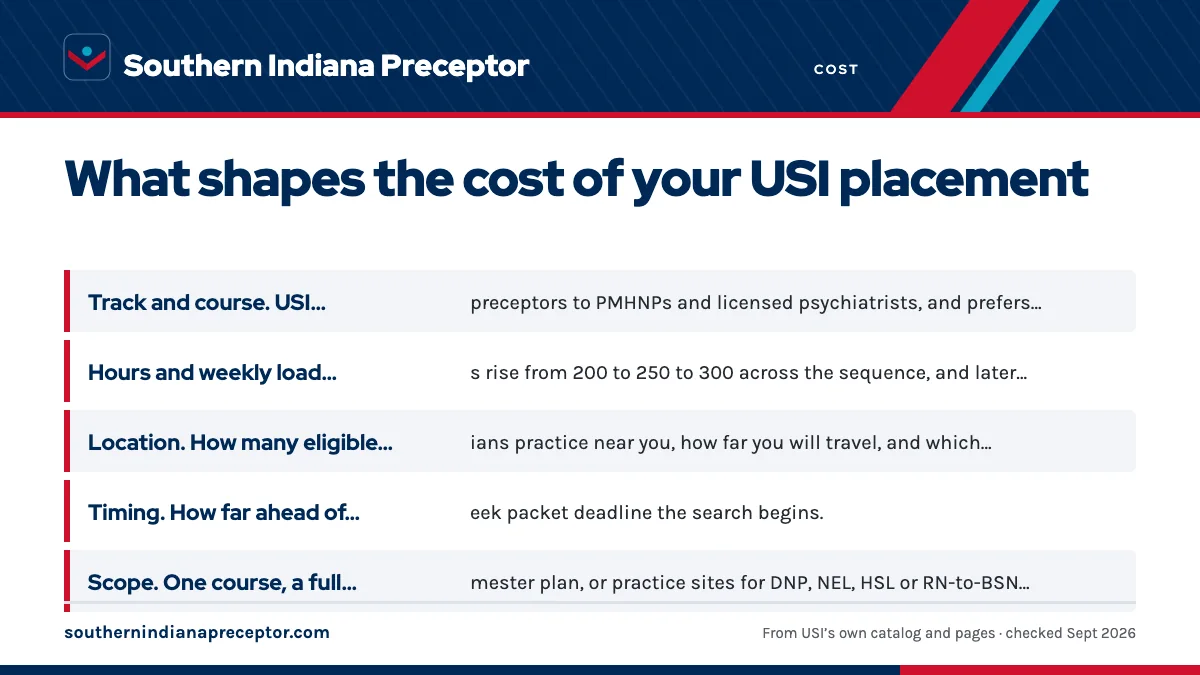
- Track and course. USI limits PMHNP preceptors to PMHNPs and licensed psychiatrists, and prefers critical care or hospitalist settings for
NRSG 637. A narrower pool usually means a longer search. - Hours and weekly load. Direct hours rise from 200 to 250 to 300 across the sequence, and later courses allow up to 36 hours a week (AGACNP) or 30 to 40 (
NRSG 647). Heavier weeks need a preceptor with room in the schedule. - Location. How many eligible clinicians practice near you, how far you will travel, and which states you hold an RN license in.
- Timing. How far ahead of USI's 6-week packet deadline the search begins.
- Scope. One course, a full three-semester plan, or practice sites for DNP, NEL, HSL or RN-to-BSN courses.
- The site's agreement status. A site that already has a Clinical Education Agreement with USI needs less groundwork than one where the signer has to be found.
Your placement advisor walks you through how each factor applies to your course, so the quote makes sense line by line.
What USI says about outside placement costs
USI is direct about this. Its Graduate Nursing Handbook tells students they may need third-party clinical placement organizations, and it states: "These fees for third party placement or travel are the sole responsibility of the student." The note has been in the handbook since late 2024, and the third-party placement page reads the whole paragraph.
Read it as budgeting advice rather than a warning sign. USI's own help remains available, the student remains responsible for identifying preceptors, and a placement service is one route among three, which the options comparison lays side by side. If you choose it, the handbook simply tells you who pays. Other USI costs, from Typhon to travel, follow below so the whole picture sits in one place.
Other clinical costs USI places on students
Our quote is one line in a wider clinical budget. USI's own pages name these student costs, though not every amount is published; the Graduate Bulletin's fees page lists the ones that are.
- Typhon NP Student Tracking, bought once, with access for up to five years after graduation
- i-Human, required for
NRSG 623and the first two specialty courses - The Barkley Board Review, bought in the second half of the second specialty course
- A clinical name badge, ordered by the student
- Health insurance, including any costs from a clinical exposure
- Personal travel to every clinical course, with automotive insurance
- For Alaska APRN students, the Alaska Board of Nursing's preceptorship registration fee
The Graduate Bulletin also lists program fees for the MSN and DNP and a Health Professions Insurance Fee for courses with direct patient care.
What our work covers
Your quote names its scope. Depending on what you ask for, the work includes:
- Mapping USI's rules for your course: hours, preceptor types, setting and weekly limits
- A search in your community, in a state USI enrolls for your program
- Screening each preceptor against USI's license, certification, experience and relationship rules
- The preceptor and site details for Form G, the site survey answers and the agreement signer
- Setting up the first meeting, with a checklist of what to bring
- Follow-through until USI's confirmation email arrives
- Planning your later courses, and a replacement search if a preceptor has to stop
USI's tuition and fees, its required purchases and any charges a clinical site makes are separate from our quote.
Getting your quote
Use the form on this page. Include your USI track, the NRSG course and semester, your city and state, your RN license states, and whether you want one course or the full sequence covered. If you have contacted practices already, list them; it sharpens the quote and the search.
You receive a written quote from your placement advisor that states what it covers, with answers to any question about it before you decide. How it works follows the placement from there, and our FAQ covers broader questions about working with us. If your rotation is only weeks away, say so in the form: a short runway shapes both the search plan and the quote, and the need a preceptor fast guide sets out USI's timing rules.
Questions USI students ask
Why do I need a quote instead of a posted price?
Because USI placements vary too much for one number to be fair. A PMHNP search for outpatient psychiatry in a rural area and an FNP search for family primary care in a city involve very different amounts of work, and so do one course and three. A written quote for your situation is more accurate than a list.
Does a quote cover one course or all three?
Whichever you ask for. You can request help with a single course, such as the next one on your calendar, or have Fall, Spring and Summer planned together. Your quote names the courses and semesters it covers, so you can compare the two approaches before choosing.
Does starting early change the quote?
Timing plays a part. A search that begins well ahead of USI's 6-week packet deadline has more preceptors to choose from and less rush, while a course starting soon calls for faster, more concentrated outreach. Your placement advisor explains how your start date affects the quote you receive.
Can I get a quote before deciding which route to take?
Yes. A quote is simply a written description of the work and its price for your course and location, and asking for one commits you to nothing. It is worth setting it beside the time your own search would take and the help USI offers once a student reports difficulty.
Related pages
Last checked 2026-09-25
We check these pages against USI's own bulletin, program pages and Graduate Nursing Handbook. Your handbook, course faculty and the Nursing Clinical Coordinator have the final word.
USI makes the search your job. We make it the easy part.
Tell us your USI track, your city and your next clinical semester. We find preceptors who fit the NRSG course and fill the Preceptor Packet and Clinical Education Agreement request with typed, complete details, well before USI's 6-week window.
- Preceptors matched to the course: family primary care for FNP, acute care teams for AGACNP, PMHNPs and psychiatrists for PMHNP
- Preceptor license, certification, years of practice and the site's agreement signer ready for the packet
- Fall, Spring and Summer planned together, close to home in a state USI enrolls
Start your placement plan
Track, city and clinical start is all we need to begin.