What the best placement service does for a USI student
The best placement service for a University of Southern Indiana student works from USI's own rules. It finds a preceptor who fits your NRSG course, checks every credential USI will check, and hands you the details for the Preceptor Packet and the agreement request, typed and early. Here is what that looks like, and the questions worth asking before you choose.
Get your placement plan
Tell us your USI program and where you live. A placement advisor replies with the preceptor and site options that fit your course.
Why the choice comes up at USI
USI raises the subject itself. Its Graduate Nursing Handbook tells graduate students they may need outside help, naming "third party clinical placement organizations" and noting that their fees, for the placement service or for administrative expenses, fall to the student. The third-party placement page covers the full paragraph and when it appeared.
Choosing well matters because the service's work still has to pass USI's review. Each preceptor and site needs the Graduate Clinical Liaison's approval, each site needs a signed Clinical Education Agreement, and your Preceptor Packet is due 6 weeks before the rotation. A service that knows those steps saves you weeks, because its work arrives already shaped for them. The choice also touches your budget, since USI's other clinical purchases, such as Typhon, i-Human and the Barkley Board Review, are yours as well.
A preceptor who fits the course, not just the specialty
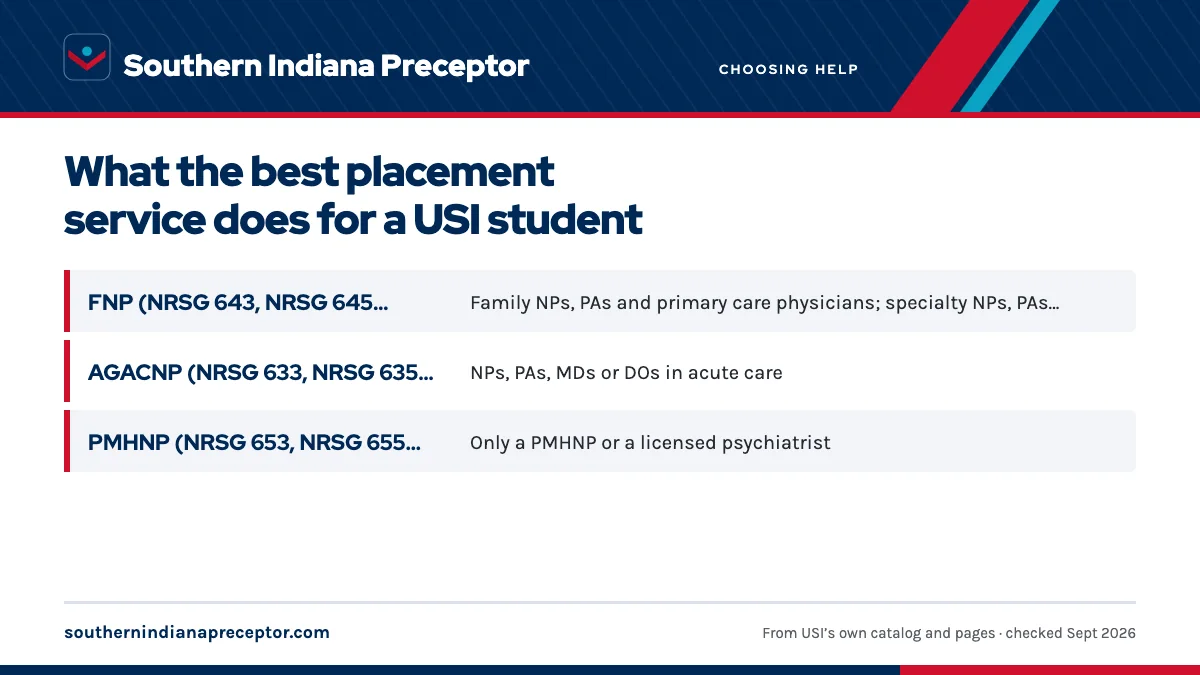
USI's Course Requirements page sets who may precept and where, course by course. A strong service matches both.
| Track | Who may precept | Setting USI describes |
|---|---|---|
FNP (NRSG 643, NRSG 645, NRSG 647) | Family NPs, PAs and primary care physicians; specialty NPs, PAs and physicians in 645 and 647 | Family primary care first; specialty sites later, with faculty approval in 647 |
AGACNP (NRSG 633, NRSG 635, NRSG 637) | NPs, PAs, MDs or DOs in acute care | Acute care; critical care or hospitalist preferred in 637 |
PMHNP (NRSG 653, NRSG 655, NRSG 657) | Only a PMHNP or a licensed psychiatrist | Outpatient mental health |
Weekly load matters as well. NRSG 647 lets FNP students pass 30 hours a week without topping 40, while AGACNP students may reach 36 in their later courses, so the preceptor's schedule has to hold your hours as the sequence climbs from 200 to 250 to 300.
Credentials checked before you meet
A preceptor who fails USI's review costs you the time it took to find them. The best services screen for every rule on the preceptor requirements page before the first meeting.
- A license without encumbrance wherever they practice
- Certification in their specialty, with NP and PA preceptors board-certified in the area matching your track
- At least one year as an advanced practice provider
- No family or personal relationship with you
- Willingness to precept one-to-one, physically present, and to co-sign your Typhon entries
- Time for USI's seven touchpoints each semester: two Preceptor Feedback Forms, three faculty emails and two phone calls you schedule
USI approves the preceptor and the site together, so confirm the exact location where your hours will happen before anyone fills in the site section of the packet.
Paperwork details, typed and complete
Form G has five parts, and a service should bring you the answers to the three that describe the preceptor and site. Part Two wants the preceptor's license and its state, the DEA number, board certification and the board behind it, and how long they have practiced at the site. Part Three covers the site, including whether it belongs to a larger entity and whether it is a telemedicine site. Part Four, the Preceptor/Site Survey, asks how many patients the site sees, how many exam rooms it has, the mix of patients and whether you can chart in the EHR.
The agreement request needs one more name: the person at the site who signs affiliation agreements, identified by the office manager or education coordinator. USI wants every field typed and sent as a PDF. Ask, too, how a service handles a site that may already have an agreement with USI, since a quick check with usi1nursing@usi.edu can save the contract step. The Preceptor Packet guide walks through each part.
The whole year, not one course
Each Preceptor Agreement is tied to one course in one term, and USI's NP sequence runs Fall, Spring and Summer. A service that plans all three courses at once spares you three separate scrambles and gives each preceptor a clear picture of the hours ahead: which course, how many hours in total and how many each week.
Plans also need a fallback. If a preceptor leaves mid-course, USI's roles page has you report it to your preceptor and faculty at once, and a second preceptor at the same practice must have USI approve a separate Preceptor Agreement. The best services stay on call for exactly that moment; the preceptor dropped out guide covers the USI side.
Questions to ask before you commit
Put these to any service you are considering. The answers show quickly whether it works from USI's rules.
- Will you search for my exact NRSG course, or just my specialty?
- Which preceptor types do you screen for my track, and which USI rules do you check?
- Which Form G and agreement-request details will I receive, and in what form?
- How long before the packet is due do you begin searching?
- Will you plan Fall, Spring and Summer together?
- What happens if my preceptor steps away partway through a course?
- What exactly does your quote cover?
Answers that name USI's forms, courses and deadlines show a service built around USI students, and they tell you what to expect at every stage.
How we answer those questions
Every search we run begins with your track and the exact NRSG course. Each preceptor passes our check of USI's rules on licensure, board certification, experience and relationships before you meet, and you receive the Part Two, Three and Four details and the agreement signer well before the packet is due.
We map out all three specialty semesters together, look near home first, and stay available all term should a preceptor leave. Your quote lists what it covers, as our cost page explains, and how it works shows each step from your first message to USI's approval email. Already have a possible preceptor in mind? We check that lead against USI's rules as well and fill in whatever the packet still needs.
Questions USI students ask
Does USI recommend a particular placement service?
USI's handbook mentions third-party clinical placement organizations in general terms and names none of them. Choosing one is your decision, and USI reviews the result exactly as it reviews a preceptor you found yourself: Preceptor Packet, Clinical Education Agreement, the liaison's approval and the confirmation email before any hours.
Can a placement service submit my Preceptor Packet to USI?
USI's step list has the student email the Preceptor Packet and the agreement request to usi1nursing@usi.edu from a USI address, with your name and "Preceptor Packet" as the subject. A good service prepares everything that goes into those forms, and the email itself goes out from your account.
What if a service finds a PA for my PMHNP course?
That preceptor cannot count for PMHNP hours. USI restricts PMHNP clinicals to two kinds of preceptor, a PMHNP or a licensed psychiatrist, across NRSG 653, NRSG 655 and NRSG 657. PAs can precept FNP and AGACNP students. A service that screens by track catches this before you meet, which is one reason to ask how they screen.
Should the service handle my DISA and license items too?
Those stay with you. USI expects your compliance record, BLS (and ACLS for AGACNP), HIPAA and OSHA items and an RN license with no encumbrance in the state where your site is to be current before you start, and nothing in the record may expire during the semester. A service can remind you of them, but you upload and maintain them.
Related pages
Last checked 2026-09-25
We check these pages against USI's own bulletin, program pages and Graduate Nursing Handbook. Your handbook, course faculty and the Nursing Clinical Coordinator have the final word.
- University of Southern Indiana Graduate Nursing Handbook: Course Requirements
- University of Southern Indiana Graduate Nursing Handbook: University Clinical Requirements and Clinical Evaluation
- University of Southern Indiana Preceptor Packet (Form G)
- University of Southern Indiana Request for USI Clinical Education Agreement
USI makes the search your job. We make it the easy part.
Tell us your USI track, your city and your next clinical semester. We find preceptors who fit the NRSG course and fill the Preceptor Packet and Clinical Education Agreement request with typed, complete details, well before USI's 6-week window.
- Preceptors matched to the course: family primary care for FNP, acute care teams for AGACNP, PMHNPs and psychiatrists for PMHNP
- Preceptor license, certification, years of practice and the site's agreement signer ready for the packet
- Fall, Spring and Summer planned together, close to home in a state USI enrolls
Start your placement plan
Track, city and clinical start is all we need to begin.