Your preceptor dropped out in the middle of a USI clinical course
Tell course faculty and the Nursing Clinical Coordinator the same day, get your logged hours co-signed before the preceptor is gone, and stop seeing patients until a replacement is approved. At the University of Southern Indiana a new clinician at the same site needs an additional Preceptor Agreement, a new site needs a full packet and agreement, and in both cases the approval email comes before your next clinical hour.
Get your placement plan
Tell us your USI program and where you live. A placement advisor replies with the preceptor and site options that fit your course.
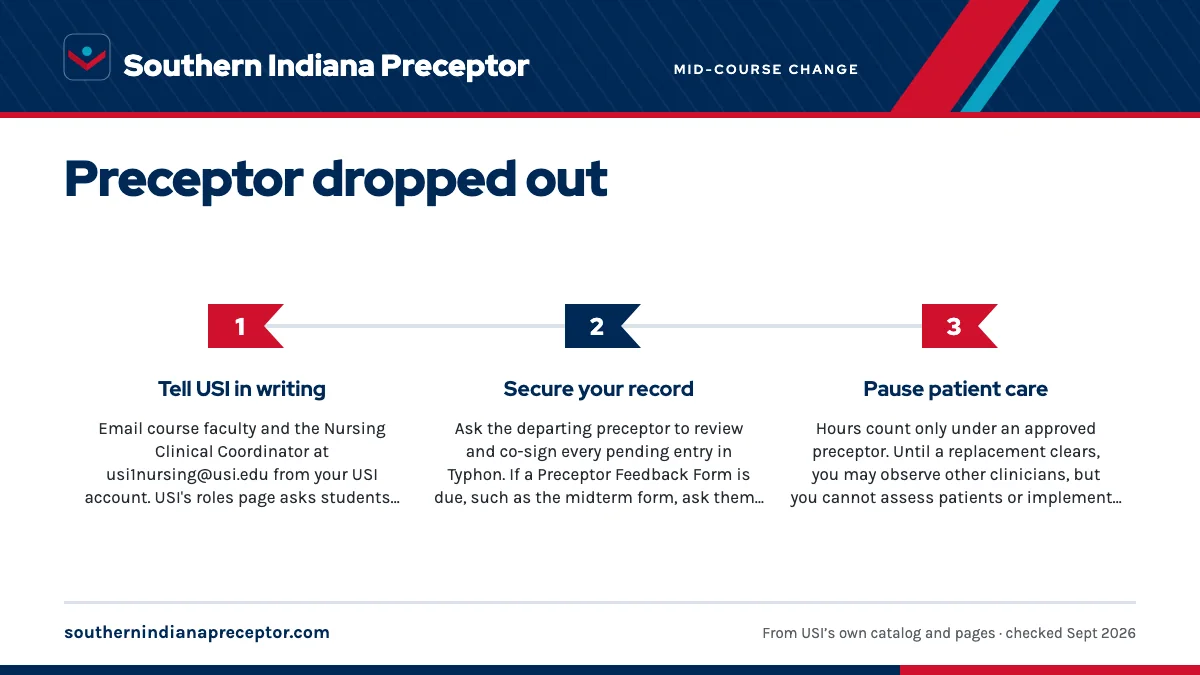
Day one: three things to do
- Tell USI in writingEmail course faculty and the Nursing Clinical Coordinator at usi1nursing@usi.edu from your USI account. USI's roles page asks students to report immediately when a clinical commitment cannot be met, and the same urgency applies when the preceptor is the one leaving. Give the date of your last shift and your current hour total.
- Secure your recordAsk the departing preceptor to review and co-sign every pending entry in Typhon. If a Preceptor Feedback Form is due, such as the midterm form, ask them to complete it before they go.
- Pause patient careHours count only under an approved preceptor. Until a replacement clears, you may observe other clinicians, but you cannot assess patients or implement care plans, and observation time stays out of your total.
Keep a short, factual note of what happened and when. Course faculty will ask, and a clear timeline makes it easier for them to approve a revised schedule.
Why the week of the semester matters
USI builds each clinical course around steady weekly work: clinical must start by week 3 and continue weekly while you are registered, and no hours are allowed during university holidays or when courses are not in session. A preceptor who leaves in week 5 of a 16-week term leaves room to recover. One who leaves late in NRSG 647, with 300 hours due, leaves very little.
Work out the numbers before you speak to faculty: hours done, hours left, weeks left, and the weekly ceiling for your course, which is up to 40 a week in NRSG 647 and up to 36 in the later AGACNP courses. That tells everyone how quickly a replacement has to start. The behind on clinical hours page walks through the pace math.
The fastest replacement: someone at the same site
If another NP, PA or physician in your preceptor's office or facility can take over, USI's route is an additional Preceptor Agreement, completed and approved before that clinician precepts you. The site and its Clinical Education Agreement stay the same, which removes the slowest part of the paperwork.
Check the fit before you ask. The new clinician must meet USI's license, certification and one-year rules and match your track, which for PMHNP students means another PMHNP or a psychiatrist. The additional preceptors page covers the form.
Ask your departing preceptor to make the introduction if they can. A colleague who already knows your work and the practice's routines is the quickest person to bring up to speed, and you keep the patient population you know.
When you need a new site
If nobody at the old site can continue, you are starting a placement from scratch in the middle of a term. The new preceptor completes the Preceptor Packet, the site completes the Request for USI Clinical Education Agreement unless USI already holds one with that organization, and you email both, typed and as PDFs, from your USI address. The placement process page lists the full sequence.
USI's usual lead time is 6 weeks before a rotation starts, which a mid-semester change cannot meet. Say so plainly in your email, ask faculty what timeline they can work with, and send the packet the moment it is complete. USI publishes no processing time, so the part you control is how complete your submission is.
One rule outranks the calendar: stay out of patient care until the confirmation email arrives. USI allows clinical participation only after approval, so any hour logged before that email is an hour that cannot help you.
Protecting the hours and the grade you have
Hours you completed with an approved preceptor and logged in Typhon are part of your course record. Confirm the running total with course faculty in your first email, so the target for the replacement is clear to everyone.
The clinical component is graded Pass or Fail, alongside a B or better in the didactic part, and a missing Pass means an F for the whole course. If the gap cannot close before the term ends, ask faculty early about the options: rescheduling inside the semester with their approval, an incomplete if your work is passing and only a small amount is unfinished, or withdrawal within the calendar's window. Each one affects the rest of your plan, as delayed graduation explains.
If it happens between courses
Some preceptors agree to all three semesters and then step back before the second or third. Because the current Preceptor Agreement is valid only for the course, semester and year written on it, a preceptor who taught you in NRSG 643 is not automatically on file for NRSG 645. Ask each preceptor to confirm the next course before the current one ends, and start a replacement search the moment the answer wavers. If one preceptor was meant to carry you through all three semesters, keep a backup name for each course so a single change does not unsettle the whole year.
Between courses the 6-week window is still within reach, and the clinical deadlines page shows how to work backward from the next start date.
Why students call us when a preceptor drops
Replacing a preceptor mid-course is exactly what our service is built for. We stay on call for every student we place and go straight to work on a replacement who fits your course, your remaining hours and your weekly pace, close to home. The placement desk gathers the license, certification, practice and site details the packet asks for, plus the name of the agreement signer, so the new paperwork reaches USI complete on the first pass. We plan your remaining semesters at the same time, so the next course starts on solid ground.
If you found your own preceptor and they have just left, we can step in too. Use the form below and tell us your course, your hours so far and the week of the semester you are in.
Questions USI students ask
Do my hours with my old preceptor still count?
Hours you completed with an approved preceptor and logged in Typhon remain part of your course record. Ask the preceptor to co-sign any pending entries before they leave, and confirm your running total with course faculty in writing. That total becomes the target the replacement plan has to meet.
Can I keep seeing patients with another provider at the clinic while paperwork is pending?
Not as a student clinician. USI requires an additional Preceptor Agreement to be completed and approved before another practitioner at the site precepts you. While you wait you may observe, but you cannot assess patients or implement care plans, and observation time does not count toward direct hours.
Will I fail the course if my preceptor quits?
Not automatically. The clinical component is Pass or Fail, and faculty can approve rescheduled hours within the semester when circumstances are unforeseen. The risk grows with delay, so report the change right away, show your remaining hours and get a replacement approved quickly. An incomplete or a withdrawal are later options to discuss with faculty.
How long does USI take to approve a replacement preceptor?
USI publishes no processing time. It asks for typed forms sent as PDFs to avoid delays, and approval ends with an email confirmation that must arrive before clinical practice resumes. A same-site additional agreement involves fewer documents than a new site, because the Clinical Education Agreement is already in place.
Who do I contact at USI when my preceptor leaves?
Your course faculty and the Nursing Clinical Coordinator, through the program mailbox usi1nursing@usi.edu. Faculty approve rescheduled clinical time and evaluate your progress, and the coordinator handles the packet and agreement for a replacement. Write from your USI email, as the handbook requires for university communication.
Related pages
Last checked 2026-09-25
We check these pages against USI's own bulletin, program pages and Graduate Nursing Handbook. Your handbook, course faculty and the Nursing Clinical Coordinator have the final word.
- University of Southern Indiana Graduate Nursing Handbook: Clinical Roles and Responsibilities
- University of Southern Indiana Graduate Nursing Handbook: Clinical FAQs
- University of Southern Indiana Graduate Nursing Handbook: Clinical Experience
- University of Southern Indiana Graduate Nursing Handbook: University Clinical Requirements and Clinical Evaluation
USI makes the search your job. We make it the easy part.
Tell us your USI track, your city and your next clinical semester. We find preceptors who fit the NRSG course and fill the Preceptor Packet and Clinical Education Agreement request with typed, complete details, well before USI's 6-week window.
- Preceptors matched to the course: family primary care for FNP, acute care teams for AGACNP, PMHNPs and psychiatrists for PMHNP
- Preceptor license, certification, years of practice and the site's agreement signer ready for the packet
- Fall, Spring and Summer planned together, close to home in a state USI enrolls
Start your placement plan
Track, city and clinical start is all we need to begin.