The green light email: what happens between submission and your first patient
At the University of Southern Indiana, no clinical hour starts until an email confirms the program has accepted your Preceptor Packet and Clinical Education Agreement. Form G's office-use box calls it the Green Light Email, and it arrives only after a run of checks: both licenses, the site's contract, a faculty approval and a Typhon set-up. Here is that sequence, what has to be true on your side, and how to use the wait.
Get your placement plan
Tell us your USI program and where you live. A placement advisor replies with the preceptor and site options that fit your course.
What the email is
USI's handbook closes its clinical checklist with a line in capitals: "DO NOT INITIATE CLINICAL PRACTICE" until email confirmation arrives that your paperwork has been returned and accepted by the program. The same step says the Preceptor Packet and the Clinical Education Agreement must both be approved before you may take part in any clinical experience as a USI graduate nursing student.
Form G supplies the nickname. On page two, its office-use box has a line reading Green Light Email Sent, placed between the faculty approval and the Typhon entries. That placement tells you what the email means: the approval work for the course and term on your packet is finished, and you are cleared to start.
The handbook gives approval authority to the Graduate Clinical Liaison, while Form G's approval line carries a faculty signature. Who approves and who helps sorts out how those roles fit.
What happens after you press send
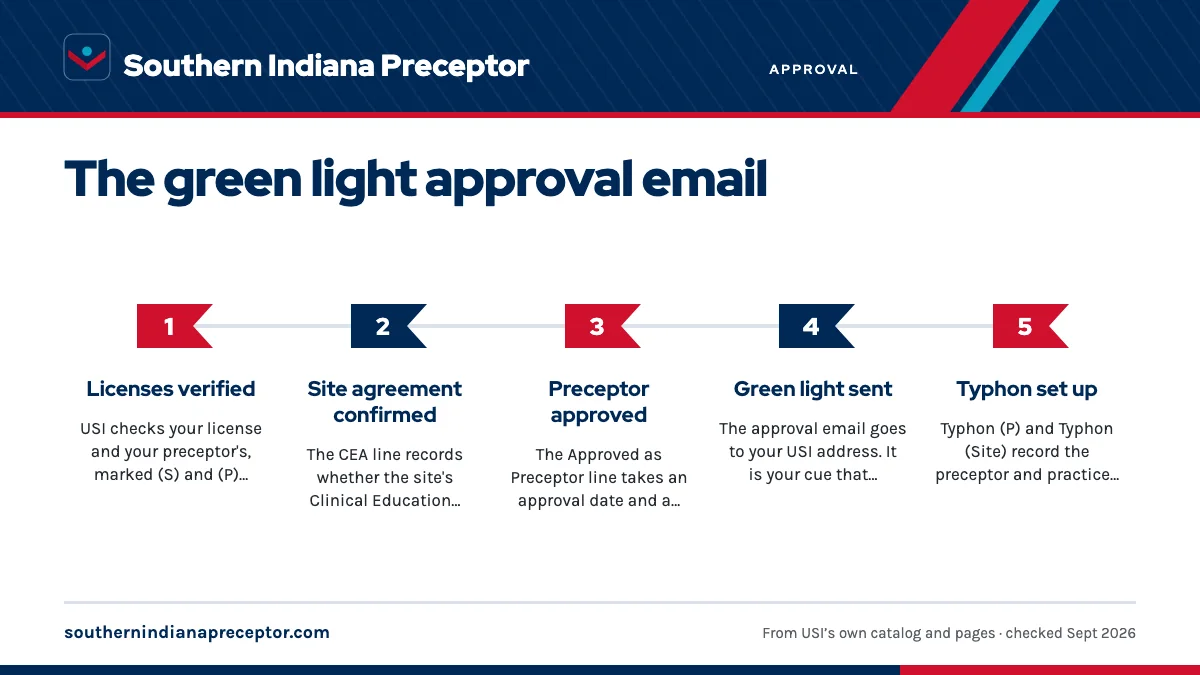
USI does not publish a narrative of its review, but Form G's office-use box lists what gets recorded. Taken together, the entries trace the path your packet follows:
- Licenses verifiedUSI checks your license and your preceptor's, marked (S) and (P). Yours must be unencumbered and valid in the state where the hours happen.
- Site agreement confirmedThe CEA line records whether the site's Clinical Education Agreement exists, whether it renews automatically, and when it expires. A new site waits here until its signer returns the contract USI emailed.
- Preceptor approvedThe Approved as Preceptor line takes an approval date and a faculty signature.
- Green light sentThe approval email goes to your USI address. It is your cue that clinical practice may begin once the course is in session.
- Typhon set upTyphon (P) and Typhon (Site) record the preceptor and practice being added, so your encounters can be logged and co-signed.
Of these, the site agreement is the step that depends most on people outside USI, because someone at the practice has to sign and return a contract. The Clinical Education Agreement page explains how to keep it moving.
What must be true before your first patient
The email is necessary but not the whole story. Other handbook conditions have to hold on the day you walk in:
- The green light email is in your USI inbox for this course and this term
- Your compliance items in CastleBranch (now DISA) are approved, with nothing due to expire before the semester ends
- Your BLS is current, and ACLS as well if you are in the AGACNP track
- The site's state is one where you hold an unencumbered RN license
- Your clinical schedule has gone to clinical faculty
- The course is in session and the day is not a university holiday
- Any other clinician who will precept you has an approved Preceptor Agreement of their own
Compliance can feel like a separate track from approval, but the handbook ties the two together: documents not approved by the due dates bring a Performance Improvement Plan contract and the possibility of being administratively dropped from the course (CastleBranch and DISA).
Starting early is not an option
When a preceptor is ready and the calendar is tight, beginning a few days early and logging the time later can look harmless. USI's rules rule it out from three directions. The handbook requires Graduate Clinical Liaison approval before you begin clinical hours. The catalog requires a written agreement with each agency before clinical experiences begin. And the final checklist step makes the email itself the trigger.
Shadowing is not a way around it. USI's FAQ lets students observe without a preceptor agreement, but observers may not assess patients or implement care plans, and observation hours do not count toward the direct patient hours your course requires. Time spent that way before approval does nothing for your total.
A signed Form G in your hand is not approval. Wait for the email.
Using the wait well
The handbook publishes no processing time, so plan as though review could take much of the 6 weeks Form G allows. In the meantime:
- Check your USI email every day, as the handbook asks; the approval and any query about your packet will come there
- Answer questions from usi1nursing@usi.edu promptly, copying license details exactly as they appear on the license
- Bring CastleBranch (DISA) up to date so no document lapses mid-semester
- Agree a weekly schedule with your preceptor that begins no later than week 3
- Put the midterm and final faculty calls on the preceptor's calendar
- Set up your Typhon account so your first encounter can be logged
If the semester is close and the email has not come, ask usi1nursing@usi.edu for a status update rather than waiting in silence. Clinical hours must begin by week 3 of the course, which the deadlines page turns into dates.
A new course, a new approval
The current Preceptor Agreement covers only the course, semester and year named in Part One, so each specialty course is its own approval. A student moving from NRSG 633 in the Fall to NRSG 635 in the Spring should expect a fresh packet and a fresh green light, even with the same preceptor, unless the Nursing Clinical Coordinator says otherwise. The site's agreement may carry over if it has not expired, one more reason to ask about it early.
Adding a preceptor partway through works the same way. Another clinician at your primary preceptor's site needs a separate Preceptor Agreement that USI approves before they precept you. Plan that paperwork as carefully as the first packet, because until it is approved, the most that clinician can do is let you observe.
How we help your packet reach the green light
Every approval step above runs on information: license numbers, certification details, survey answers, an agreement signer. When a piece is missing, the review waits for it. Our placement desk gathers every piece before your packet goes in. We check the preceptor's license, certification and advanced-practice experience against USI's rules, collect the Form G site and survey answers, and identify the person who signs affiliation agreements.
Your packet reaches usi1nursing@usi.edu typed, complete and early in the 6-week window, and we stay in touch with the site until its agreement is signed and returned. Every approval decision is USI's to make; our part is putting the full set of materials in front of the people who make it. See how it works, or send your course and term through the contact form.
Questions USI students ask
How long does USI take to approve a preceptor and site?
USI does not publish a processing time. Form G asks for the packet 6 weeks before the rotation starts, and the site's Clinical Education Agreement depends on how quickly the site's signer returns the contract. Treat 6 weeks as the minimum lead time, send everything typed and complete, and ask usi1nursing@usi.edu for an update if the semester is close.
Can I start clinical hours once my preceptor signs the packet?
No. The preceptor's signature is one input. USI's checklist says not to initiate clinical practice until you receive email confirmation that the paperwork has been accepted, and both the Preceptor Packet and the Clinical Education Agreement must be approved first. Hours before that point are not approved clinical hours, however willing the preceptor is.
Where does the USI green light email come from?
It comes from the Graduate Nursing Program once your paperwork has been accepted, and it arrives at your USI email address, the account the handbook requires you to use and check daily. Form G's office-use box records the moment it is sent, after the license checks, the agreement check and the faculty approval.
Do I need a new approval for each clinical course?
Expect one. The 07/2026 Preceptor Agreement is valid only for the course, semester and year listed in Part One, so a new course generally means a new packet and a new approval, even with the same preceptor. Ask the Nursing Clinical Coordinator how it applies to you. The site's agreement may still be current if it has not expired.
What if the semester starts and I still have no approval?
Tell course faculty and the Nursing Clinical Coordinator straight away, and ask usi1nursing@usi.edu where your paperwork stands. Clinical hours must start by week 3 of a clinical course and continue weekly, so a late approval squeezes the semester. The earlier faculty know, the more options they have to help you plan the hours.
Related pages
Last checked 2026-09-25
We check these pages against USI's own bulletin, program pages and Graduate Nursing Handbook. Your handbook, course faculty and the Nursing Clinical Coordinator have the final word.
- University of Southern Indiana Graduate Nursing Handbook: Clinical Experience
- University of Southern Indiana, Preceptor Packet (Form G, updated 07/2026)
- University of Southern Indiana Graduate Nursing Handbook: University Clinical Requirements and Clinical Evaluation
- University of Southern Indiana Graduate Nursing Handbook: Clinical Practice FAQs
USI makes the search your job. We make it the easy part.
Tell us your USI track, your city and your next clinical semester. We find preceptors who fit the NRSG course and fill the Preceptor Packet and Clinical Education Agreement request with typed, complete details, well before USI's 6-week window.
- Preceptors matched to the course: family primary care for FNP, acute care teams for AGACNP, PMHNPs and psychiatrists for PMHNP
- Preceptor license, certification, years of practice and the site's agreement signer ready for the packet
- Fall, Spring and Summer planned together, close to home in a state USI enrolls
Start your placement plan
Track, city and clinical start is all we need to begin.