USI clinical hours by program, course by course
Every nurse practitioner track at the University of Southern Indiana now asks for 750 direct clinical hours, split 200, 250 and 300 across three specialty courses. The DNP routes stack practice hours on top of that, the leadership MSN tracks need far fewer, and a handful of totals change depending on which USI page you read. Pick your program in the planner below, then use the table and notes that follow to check the details.
Get your placement plan
Tell us your USI program and where you live. A placement advisor replies with the preceptor and site options that fit your course.
NRSG 661, the leadership tracks' clinical course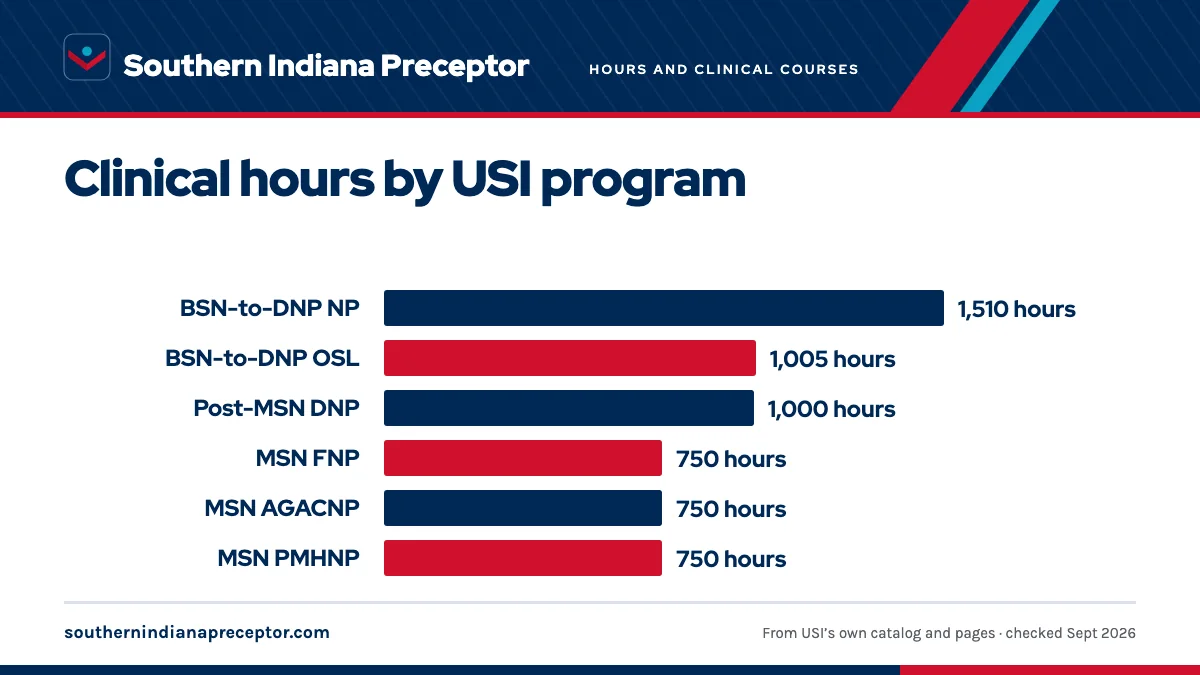
Pick your USI program
Your clinical courses and hours, who can precept you, where, and when to start looking. From USI's own catalog and program pages.
- Who precepts
- FNPs, PAs and primary care physicians, board certified with a year as an advanced provider; specialty clinicians later
- Where
- Family primary care in your own community; specialty sites such as pediatrics or dermatology in the later courses
- Start looking
- Preceptor Packet and Clinical Education Agreement request 6 weeks before each rotation; clinicals start by week 3
- Who precepts
- NPs, PAs, MDs or DOs working in acute care; critical care or hospitalist preferred for the last course
- Where
- Acute care settings, up to 36 clinical hours a week in the later courses; ACLS required
- Start looking
- Packet 6 weeks before each rotation, one specialty course each Fall, Spring and Summer
- Who precepts
- A PMHNP or a licensed psychiatrist only
- Where
- Outpatient mental health settings; up to 150 telehealth hours with the preceptor in the same room
- Start looking
- Packet 6 weeks before each rotation; the sequence runs Fall, Spring, Summer
- Who precepts
- The same preceptor rules as the matching MSN track
- Where
- Close to home in a state USI enrolls for the certificates
- Start looking
- No clinical hours carry over from your earlier degree; plan all three rotations
- Who precepts
- Track preceptors as in the MSN, then a practice partner for the DNP project
- Where
- Your own community, in a state USI enrolls for the BSN-to-DNP
- Start looking
- Specialty courses in the 800-level sequence, then the project courses
- Who precepts
- A practice partner you identify, working with your faculty mentor
- Where
- The organization where your DNP project runs
- Start looking
- Up to 500 hours may come from your MSN; the rest are completed at USI
- Who precepts
- A faculty or clinical educator preceptor (NEL) or leadership mentors (HSL)
- Where
- Acute care, long-term care or community clinics for NRSG 661; education or leadership settings for the practicums
- Start looking
- NRSG 661 in Fall, then the practicums in Spring and Summer
- Who precepts
- An RN with at least six months of experience, approved by faculty
- Where
- Practice sites you identify in your own area that meet the course requirements
- Start looking
- Faculty approve the preceptor and site before any hours start
Every USI program's hours in one table
The figures below come from the Graduate Nursing Handbook (its Course Requirements page, its Specialty Track Overview and its DNP page) and the 2026-27 bulletins. Only direct patient care with an approved preceptor counts toward the NP totals; observation time and i-Human simulation work sit outside them.
| Program | Courses that carry hours | Total | Worth knowing |
|---|---|---|---|
| MSN Family Nurse Practitioner | NRSG 643 200, NRSG 645 250, NRSG 647 300 | 750 direct | Up to 75 may be telehealth |
| MSN Adult-Gerontology Acute Care NP | NRSG 633 200, NRSG 635 250, NRSG 637 300 | 750 direct | Each course figure is a minimum; no telehealth |
| MSN Psychiatric Mental Health NP | NRSG 653 200, NRSG 655 250, NRSG 657 300 | 750 direct | Up to 150 may be telehealth |
| Post-master's certificates (FNP, AGACNP, PMHNP) | The same three specialty courses as the matching MSN track | 750 direct | Hours from an earlier program are not credited |
| BSN-to-DNP (FNP, AGACNP, PMHNP) | 800-level specialty courses such as NRSG 843, hours embedded in DNP courses, project courses NRSG 801, NRSG 803, NRSG 805 | 1,510 | 750 specialty, 260 embedded, 500 project |
| BSN-to-DNP Organizational and Systems Leadership | NRSG 761, NRSG 861, NRSG 867, the embedded DNP courses and the project courses | 1,005 | The program web page says 1,000 |
| Post-MSN DNP | Embedded DNP course hours and the three project courses | 1,000 post-baccalaureate | Up to 500 from your MSN; the handbook table shows 760 at USI |
| MSN Nursing Education Leadership | NRSG 661 40, practicums NRSG 665 and NRSG 668 | 200 practice hours | Practicum hours are not broken out |
| MSN Healthcare Systems Leadership | NRSG 661 40, practicums NRSG 671 and NRSG 673 | 240 practice hours | Practicum hours are not broken out |
| RN-to-BSN (online) | Practice experiences in NURS 457, NURS 487, NURS 492 | Not published | Course faculty set the requirement |
The DNP rows are explained in full on DNP practice hours.
630 and 675 in 2025-26, 750 now
The totals above are new. In 2025-26 the FNP and PMHNP tracks each required 630 direct hours and the AGACNP track 675, spread over NURS-numbered courses. The 2026-27 curriculum rebuild renamed every graduate course with the NRSG prefix, added a two-credit introduction course with no direct hours to each track, and reset the three clinical courses to 200, 250 and 300.
If you began on the NURS sequence, your own plan of study decides which total you are working toward. Ask course faculty or the Graduate Chair and APRN Director to confirm it in writing before you promise a preceptor a number of hours. The year-by-year history, including the 665 and 705 totals printed in earlier catalogs, lives on the 750-hour page.
Which hours count, and which do not
USI uses a few categories of hours, and only one of them fills the 750.
- Direct hours: patient care under an approved preceptor who is physically present at the site, starting only after your approval email arrives.
- Indirect hours: the i-Human simulation cases in
NRSG 623and the first two specialty courses. USI calls them indirect clinical hours, and they are separate from the direct total. - Observation: you may shadow without a Preceptor Agreement, but observation time is excluded from direct patient hours. USI still encourages about 8 hours of observation with a new preceptor before you see patients more independently.
- Telehealth: counted only in the FNP track (up to 75) and the PMHNP track (up to 150), with you and the preceptor in the same room. The rules are on telehealth clinical hours.
- DNP practice hours: logged in the embedded and project courses of the doctoral routes, apart from the specialty clinicals.
Direct hours go into Typhon as you go, and your preceptor reviews and co-signs the entries where applicable.
Spreading hours across a 16-week semester
The calendar rules shape your weekly load as much as the totals do. A clinical course must be under way by its third week and continue weekly for as long as you are registered, clinical faculty receive your schedule before your first day on site, and hours are off limits on university holidays and whenever courses are not in session.
Worked through for 2026-27: a Fall course that starts clinical in week 3 and skips Labor Day, Fall Break and Thanksgiving has about 14 working weeks, so 200 hours comes to roughly 14 or 15 a week. Spring, minus its recess week, also has about 14, which puts 250 hours near 18 a week. The Summer FNP course carries 300 hours at 30 or more a week with a ceiling of 40, and acute care students may log up to 36 a week in their later courses.
Hours logged before the approval email, on a university holiday or between terms do not count, however long you worked.
Where USI's pages disagree about hours
Some hour figures depend on which USI page you open. When they conflict, the current Graduate Nursing Handbook and your course faculty have the final say; these are the ones worth raising in writing.
- Leadership MSN tracks. For Nursing Education Leadership the Specialty Track Overview lists 200 practice hours, and for Healthcare Systems Leadership 240. The bulletin's practicum courses (
NRSG 665,NRSG 668,NRSG 671,NRSG 673) print no hours, and onlyNRSG 661has a published count of 40. Ask faculty how the remainder divides before each practicum starts. - BSN-to-DNP leadership route. The handbook table adds up to 1,005 hours; the program page says 1,000. The same table lists an
NRSG 856row that is not in the leadership curriculum. - Post-MSN DNP. The bulletin mentions 215 hours built into courses, while the handbook's embedded course hours add up to 260, for a 760-hour total at USI.
- AGACNP. The Course Requirements page gives each acute care course a minimum and no track total; the Specialty Track Overview gives 750.
- Introduction courses.
NRSG 641,NRSG 631andNRSG 651have no direct-hour line at all. Treat them as didactic unless your syllabus says otherwise.
From an hour total to a preceptor who can host it
An hour total is really a scheduling question. A preceptor who can take you for 14 hours a week in Fall may have no room for 30 a week in Summer, and a specialty block in Spring needs its own approved site. USI students come to us with the whole sequence so those gaps are solved before they open.
Your placement advisor matches each course's hours to real clinic days, checks the setting against the course (family primary care, acute care or outpatient mental health), and collects the preceptor's license, board certification and years of practice so the Preceptor Packet goes in complete, typed and early, well inside USI's 6-week window. If a preceptor's schedule changes mid-term, we find the replacement and keep your weekly hours on pace. Start with the form below.
Questions USI students ask
How many clinical hours is USI's FNP program?
750 direct clinical hours in 2026-27: NRSG 643 (200), NRSG 645 (250) and NRSG 647 (300), one per term from Fall to Summer. Up to 75 of them may be telehealth under USI's same-room rule. Students who started on the older NURS courses had 630, so check your plan of study if that is you.
Do i-Human simulation hours count toward the 750?
No. USI treats i-Human cases as indirect clinical hours for the program. The 750 are direct hours with patients, supervised by an approved preceptor and logged in Typhon. i-Human is required in NRSG 623 and the first two specialty courses, and it runs alongside your preceptor time rather than replacing any of it.
Can I start clinical hours before the semester begins?
No. USI allows no clinical hours while courses are out of session or on university holidays, and none before the email confirming your Preceptor Packet and Clinical Education Agreement were accepted. Once the course opens, you must be on site by week 3 and keep a weekly rhythm until the term ends.
Do my hours from a first master's degree count in a USI post-master's certificate?
No. USI runs a gap analysis on every post-master's applicant and credits no earlier clinical hours toward the certificate, so you complete the full 750 in the track's three specialty courses. Some didactic credit, for pathophysiology, pharmacology or advanced health assessment, may transfer under set conditions. See the FNP certificate page.
What are the clinical hours for USI's BSN-to-DNP?
The FNP, AGACNP and PMHNP routes total 1,510 practice hours: the same 750 specialty hours in 800-level courses such as NRSG 843, 260 hours embedded in DNP courses, and 500 in the three project courses. The Organizational and Systems Leadership route totals 1,005 in the handbook table, or 1,000 on the program page.
Can I log more than 40 clinical hours a week to finish sooner?
In NRSG 647, FNP students may log 30-plus hours weekly with 40 as the hard ceiling, and acute care students may log up to 36 a week in the later courses. Because clinical must also run weekly from week 3 onward, spreading hours evenly is the safer plan than packing them into a few weeks.
Related pages
Last checked 2026-09-25
We check these pages against USI's own bulletin, program pages and Graduate Nursing Handbook. Your handbook, course faculty and the Nursing Clinical Coordinator have the final word.
- University of Southern Indiana Graduate Nursing Handbook: Course Requirements
- USI Graduate Nursing Handbook: Specialty Track Overview
- USI Graduate Nursing Handbook: BSN-DNP and Post MSN-DNP
- USI Graduate Nursing Handbook: University Clinical Requirements and Clinical Evaluation
- USI 2026-2027 Graduate Bulletin: MSN Family Nurse Practitioner
USI makes the search your job. We make it the easy part.
Tell us your USI track, your city and your next clinical semester. We find preceptors who fit the NRSG course and fill the Preceptor Packet and Clinical Education Agreement request with typed, complete details, well before USI's 6-week window.
- Preceptors matched to the course: family primary care for FNP, acute care teams for AGACNP, PMHNPs and psychiatrists for PMHNP
- Preceptor license, certification, years of practice and the site's agreement signer ready for the packet
- Fall, Spring and Summer planned together, close to home in a state USI enrolls
Start your placement plan
Track, city and clinical start is all we need to begin.