NRSG 635 Adult and Geriatric Acute Care Management II: 250 hours in the Spring semester
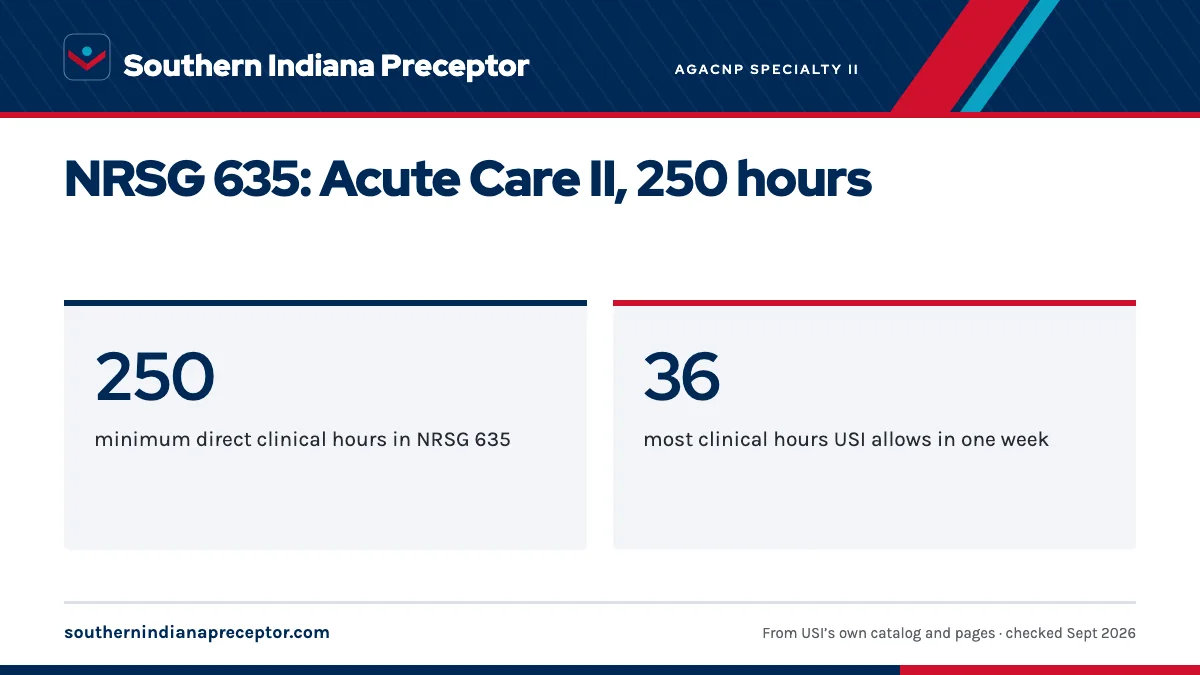
NRSG 635 is the middle acute care course in the University of Southern Indiana's AGACNP track: a Spring semester with a floor of 250 direct clinical hours and a limit of 36 clinical hours in any week. Keeping your Fall preceptor is an option, but USI still needs a new Preceptor Packet for this course, and the window for it runs through Thanksgiving.
Get your placement plan
Tell us your USI program and where you live. A placement advisor replies with the preceptor and site options that fit your course.
Where Management II fits
The bulletin lists NRSG 635 at 6 credits with a 3.5-2.5 lecture-lab split, offered in Spring, between NRSG 633 in Fall and NRSG 637 in Summer. The Course Requirements page gives it a clinical minimum of 250 direct hours and adds one line the Fall course lacks: students may practice up to 36 hours of clinical per week.
BSN-to-DNP students on the acute care route take it as NRSG 835, with the same floor and the same weekly limit. Under the NURS numbering used through 2025-26, the second acute care clinical course was NURS 675 at 225 hours, so the 2026-27 rebuild added 25 hours to this slot.
By January you will have at least 200 direct hours in Typhon, a Fall midterm and final evaluation behind you, and a clear picture of what your first site offered. Spring is the natural semester to widen that experience before the critical care or hospitalist emphasis of the Summer course.
The 36-hour ceiling in practice
Thirty-six hours a week is a limit, not a quota. If your preceptor works 12-hour shifts, three shifts reach the ceiling exactly and a fourth would pass it, so a heavy week is three shifts at most.
On the Spring 2027 calendar, classes run from January 11 to May 7. With clinical under way by Week 3, the week of January 25, and Spring Recess on March 8 to 13 taken out, about 13 to 14 working weeks remain. Spread evenly, 250 hours comes to roughly 18 or 19 hours a week. Worked at the full 36, the minimum still takes nearly seven weeks.
A few other Spring dates need a place in your schedule: Martin Luther King Jr. Day on January 18, a university closure on March 26 and the Spring Engaged Learning Day on March 30. USI permits no clinical hours on university holidays, so confirm with course faculty how each date is treated before you send your schedule.
A new Preceptor Packet, even with the same preceptor
The current Form G closes with a Preceptor Agreement valid only for the course, semester and year named in Part One. A packet approved for NRSG 633 in Fall therefore does not carry into NRSG 635. The 2019 version of the form ran for a year with an option to renew, which is why older advice from classmates may tell you otherwise.
So every Spring you file again: the Preceptor Packet with NRSG 635 and the Spring term in Part One, typed and sent as a PDF to usi1nursing@usi.edu from your USI email. If the site is unchanged, ask the Nursing Clinical Coordinator whether its Clinical Education Agreement is still in force; the office box on Form G tracks whether each agreement auto-renews and when it expires.
If a second provider at the same site will cover some of your shifts, that person needs an additional Preceptor Agreement approved before they precept you. Additional preceptors and observation explains how USI handles it.
Counting back from January 11
Six weeks before the first day of Spring 2027 classes is Monday, November 30, 2026. The handbook's one-month and 4-week wording points to mid-December instead. Either way the window runs straight through Thanksgiving recess (November 25 to 29) and closes just before winter recess starts on December 23. USI's clinical deadlines explains both counts.
Hospital systems move earlier still for Spring. Community Health Network in Indianapolis takes Spring applications until September 1, IU Health's window runs from July 1 to September 1, Good Samaritan in Vincennes closes August 31 and Deaconess September 30. Those are each system's own rules, mostly for students of affiliated schools, and they mean a Spring change of site is best decided by the time your Fall semester begins.
Keeping your Fall preceptor makes the calendar gentler. Agree on the Spring schedule with them before Thanksgiving, have the new packet signed, and send it in November.
What else the Spring semester brings
USI requires i-Human in Specialty I and II, so simulation cases continue beside your NRSG 635 hours as indirect work. The Barkley Board Review, a required purchase, is due in the second half of your Specialty II course, which for acute care students means the back half of this Spring. More on both is on the i-Human and board review page.
Clinical faculty evaluate you at midterm and at the end of the course on a Does not meet, Meets or Exceeds scale, and your preceptor files a feedback form in Typhon at each of those points. Faculty and preceptor connect at least seven times in the semester, and setting up the two phone calls is your job. The evaluations page explains how the final rating decides the course.
Keep ACLS and BLS current in DISA through May 7. USI stops clinical hours when BLS lapses, until the renewal is verified, and ACLS must stay current for every AGACNP student.
How we keep NRSG 635 on schedule
USI students choose us for the Spring course because we treat it as one piece of a single acute care plan, not a fresh search each January. When your Fall site can carry you forward, we confirm the Spring schedule with the preceptor, complete the new Form G with the right course and term, and check the status of the site's Clinical Education Agreement well before Thanksgiving.
When you need a new site, or a second preceptor so 250 hours fit inside the 36-hour limit, your placement advisor finds acute care NPs, PAs and physicians who meet USI's rules, collects their license, certification, DEA and site details, and has a typed packet ready for your review weeks before November 30.
Should a preceptor withdraw partway through the term, the search for a successor starts at once. USI keeps the final say on every preceptor and site, and whatever reaches its inbox from us is complete. Tell us about your Spring or use the form below.
Questions USI students ask
Can I stay with my NRSG 633 preceptor for NRSG 635?
Yes. USI's published rules do not ask you to change preceptors between courses, but the paperwork starts over: the current Preceptor Agreement covers only the course and term written on it. File a new Preceptor Packet for NRSG 635, confirm the site's agreement is still current, and wait for USI's approval email before logging Spring hours.
Can I go over 36 hours in a week to catch up in NRSG 635?
No. The handbook caps practice in NRSG 635 at 36 clinical hours a week, so catching up means adding weeks, not stretching one. If you fall behind, talk to course faculty early: USI lets hours be rescheduled within the semester for unforeseen circumstances when course faculty approve. The behind on clinical hours page walks through the options.
Is NRSG 835 the same course as NRSG 635?
NRSG 835 is the BSN-to-DNP version of Management II, taken by doctoral students on the acute care track. USI's Course Requirements page writes the 250-hour minimum and the 36-hour weekly limit for both numbers, and the hours count toward the 1,510 practice hours the BSN-to-DNP APRN route requires.
When do AGACNP students buy the Barkley Board Review?
The handbook ties the required Barkley purchase to the second half of your Specialty II course, which for AGACNP students is NRSG 635 (or NRSG 835). The bulletin's Specialty III course entry also mentions the purchase, so follow the instructions in your Blackboard course and ask course faculty if the timing looks unclear.
What if my preceptor leaves in the middle of Spring?
Tell the preceptor's office and your course faculty right away, since prompt reporting is a student duty on USI's roles page. A replacement needs its own approved Preceptor Packet before you log hours there. With a 250-hour floor and a weekly cap, the sooner a new preceptor is approved, the more weeks you keep. See when a preceptor drops out.
Related pages
Last checked 2026-09-25
We check these pages against USI's own bulletin, program pages and Graduate Nursing Handbook. Your handbook, course faculty and the Nursing Clinical Coordinator have the final word.
- University of Southern Indiana Graduate Nursing Handbook: Course Requirements
- University of Southern Indiana Preceptor Packet (Form G, updated 07/2026)
- University of Southern Indiana Academic Calendar
- University of Southern Indiana Graduate Nursing Handbook: University Clinical Requirements and Clinical Evaluation
USI makes the search your job. We make it the easy part.
Tell us your USI track, your city and your next clinical semester. We find preceptors who fit the NRSG course and fill the Preceptor Packet and Clinical Education Agreement request with typed, complete details, well before USI's 6-week window.
- Preceptors matched to the course: family primary care for FNP, acute care teams for AGACNP, PMHNPs and psychiatrists for PMHNP
- Preceptor license, certification, years of practice and the site's agreement signer ready for the packet
- Fall, Spring and Summer planned together, close to home in a state USI enrolls
Start your placement plan
Track, city and clinical start is all we need to begin.