NRSG 633 Adult and Geriatric Acute Care Management I: planning your first 200 acute care hours
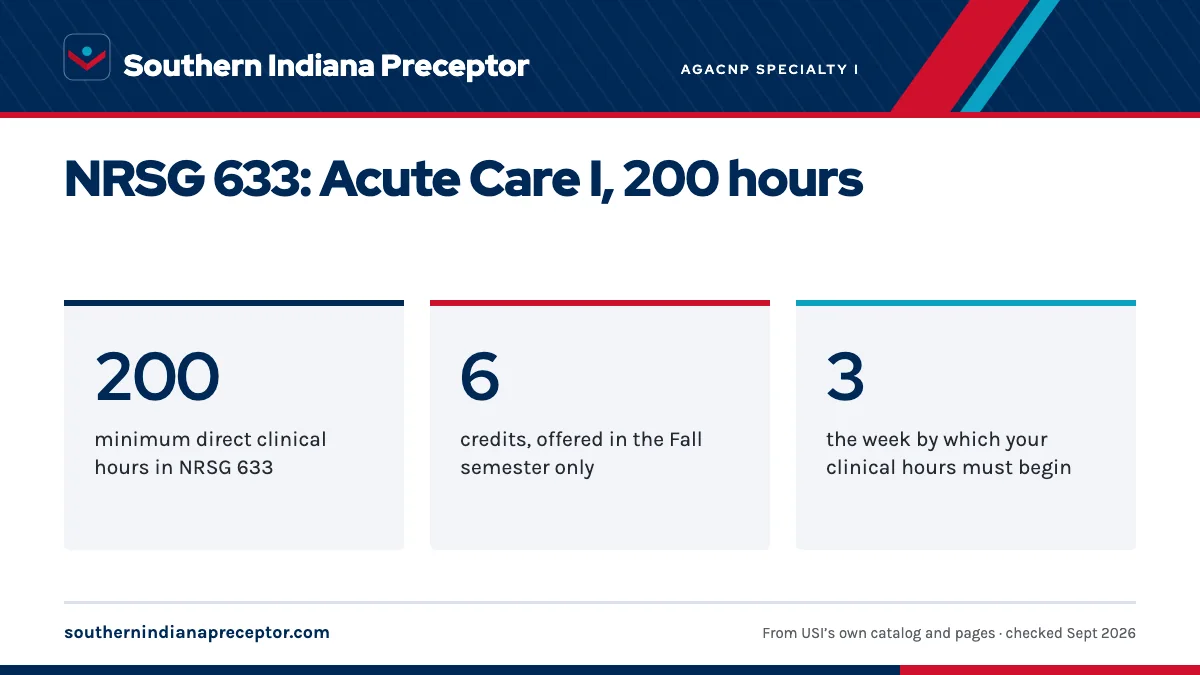
NRSG 633 is where the University of Southern Indiana's AGACNP track starts counting direct clinical hours: at least 200 of them, in acute care settings, during the Fall semester. An NP, PA, MD or DO who works in acute care can precept you, once USI has approved that person and the site. Hospitals keep their own student calendars, so a Fall rotation is best settled by spring.
Get your placement plan
Tell us your USI program and where you live. A placement advisor replies with the preceptor and site options that fit your course.
Where NRSG 633 sits in the acute care track
Management I opens the three-course clinical run of the Adult-Gerontology Acute Care NP specialty. The 2026-27 Graduate Bulletin lists it at 6 credits with a 4-2 lecture-lab split, taught in Fall. The Graduate Nursing Handbook's Course Requirements page sets the clinical floor: a minimum of 200 direct hours "in various acute care settings."
It comes after a Summer spent on NRSG 631 Introduction to Adult and Geriatric Acute Care Management and NRSG 623, the advanced health assessment course; neither carries direct hours. So this is the semester your first approved preceptor has to be in place. Management II and III then add at least 550 more hours toward the track's 750.
Students in the BSN-to-DNP take the same material as NRSG 833. USI's numbering note is short: 600-level means MSN, 800-level means DNP. The 200-hour minimum is identical, and those hours feed the doctorate's 1,510-hour practice total.
| Course (MSN / BSN-to-DNP) | Term | Credits | Direct clinical hours |
|---|---|---|---|
NRSG 631 / NRSG 831 Introduction | Summer | 2 | None |
NRSG 633 / NRSG 833 Management I | Fall | 6 | 200 minimum |
NRSG 635 / NRSG 835 Management II | Spring | 6 | 250 minimum |
NRSG 637 / NRSG 837 Management III | Summer | 5 | 300 minimum |
Who can precept you in NRSG 633
The acute care rule is broad on role and firm on setting. USI's Course Requirements page accepts NPs, PAs, MDs or DOs, provided they practice in acute care. In practice that opens hospital-based physicians, acute care NPs and PAs on inpatient services, which is a wider pool than the PMHNP track ever sees.
Each preceptor also has to meet USI's graduate-wide bar: a clean, unencumbered license where they work, specialty certification, a year or more practicing as an advanced provider, and USI's signed agreement on file. For NP and PA preceptors, the board certification has to line up with your specialty track. A relative or partner cannot precept you, and the preceptor stays physically present and teaches you one to one.
The complete checklist, with how USI verifies licenses, is on who can precept a USI graduate student. If you are weighing a PA or a physician, the PA and physician preceptor page covers the track differences.
Why a Fall rotation gets planned in spring
USI's own clock is short. Form G asks for the finished Preceptor Packet 6 weeks before the rotation begins; a different handbook page uses one month instead. Counted back from the Fall 2026 opening day of August 17, six weeks lands on July 6. USI's clinical deadlines set the two figures side by side.
Hospitals keep a longer clock. Several systems in and around the tri-state publish application windows for NP students, and for Fall rotations those windows shut in spring: Deaconess lists April 30, Good Samaritan in Vincennes lists March 31, and IU Health's Office of Clinical Education takes Fall applications from March 1 to April 1. Each is that system's own process, most require an affiliation agreement with the school, and none amounts to a promise of a spot.
So the workable order for NRSG 633 runs like this: choose a hospital and a preceptor over the winter, move through the hospital's process in early spring, then finish USI's Preceptor Packet and Clinical Education Agreement request well before July. The Evansville-area guide gathers what each system publishes.
Pacing 200 hours through a 16-week Fall
USI wants clinical under way by Week 3 of the course and continuing every week you are registered. On the Fall 2026 calendar, that means your first shift falls no later than the week of August 31, with the term closing December 11.
USI also allows no clinical hours on university holidays. The Fall 2026 calendar marks Labor Day on September 7, a Fall Engaged Learning Day on September 15, Fall Break on October 5 and 6, and Thanksgiving recess from November 25 to 29. Allowing for those, about 14 working weeks remain, so 200 hours averages roughly 14 to 15 hours a week. If your preceptor works 12-hour shifts, that is a little more than one shift a week.
The handbook prints a 36-hour weekly ceiling for the Spring and Summer acute care courses but gives no weekly figure for NRSG 633, so check with course faculty before planning long stretches. Your clinical schedule goes to clinical faculty before you attend, and any hours you need to move require course faculty approval.
Paperwork for a hospital site
Hospitals add layers a small practice may not. Alongside the Preceptor Packet (Form G), you complete the Request for USI Clinical Education Agreement, on which someone at the facility, usually the office manager or education coordinator, names the person who signs affiliation agreements. Before the site fills that in, email usi1nursing@usi.edu to learn whether an agreement with the facility already exists, which can save a step.
Some systems also manage students in their own compliance software once a rotation is approved. Deaconess, for example, uses myClinicalExchange and has the school's clinical coordinator request the rotation there. Keep your DISA record current in parallel: BLS for every student and ACLS for every AGACNP student, with nothing set to expire before the semester ends. The BLS, ACLS, HIPAA and OSHA page lists the renewals.
No hour counts until USI's approval email arrives, and the handbook states that rule in capital letters. What happens between submission and that email is on the approval email page.
How we set up NRSG 633 for USI students
USI students choose us for NRSG 633 because our work starts when the hospital calendars do. Your placement advisor searches near home, within USI's enrollment states, for acute care NPs, PAs and hospital-based physicians, and checks each one against USI's license, certification and one-year rules before bringing them to you.
We then pull together each item Form G and the agreement request want: the preceptor's license and DEA details, board certification, years at the current practice, the site survey figures and the name of the hospital's agreement signer. It all goes to usi1nursing@usi.edu as a typed PDF, whole, and weeks before the cutoff.
Because NRSG 633 is only the first of three acute care semesters, we plan Management II and III alongside it, keeping the ICU or hospitalist setting that USI favors for the last course in view. If a preceptor steps away mid-semester, your advisor lines up a replacement. Every approval remains USI's decision, and every packet we prepare is built to clear it on the first read. See how it works or use the form below.
Questions USI students ask
Does i-Human count toward the 200 hours in NRSG 633?
No. i-Human is a required purchase for health assessment and for Management I and II, but USI files that simulation time under indirect hours. What NRSG 633 measures is direct patient care beside an approved preceptor, entered in Typhon for the preceptor to co-sign. The simulations run in parallel and replace none of the 200.
Can I complete NRSG 633 hours at the hospital where I work as an RN?
Possibly. No handbook rule forbids it, and USI asks students who are stuck whether their employer has a preceptor to offer, which suggests employer sites can work. Two limits apply: a clinical placement cannot double as workplace orientation, and USI's malpractice insurance covers you only while you act in the student advanced practice role, under your approved preceptor.
Can NRSG 633 hours be done in long-term care or urgent care?
When the bulletin describes the AGACNP track, it reaches beyond hospitals to long-term care, physician offices, and urgent and ambulatory care, while this course asks for a variety of acute care settings. Whether a particular site fits NRSG 633 is for course faculty to decide when they approve the Preceptor Packet, so ask before you commit a preceptor and keep a hospital option in reserve.
What happened to NURS 674?
Through 2025-26, USI's graduate courses used the NURS prefix, and the first acute care clinical course in that sequence was NURS 674, with 180 hours. The 2026-27 rebuild moved graduate courses to NRSG and lifted the AGACNP total from 675 to 750 hours. USI has published no official crosswalk, so check your plan in Degree Works or with your advisor if you began under the old numbers.
What if my NRSG 633 preceptor pulls out in October?
Tell your preceptor's office and your course faculty at once, as USI's roles page expects. A new preceptor needs an approved Preceptor Packet before you log hours with them, and with a 200-hour floor and weekly hours required, every week of delay matters. The preceptor dropped out page sets out the steps.
Related pages
Last checked 2026-09-25
We check these pages against USI's own bulletin, program pages and Graduate Nursing Handbook. Your handbook, course faculty and the Nursing Clinical Coordinator have the final word.
- University of Southern Indiana Graduate Nursing Handbook: Course Requirements
- University of Southern Indiana 2026-2027 Graduate Bulletin: MSN, Adult-Gerontology Acute Care Nurse Practitioner
- University of Southern Indiana Graduate Nursing Handbook: University Clinical Requirements and Clinical Evaluation
- University of Southern Indiana Academic Calendar
USI makes the search your job. We make it the easy part.
Tell us your USI track, your city and your next clinical semester. We find preceptors who fit the NRSG course and fill the Preceptor Packet and Clinical Education Agreement request with typed, complete details, well before USI's 6-week window.
- Preceptors matched to the course: family primary care for FNP, acute care teams for AGACNP, PMHNPs and psychiatrists for PMHNP
- Preceptor license, certification, years of practice and the site's agreement signer ready for the packet
- Fall, Spring and Summer planned together, close to home in a state USI enrolls
Start your placement plan
Track, city and clinical start is all we need to begin.