USI's BSN-to-DNP nurse practitioner tracks: 72 credits and 1,510 hours
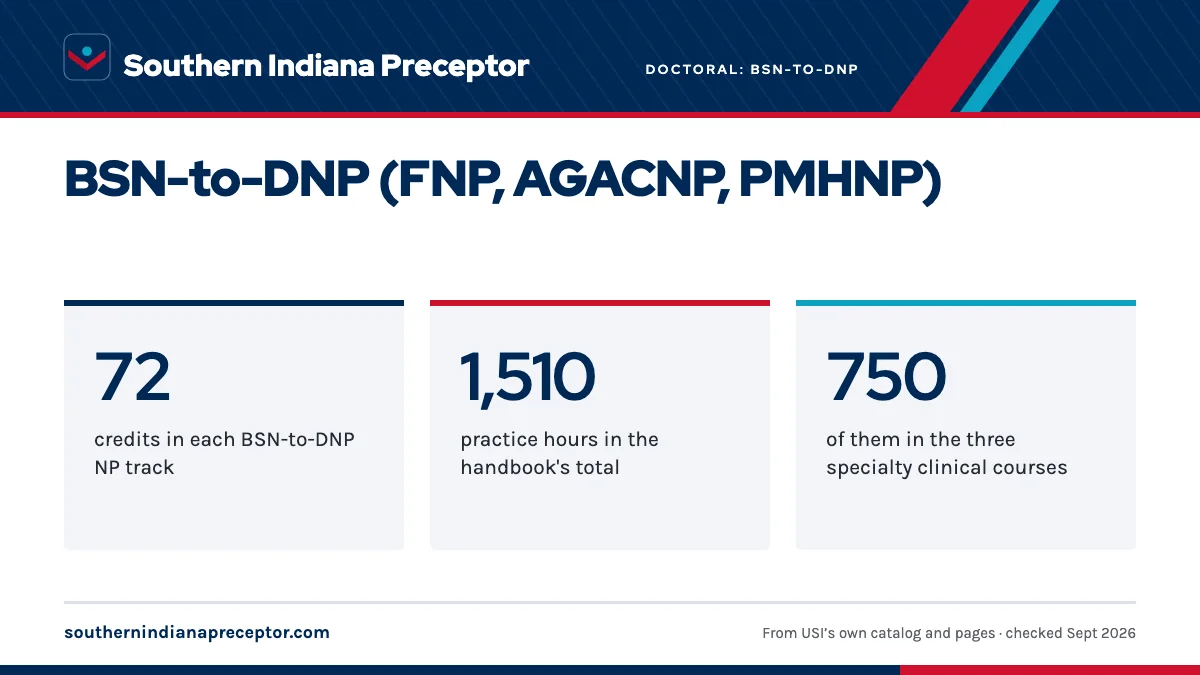
The University of Southern Indiana's online BSN-to-DNP takes a BSN-prepared nurse straight to the Doctor of Nursing Practice in family (FNP), adult-gerontology acute care (AGACNP) or psychiatric mental health (PMHNP) practice. It is 72 credits and 1,510 practice hours: 750 in the 800-level specialty courses, 260 embedded in core courses and 500 in the DNP project.
Plan your DNP clinicals
Your track, your city and your specialty start year are enough to begin.
How the 72 credits are built
BSN-to-DNP students do not pick up an MSN on the way; the bulletin says they proceed directly from the BSN to the doctorate. The plan has four blocks, and only the specialty block changes with your track.
| Block | Courses | Credits |
|---|---|---|
| Nursing courses | NRSG 601, NRSG 602, NRSG 603, NRSG 701 to NRSG 715, NRSG 807, NRSG 809 | 36 |
| Clinical core | NRSG 621, NRSG 622, NRSG 623 | 9 |
| DNP project | NRSG 801, NRSG 803, NRSG 805 (Pass/No Pass) | 8 |
| Specialty | Four 800-level courses for your track | 19 |
| Total | 72 |
The Organizational and Systems Leadership route shares the nursing and project blocks but has no NP specialty and totals 70 credits; it has its own page. Post-MSN nurses follow a separate 35-credit plan on the post-MSN DNP page.
The 800-level specialty courses
USI's handbook spells out the numbering: 600-level courses indicate the MSN and 800-level courses the DNP. Each BSN-to-DNP specialty course is the twin of an MSN course, with the same direct hours, the same setting language and the same preceptor rule, and the introductory courses carry "for BSN to DNP" in their titles.
| Track | Intro (Summer) | I (Fall) | II (Spring) | III (Summer) |
|---|---|---|---|---|
| FNP | NRSG 841 | NRSG 843: 200 | NRSG 845: 250 | NRSG 847: 300 |
| AGACNP | NRSG 831 | NRSG 833: 200 minimum | NRSG 835: 250 minimum | NRSG 837: 300 minimum |
| PMHNP | NRSG 851 | NRSG 853: 200 | NRSG 855: 250 | NRSG 857: 300 |
One catalog quirk: the 2026-27 entry for NRSG 843 lists NRSG 641, the MSN introductory course, as its prerequisite instead of NRSG 841. Follow your plan of study, not that line. The MSN course pages describe each semester in more depth, for example NRSG 653 for the psychiatric track.
Where the 1,510 hours come from
The handbook's DNP page builds the total from three sources. The national floor for any DNP is 1,000 post-baccalaureate practice hours; the NP specialty is what carries the BSN-to-DNP well past it.
| Source | Courses and hours | Hours |
|---|---|---|
| Specialty clinical courses | Specialty I 200, II 250, III 300 | 750 |
| Embedded in core courses | NRSG 703 25, NRSG 709 50, NRSG 711 40, NRSG 715 30, NRSG 807 40, NRSG 809 75 | 260 |
| DNP project | NRSG 801 125, NRSG 803 200, NRSG 805 175 | 500 |
| Total | 1,510 |
Specialty hours are logged in Typhon with preceptor co-signatures, as in the MSN. Project hours go on USI's DNP hour-tracking record with each activity, its date and the objectives it meets. The DNP practice hours page compares every DNP route and flags where USI's own figures disagree.
Preceptors by track
Each specialty has its own preceptor rule on the Course Requirements page, and it applies to the 800-level course exactly as to its 600-level twin.
Who may precept each specialty
- FNP: family nurse practitioners, physician assistants and primary care physicians in
NRSG 843; specialty NPs, PAs and physicians are added forNRSG 845andNRSG 847. - AGACNP: NPs, PAs, MDs or DOs working in acute care, and every AGACNP student must hold current ACLS.
- PMHNP: a PMHNP or a licensed psychiatrist only, with no physician assistants.
Across all three tracks, a preceptor's license must carry no encumbrance, their specialty certification must be current, they need one year or more as an advanced provider, and they sign USI's agreement; relatives and partners are ruled out. For NPs and PAs, the board certification has to match your own specialty track. The Preceptor Packet covers only the course and term it lists, and it is due 6 weeks before the rotation, so the paperwork repeats through the specialty year. The preceptor requirements page has the details.
The DNP project and your practice partner
Alongside the specialty preceptors, USI pairs each DNP student with a primary faculty mentor, and you recruit one or more practice partners to work on the project with you both. The partner is named on a form kept in Blackboard, and the proposal has to clear USI's review committee and IRB requirements before anything is implemented.
Completion is due by the close of NRSG 805, and graduation requires a proposal poster, an Executive Summary and a dissemination step, either a conference talk or a journal submission. For BSN-to-DNP NP students the partner is a separate search from the three specialty preceptors, possibly at a different organization. The practice partner page walks through it.
Pace, intensives and progression
Entry is once a year, in August; the program page shows August 2027 (applications by July 2027) and August 2028, and estimates 4 to 5 years to finish. Coursework is online, with virtual synchronous intensives whose attendance the handbook makes mandatory. A 2022 version of USI's page described four years full time or five part time and said clinical hours were completed in the final year; confirm the current timing on your plan of study.
Applicants bring a BSN, a GPA of 3.00 or more, an undergraduate statistics course at C level or higher, and RN licensure without encumbrance in every state of practice, and USI recommends, without requiring, a year of full-time RN experience. Once enrolled, every course needs a B or better. A BSN-to-DNP student can withdraw twice, but a third withdrawal halts progression, and all withdrawals within one semester count as one.
States and licensure for the DNP NP tracks
The BSN-to-DNP NP tracks carry the longest Enrollment Not Allowed list of any USI graduate program. The FNP, AGACNP and PMHNP doctoral rows of the disclosure table read the same way.
| Column or issue | States |
|---|---|
| Enrollment Not Allowed | AL, AZ, CO, DE, LA, MA, MN, MS, NV, NY, OK, OR, PA, SD, WA, WY, plus DC, AS, GU, CNMI and PR |
| Listed as both Meets and Does Not Meet | ND |
| Banned but in neither licensure column | CO |
North Dakota is the puzzle: the table marks it as meeting and as not meeting requirements for these tracks, yet it stays off their ban list. Read the live licensure disclosure and get confirmation from USI before you commit several years to the program.
A four- or five-year doctorate leaves more time for life to change than a shorter MSN. Tell the Program Chair and APRN Director about any planned relocation first: only active military status is exempt from the rule that a move to an unrecognized state halts coursework.
Why BSN-to-DNP students choose us
A BSN-to-DNP NP track asks for three specialty preceptors across a Fall, Spring and Summer, plus a practice partner for the project, possibly years after you first enroll. Our placement desk plans the whole run with you: the right preceptor type for your track (family, acute care or psychiatric), near where you live in one of USI's enrollment states, screened against USI's license, certification and experience rules.
Each specialty course gets its own complete file: preceptor license and DEA numbers, board certification, the site survey and the agreement signer, typed and sent well before USI's 6-week cutoff. We can also search for an organization and practice partner to host your DNP project, and we remain available through every semester if a preceptor withdraws. Tell us your track and city using the form below.
Questions USI students ask
Will I receive an MSN partway through USI's BSN-to-DNP?
No. The 2026-27 Graduate Bulletin says BSN-to-DNP students proceed directly from the BSN to the Doctor of Nursing Practice without being awarded an MSN. Your specialty courses carry 800-level numbers but the same 750 direct hours as the MSN versions, and your transcript shows one degree: the DNP.
Are the BSN-to-DNP clinical courses the same as the MSN ones?
In clinical terms, yes. Each 800-level course pairs with a 600-level MSN course, and USI's handbook gives the pair the same direct hours and preceptor rules: NRSG 853 matches NRSG 653, for example. The introductory courses differ in title, and the DNP adds 760 more practice hours in core and project courses around the specialty.
When do BSN-to-DNP clinical hours start?
USI publishes no current sample plan, and an older 2022 page said clinical hours fell in the final year. The course terms set the order: the introductory specialty course and NRSG 623 in a Summer, then Specialty I in Fall, II in Spring and III in Summer. Your plan of study shows which year that sequence begins for you.
Can I switch BSN-to-DNP tracks, for example from FNP to PMHNP?
USI's progression policies route a change of specialty through a written request to the Graduate Chair and APRN Director. Approval depends on the program, and a switch changes both your specialty courses and your preceptor rules: the PMHNP track accepts only PMHNPs and psychiatrists. Ask before your first specialty course, since each one runs in a single term.
Is there an on-campus residency in the BSN-to-DNP?
The handbook describes virtual synchronous intensives rather than a campus residency, and it makes attendance mandatory. USI's APRN pages add that a student can be called to campus to show clinical competency, so plan for the intensives and keep a campus visit in mind as a possibility, not a fixed event.
Related pages
Last checked 2026-09-25
We check these pages against USI's own bulletin, program pages and Graduate Nursing Handbook. Your handbook, course faculty and the Nursing Clinical Coordinator have the final word.
- University of Southern Indiana 2026-2027 Graduate Bulletin: DNP, Family Psychiatric Mental Health NP (BSN to DNP)
- University of Southern Indiana 2026-2027 Graduate Bulletin: DNP, Family Nurse Practitioner (BSN to DNP)
- University of Southern Indiana Graduate Nursing Handbook: BSN-DNP and Post MSN-DNP
- University of Southern Indiana Graduate Nursing Handbook: Course Requirements
- University of Southern Indiana Professional Licensure Disclosure
USI makes the search your job. We make it the easy part.
Tell us your USI track, your city and your next clinical semester. We find preceptors who fit the NRSG course and fill the Preceptor Packet and Clinical Education Agreement request with typed, complete details, well before USI's 6-week window.
- Preceptors matched to the course: family primary care for FNP, acute care teams for AGACNP, PMHNPs and psychiatrists for PMHNP
- Preceptor license, certification, years of practice and the site's agreement signer ready for the packet
- Fall, Spring and Summer planned together, close to home in a state USI enrolls
Start your placement plan
Track, city and clinical start is all we need to begin.