USI BSN-to-DNP Organizational and Systems Leadership: 1,005 hours and your practice partner
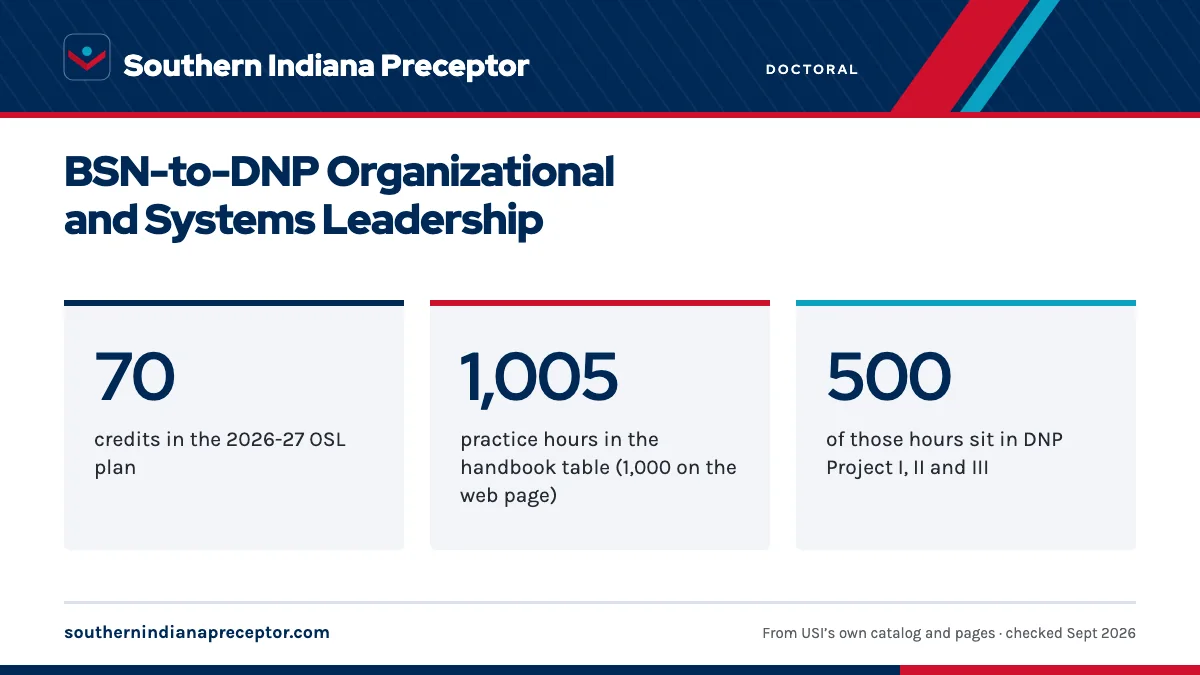
The University of Southern Indiana's BSN-to-DNP in Organizational and Systems Leadership (OSL) takes a BSN-prepared nurse to a practice doctorate in 70 credits, with no MSN awarded along the way. The Graduate Nursing Handbook counts 1,005 practice hours across coursework, NRSG 761, the NRSG 867 practicum and three DNP project courses, while the program's web page says 1,000. You identify the practice partner for your project; USI assigns your faculty mentor.
Plan your OSL practice hours
Tell us your state, your cohort year and where you hope to run your DNP project.
The program in brief
OSL is one of four BSN-to-DNP routes at USI and the only one that does not prepare you as a nurse practitioner. The bulletin is clear that no master's degree is conferred on the way: you move from the BSN straight to the practice doctorate, and every course requires a B or better.
Admission is offered once a year, with an August start (August 2027, applications by July 2027), and USI's web page estimates four to five years to finish. Applicants bring a bachelor's in nursing, a GPA of at least 3.00, a statistics course passed at C or above and an RN license with no encumbrances in each state where they practice; a year of full-time RN work is recommended but not required.
Coursework is online, with virtual synchronous intensives that the handbook makes mandatory. The 2026-27 rebuild cut OSL from 78 credits to 70 and moved every course to the NRSG prefix.
| Block | Courses | Credits |
|---|---|---|
| BSN to DNP nursing courses | NRSG 601, 602, 603, 701, 703, 705, 707, 709, 711, 713, 715, 807, 809 | 36 |
| Clinical core | NRSG 761 Advanced Nursing Core Concepts for BSN to DNP (3); NRSG 867 OSL Practicum Experience (2) | 5 |
| DNP project | NRSG 801 DNP Project I; NRSG 803 DNP Project II; NRSG 805 DNP Project III | 8 |
| Specialty | MHA 624, 633, 637 and 643; NRSG 861 Systems-Based Marketing and Innovations in Nursing; NRSG 863 Advanced Organizational Leadership in Healthcare and Nursing; NRSG 865 Strategic Project Management in Nursing | 21 |
Where the 1,005 hours come from
USI sets a floor of 1,000 practice hours after the bachelor's degree for every DNP. Students entering after an MSN can carry as many as 500 hours over, but you enter with a BSN, so the OSL route builds every hour inside the program. The handbook's "Concentration / Total Hours" table spells out where each block sits.
| Group | Courses and hours | Subtotal |
|---|---|---|
| Shared DNP courses | NRSG 703: 25; NRSG 709: 50; NRSG 711: 40; NRSG 715: 30; NRSG 807: 40; NRSG 809: 75 | 260 |
| OSL clinical and specialty | NRSG 761: 40; NRSG 861: 30; "NRSG 856" (as printed): 75; NRSG 867: 100 | 245 |
| DNP project | NRSG 801: 125; NRSG 803: 200; NRSG 805: 175 | 500 |
| Handbook total | 1,005 |
Two details in that table conflict with other USI pages. The OSL web page describes the program as "70 credit hours with 1,000 practice hours," five short of the handbook total. And the 75-hour row names "NRSG 856," which is not an OSL course: the OSL specialty and practicum courses are numbered 861, 863, 865 and 867. NRSG 865 is the probable intent, though no USI page confirms it, so ask your faculty mentor or the Graduate Chair and APRN Director which course carries those hours. For a side-by-side view of all the doctoral routes, see DNP practice hours.
NRSG 761 and NRSG 867: the clinical core
NRSG 761 is a 3-credit Summer course that the handbook pairs with the MSN's NRSG 661: both require 40 hours of direct care clinical in acute care, long-term care or community clinics. Those hours need a supervisor, a Preceptor Packet and a site agreement like any graduate clinical, and the NRSG 661 page covers the setting and approval questions in detail.
NRSG 867 OSL Practicum Experience is the 2-credit Summer course where "students will implement the approved culminating project proposal developed in NRSG 865." The handbook assigns it 100 hours. Because NRSG 865 Strategic Project Management runs in Spring and is a prerequisite, it makes sense to plan the project in Spring with the same organization that will host it in Summer.
In 2025-26 the culminating course was NURS 838 Nursing Leadership and Management Culminating Practicum. Older plans of study and student notes that mention NURS 838 describe the retired version of the program.
Your practice partner and faculty mentor
USI splits project support between two people. The handbook pairs every DNP student with a primary faculty mentor chosen by USI, and leaves the practice partner, the person or people at the host organization who collaborate on the project, for the student to identify. The partner is yours to find.
Every DNP student completes the DNP Project Practice Partner form, which is posted in Blackboard and asks for the partner's academic credentials and relationship to you, and must follow the terms of that agreement at the project site. A 2016 USI schedule asked for the form by the end of DNP Project I, so line up your partner before NRSG 801 finishes.
The proposal then goes to the DNP Project Proposal Review Committee and must meet IRB requirements before implementation. To graduate, you finish the project by the end of NRSG 805, present a poster of the proposal in NRSG 803, write an Executive Summary and disseminate the work through a peer-reviewed conference presentation or a journal manuscript. The practice partner page covers the form and the committee timeline.
Your practice partner is part of the project's approval, not a formality: choose an organization that can support the work from proposal through implementation in NRSG 867.
Logging, withdrawals and transfer credit
The handbook requires every hour completed in project courses to be recorded: what you did, when, which course objectives and program outcomes it served, and which DNP Essentials it addresses. Keep the log as you go; rebuilding a semester of leadership work from memory is much harder than writing it down weekly. Typhon is also a required one-time purchase for all graduate nursing students.
Two policies are more generous for BSN-to-DNP students than for the MSN. You can progress with up to two course withdrawals, against one in the MSN, and several withdrawals in one term are treated as one event. Up to 40% of the program's total credit hours may transfer in from another nationally and regionally accredited nursing program.
Enrollment limits for OSL
USI's Professional Licensure Disclosure treats OSL as a program that does not lead to licensure: both licensure columns read "N/A," even though the certificate cell says "Advanced Practice Registered Nurse," a mismatch the table leaves unexplained. The OSL row's "Enrollment Not Allowed" cell names eight states: Colorado, Delaware, Minnesota, Mississippi, New York, Oklahoma, Pennsylvania and Wyoming, plus DC, American Samoa, Guam and the Northern Mariana Islands.
That is the shortest list among USI's graduate rows. Residents of Alabama, Arizona, Louisiana, Massachusetts, Nevada and Washington, who are barred from the MSN leadership tracks, do not appear on it. The licensure disclosure page lays out every row and conflict.
Wherever your project and NRSG 761 hours happen, your RN license has to be valid and unencumbered there. USI's Alaska policy exempts only the HSL and NEL tracks from Alaska Board prior authorization, so OSL students living there should ask the program how the policy applies to them.
Why OSL students choose us
An OSL doctorate needs two very different placements: a direct care site for NRSG 761 and an organization willing to host a doctoral project from proposal to implementation. We find both near you, and we look for a practice partner whose credentials and role will read well on USI's Practice Partner form and in front of the review committee.
We collect every field the Preceptor Packet needs and the details the agreement request asks each organization to provide, confirm who signs there, and time your submissions around the Spring and Summer sequence of NRSG 865 and NRSG 867. Everything reaches USI typed, complete and early.
Doctoral projects run over several semesters, and people change jobs. If your partner or supervisor moves on, your placement advisor lines up someone new to carry the project forward. Tell us your state and cohort year with the form below.
Questions USI students ask
Do USI BSN-to-DNP OSL students earn an MSN along the way?
No. USI's 2026-27 bulletin is explicit that this route skips the master's degree entirely, so the DNP is the only degree you receive. If you want a master's degree first, USI's MSN in Healthcare Systems Leadership is a separate 36-credit program, and a post-MSN DNP in OSL is available afterward.
Are the OSL intensives held on the Evansville campus?
No published intensive is on campus. The handbook describes a hybrid delivery with live virtual intensives and makes each one compulsory, while the web page calls the program 100% online. Both describe live online sessions, so plan work and time-zone conflicts around them rather than travel.
Can my practice partner be someone at my own employer?
USI publishes no rule against it. The Practice Partner form has a line for how the partner is related to you, which lets faculty judge the arrangement, and USI's preceptor rules, which bar relatives and anyone in a relationship with the student, are a sensible guide here too. Discuss a workplace partner with your faculty mentor before you submit the form, and make sure the project serves the organization beyond your normal duties.
Does the OSL doctorate prepare me for APRN licensure?
No. OSL is a leadership doctorate, and USI's licensure table marks both of its licensure columns "N/A." The row's certificate cell says "Advanced Practice Registered Nurse," which conflicts with those columns, so if licensure matters to your plans, get the program's answer in writing. The BSN-to-DNP FNP, AGACNP and PMHNP routes are the ones built for APRN licensure.
When do OSL students do their practice hours?
They are spread across the program. Six shared DNP courses carry embedded hours, NRSG 861 falls in Fall, NRSG 761 and NRSG 867 in Summer, and the three project courses, offered Fall and Spring, hold 500 hours between them. Map your plan of study against the handbook table early so no term surprises you.
Related pages
Last checked 2026-09-25
We check these pages against USI's own bulletin, program pages and Graduate Nursing Handbook. Your handbook, course faculty and the Nursing Clinical Coordinator have the final word.
- University of Southern Indiana 2026-2027 Graduate Bulletin: BSN to DNP, Organizational and Systems Leadership
- University of Southern Indiana Graduate Nursing Handbook: BSN-DNP and Post MSN-DNP
- University of Southern Indiana: Doctor of Nursing Practice, Organizational and Systems Leadership (BSN to DNP)
- University of Southern Indiana 2026-2027 Graduate Bulletin: NRSG 867 OSL Practicum Experience
- University of Southern Indiana DNP Project Practice Partner Form
USI makes the search your job. We make it the easy part.
Tell us your USI track, your city and your next clinical semester. We find preceptors who fit the NRSG course and fill the Preceptor Packet and Clinical Education Agreement request with typed, complete details, well before USI's 6-week window.
- Preceptors matched to the course: family primary care for FNP, acute care teams for AGACNP, PMHNPs and psychiatrists for PMHNP
- Preceptor license, certification, years of practice and the site's agreement signer ready for the packet
- Fall, Spring and Summer planned together, close to home in a state USI enrolls
Start your placement plan
Track, city and clinical start is all we need to begin.