USI MSN Healthcare Systems Leadership: mentors, the capstone project and 240 hours
The University of Southern Indiana's online MSN in Healthcare Systems Leadership is a 36-credit track built around a single leadership project. You start it with mentors and interprofessional teams in NRSG 671 in Spring and complete and present it in NRSG 673 in Summer, after 40 direct care hours in NRSG 661 in Fall. The handbook puts the track at 240 practice hours, but the practicum courses print none, so settle the hour plan with faculty before you pick a host.
Plan your HSL placements
Tell us your state, your start term and the kind of organization you want to lead in.
How the 36 credits are built
Healthcare Systems Leadership is a 100% online track with starts listed for January, May and August. USI's web page divides it into 16 credits of nursing core, an 8-credit clinical core and 12 credits of electives, and every course needs a B or better.
The track leans on health administration. MHA 643 Healthcare Finance sits in the clinical core and all four electives come from USI's MHA list, so 15 of your 36 credits are MHA courses. The clinical core is where placements happen: NRSG 661 for direct care, then the two HSL practicums.
Admission follows the general MSN rules in the 2026-27 Graduate Bulletin: an accredited BSN, a 3.0 GPA, undergraduate statistics at C or better, an unencumbered RN license, and a strong recommendation for about a year of RN practice first.
| Block | Courses | Credits |
|---|---|---|
| Nursing core | NRSG 601 through NRSG 606 | 16 |
| Clinical core | MHA 643 Healthcare Finance (3); NRSG 661 Advanced Nursing Core Concepts (3, Fall); NRSG 671 HSL Practicum I (1, Spring); NRSG 673 HSL Practicum II (1, Summer, after NRSG 671) | 8 |
| Electives | Four of MHA 621, 624, 625, 626, 628, 633, 637 or 655 | 12 |
One project, two practicums
The bulletin describes NRSG 671 HSL Practicum I as an "immersive, hands-on experience in healthcare systems leadership" in which students work with mentors and interprofessional teams to begin developing a leadership project. NRSG 673 HSL Practicum II, listed as "0-1 (Clinical)" and open only after NRSG 671, is where you complete that project and present it as a capstone.
That design has a practical consequence. The organization and mentor you choose in Spring ideally stay with you into Summer, because a project started in one place is hard to finish in another. A mentor who can commit to both terms is worth more to this track than a better-known leader who can offer only one.
The paperwork, though, is per course. USI's Preceptor Packet (Form G) is valid only for the course and term written in Part One, so even a mentor who hosts you for both practicums signs a new packet for NRSG 673. The Preceptor Packet page lists what each one needs.
240 hours and the gap in the course pages
The Graduate Nursing Handbook's Specialty Track Overview says of this track: "There are a total of 240 practice hours." Forty of them belong to NRSG 661, whose direct care requirement is printed on the Course Requirements page. The other 200 are not tied to any course in the bulletin or the handbook, and neither practicum lists an hour figure.
Treat that as a conflict between USI's pages and ask before you plan. Course faculty or the Nursing Clinical Coordinator can tell you what NRSG 671 and NRSG 673 each expect, and a mentor will want that number before agreeing to a schedule. The clinical hours page shows how the leadership figures sit beside the other programs.
The structure itself is new. Until 2023-24 the track was named Nursing Management and Leadership, and through 2025-26 its clinical core was just 6 credits, MHA 643 plus the direct care course then numbered NURS 648, with no practicums at all. The overview also notes that the track is currently offered only as an MSN.
Get the per-practicum hour expectation from faculty before a mentor sets aside time for you.
Choosing a mentor and a host organization
USI's course descriptions call HSL supervisors "mentors" and publish no credential rule for them. The handbook's general preceptor standard, built around nurse practitioner tracks, asks for specialty certification and a year as an advanced provider, and no page says how that translates to a leadership mentor.
Some parts apply to every preceptor as written. The mentor cannot be a relative or someone you are in a relationship with, and the organization needs a signed Clinical Education Agreement with USI before your hours start. Before you commit, describe the mentor's role and background to course faculty and ask whether it fits the practicum.
Look for a host where interprofessional leadership work is actually happening, since the course asks you to work alongside teams rather than observe a single manager. Ask usi1nursing@usi.edu early whether USI already has an agreement with the organization; if it does, one step of your approval is already done.
A year of HSL placements, in order
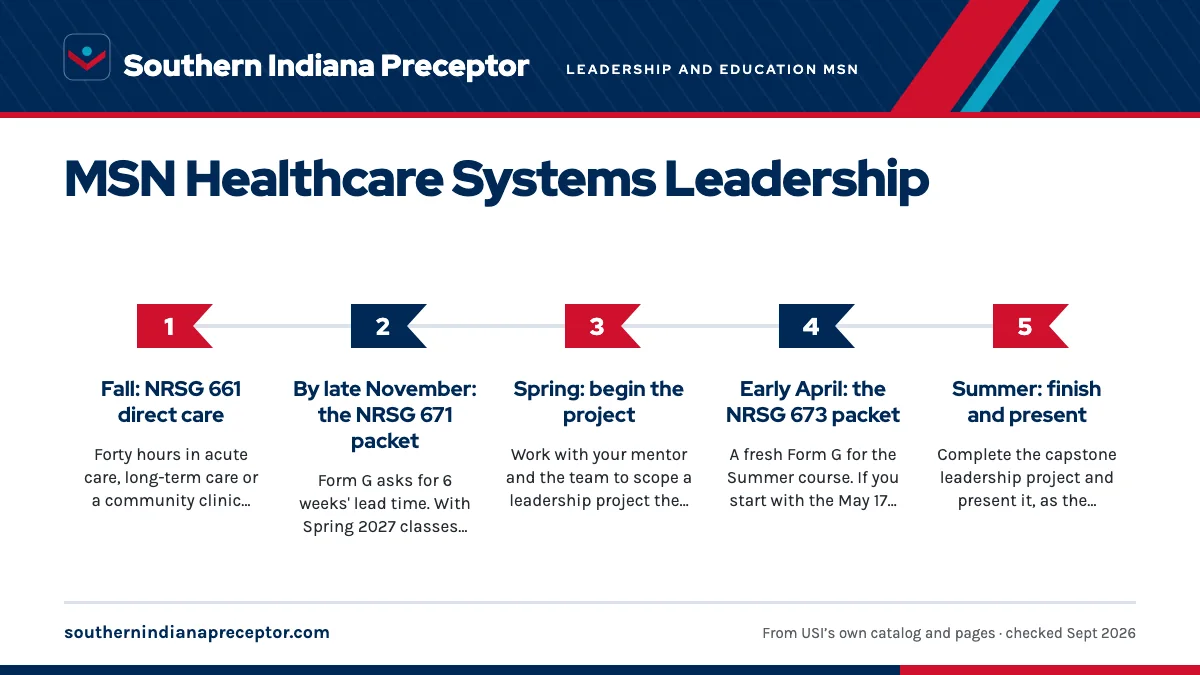
- Fall: NRSG 661 direct careForty hours in acute care, long-term care or a community clinic, approved through the same packet process; see the NRSG 661 page.
- By late November: the NRSG 671 packetForm G asks for 6 weeks' lead time. With Spring 2027 classes beginning January 11, a rotation starting in week one needs its packet in by about November 30.
- Spring: begin the projectWork with your mentor and the team to scope a leadership project the organization will support through Summer.
- Early April: the NRSG 673 packetA fresh Form G for the Summer course. If you start with the May 17 session, six weeks earlier is about April 5.
- Summer: finish and presentComplete the capstone leadership project and present it, as the course description requires.
Approval for each term comes from the Graduate Clinical Liaison, and no hours count until the program's confirmation email arrives. If you live in Alaska, the leadership tracks are spared one step that APRN students face: no advance authorization from the Alaska board is needed for HSL practicums.
State limits for the leadership MSN
The HSL row of USI's Professional Licensure Disclosure reads "N/A" for licensure, since the degree does not prepare you for an APRN license. Its "Enrollment Not Allowed for Residents of These States" cell still bars residents of 13 states, DC and the territories, and Nursing Education Leadership shares the identical list. Recheck the row before any move, since USI revises it.
If you live in one of those states, or plan to move to one, the licensure disclosure page shows how the table was built and where it contradicts itself. Each practicum site also requires an unencumbered RN license in its state, and your clearance items, from the background check and drug screen to BLS and annual HIPAA and OSHA training, must be on file before your first placement.
Why HSL students choose us
HSL placements reward planning across the whole year, and that is how we work. We find a direct care site for NRSG 661, then an organization and mentor prepared to carry your leadership project from NRSG 671 through the capstone in NRSG 673, so you build one project in one place.
We confirm the mentor background your course faculty will accept, gather what Form G and the agreement request ask for, and identify who signs affiliation agreements at the organization. Your packets for each term go in complete and typed, with time to spare before the 6-week mark.
If a mentor changes roles or leaves, your placement advisor finds a replacement who can pick up the project and helps you rebuild the paperwork. Tell us your state and start term with the form below.
Questions USI students ask
Is Healthcare Systems Leadership the same as USI's old Nursing Management and Leadership track?
It is the renamed successor. The 2023-24 Graduate Bulletin listed the MSN in Nursing Management and Leadership under its new name, Healthcare Systems Leadership, and the 2026-27 rebuild added the two practicums and moved the courses to NRSG numbers. The credit total stayed at 36, but the clinical core grew from 6 credits to 8.
Can I study Healthcare Systems Leadership at the doctoral level?
Not under that name. The handbook's track overview says HSL is currently offered only in the MSN program. USI's doctoral leadership route is Organizational and Systems Leadership, offered as a BSN-to-DNP and a post-MSN DNP, and the BSN-to-DNP OSL page covers its practice hours and project.
Do HSL students buy i-Human or the Barkley Board Review?
Those purchases are tied to the nurse practitioner tracks: i-Human for the APRN assessment and specialty courses, and the Barkley Board Review during Specialty II. The handbook does make Typhon a one-time purchase for students in every graduate nursing program, with access for up to five years after graduation.
Can my HSL leadership project be based at my own employer?
USI has no written rule against an employer host, and its placement help asks students who are stuck whether their workplace offers an option. The project still needs an approved mentor, a Clinical Education Agreement and a purpose beyond your regular job, since the FAQ says clinical sites are not for workplace orientation. Raise the plan with course faculty before you begin.
Which electives count toward the HSL MSN?
You take four 3-credit courses from USI's approved MHA list: MHA 621, 624, 625, 626, 628, 633, 637 or 655. The bulletin lists each course's title, so check when your picks are offered as you plan around NRSG 671 and NRSG 673, which fall in Spring and Summer.
Related pages
Last checked 2026-09-25
We check these pages against USI's own bulletin, program pages and Graduate Nursing Handbook. Your handbook, course faculty and the Nursing Clinical Coordinator have the final word.
- University of Southern Indiana 2026-2027 Graduate Bulletin: MSN Healthcare Systems Leadership
- University of Southern Indiana: MSN Healthcare Systems Leadership program page
- University of Southern Indiana Graduate Nursing Handbook: Specialty Track Overview
- University of Southern Indiana 2026-2027 Graduate Bulletin: NRSG 671 HSL Practicum I
- University of Southern Indiana 2026-2027 Graduate Bulletin: NRSG 673 HSL Practicum II
USI makes the search your job. We make it the easy part.
Tell us your USI track, your city and your next clinical semester. We find preceptors who fit the NRSG course and fill the Preceptor Packet and Clinical Education Agreement request with typed, complete details, well before USI's 6-week window.
- Preceptors matched to the course: family primary care for FNP, acute care teams for AGACNP, PMHNPs and psychiatrists for PMHNP
- Preceptor license, certification, years of practice and the site's agreement signer ready for the packet
- Fall, Spring and Summer planned together, close to home in a state USI enrolls
Start your placement plan
Track, city and clinical start is all we need to begin.