The Clinical Education Agreement: the contract only your site can sign
Before the University of Southern Indiana approves a clinical site, the site signs a Clinical Education Agreement with the university. You start it with a one-page form, the Request for USI Clinical Education Agreement (once called the Memorandum of Understanding), but the contract itself goes from USI straight to the person the site names. Students may not sign it, so finding that person early is what keeps a rotation on schedule.
Get your placement plan
Tell us your USI program and where you live. A placement advisor replies with the preceptor and site options that fit your course.
The request form is not the agreement
The PDF you download is a request, and it says so plainly: "This is not the actual agreement." USI builds the real contract from the details on the form, titles it the Clinical Education Agreement, and emails it to the person the form names for review and signature. USI has to hold that signed contract before it approves the site for your clinical experience.
The request therefore does two jobs. It tells USI which organization the contract is with, and it tells USI who inside that organization can sign. Get either wrong and the contract lands on the wrong desk, or sits with someone who has no authority to act on it.
The same rule appears in two other places. Every 2026-27 Graduate Bulletin program page requires a written agreement with each agency before clinical experiences begin. The handbook's University Clinical Requirements page describes a formal clinical application process that includes a written affiliation agreement completed by the agency.
Who completes it and who signs
Part 2 of the request belongs to the site. The practice's office manager or education coordinator fills it in, and it names the person who signs affiliation agreements for that organization. In a small independent practice that may be the owner or even the preceptor. In a clinic owned by a health system it can be someone in a central office the preceptor has never met.
That difference matters. A preceptor's yes covers their own Preceptor Agreement in Part Five of the Preceptor Packet. It does not commit the organization. The organization's signer decides whether USI's contract is acceptable, and works to the organization's own schedule, not the semester's.
The handbook step that has you leave the packet with the preceptor also asks for both the Preceptor Agreement and the agreement request to be signed and returned to you. It adds a message to pass on: the clinical experience cannot begin until the paperwork is complete and back with the Graduate Nursing Program.
Why students cannot sign it
The request form ends with a line in capitals: "Students are NOT at liberty to sign the agreement." The form offers no exception. The rule holds if you are employed at the site, if you manage the unit, and if a busy signer suggests you sign for them to save time (clinicals where you work).
The logic is simple. The handbook describes this contract as an agreement between the university and the facility. A student is the person the arrangement is about, not one of the two organizations making it. Your own commitments live elsewhere: the Graduate Professional Behavior Agreement you initial, and the compliance record you keep current in CastleBranch (now DISA).
What you can do is make the signer's job easy. Return the request complete, double-check the spelling of the signer's email address, and let the office manager know a message from USI is on its way so it is expected rather than overlooked.
When the site already has an agreement with USI
Ask USI before you ask the site for anything. The Preceptor Packet Instructions page tells students to check with usi1nursing@usi.edu whether an agreement between the university and the facility is already in place. If one is, tell the office manager, because a new contract may not be needed.
Form G's office-use box shows how USI keeps track. Beside CEA it records whether the agreement renews automatically and when it expires. An agreement that covered another USI student some years ago may have lapsed, and a practice inside a larger system may or may not sit under a system-wide contract. Only the program can say which, so ask rather than assume.
Some health systems add their own student intake on top of the school contract. Deaconess, for example, states on its own site that NP programs need an active affiliation agreement with Deaconess and that it is not currently pursuing new affiliations. Rules like these are set by each system, and the Evansville preceptors page walks through the ones published across the tri-state.
One contract, several names
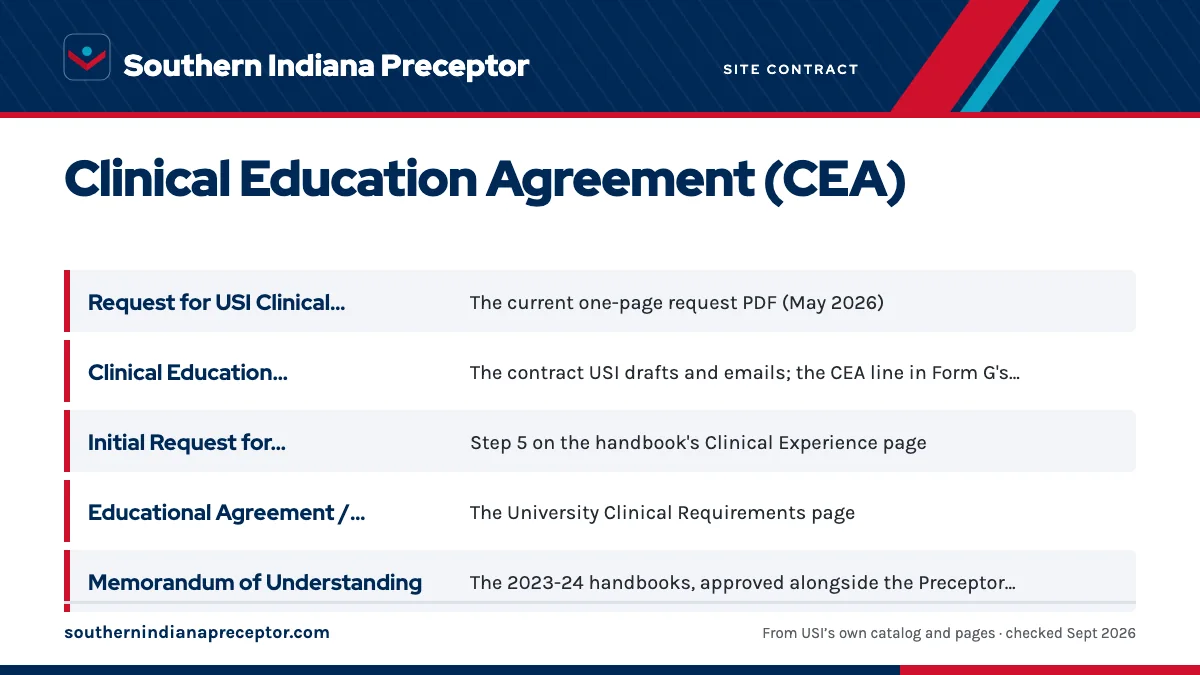
USI's documents have called this contract by several names over the years, sometimes on the same page. They all point to the same step: a signed agreement between USI and the organization that hosts you.
| Name used | Where it appears |
|---|---|
| Request for USI Clinical Education Agreement, "Formerly Known as Memorandum of Understanding" | The current one-page request PDF (May 2026) |
| Clinical Education Agreement (CEA) | The contract USI drafts and emails; the CEA line in Form G's office-use box |
| Initial Request for Clinical Educational Agreement (MOU/Affiliation Agreement) | Step 5 on the handbook's Clinical Experience page |
| Educational Agreement / Memorandum of Understanding / Clinical Affiliation | The University Clinical Requirements page |
| Memorandum of Understanding | The 2023-24 handbooks, approved alongside the Preceptor Agreement |
| A written agreement with each agency | The 2026-27 Graduate Bulletin program pages |
If an office manager recalls signing an MOU with USI in the past, it is the same family of document. Send the facility name and the approximate date to usi1nursing@usi.edu so the program can confirm whether it is still current.
Timing: the contract runs on the site's clock
The request travels in the same email as Form G, so it shares Form G's deadline of 6 weeks before the rotation starts. Sending it only opens the process. USI then drafts the contract, emails it to the signer and waits for it to come back signed, and the handbook gives no processing time for any of those stages.
Two handbook lines show how much weight USI puts on this. The Clinical Experience page asks you to tell course faculty or the Nursing Clinical Coordinator, at least 6 weeks before the course, if you have no preceptor or no Clinical Education Agreement contact. And the email that clears you to start goes out only after both the packet and the agreement are approved. A willing preceptor at a site whose signer cannot be found is not yet a placement in USI's eyes. The deadlines page sets out the dates for 2026-27.
How we get the agreement contact right the first time
Our placement desk treats the signer as part of the placement, not a detail for later. As soon as a preceptor agrees to take a USI student, we put the Part 2 questions to the office manager or education coordinator: the organization's legal name, whether the practice sits inside a larger entity, and the name and email of the person who signs affiliation agreements. We also flag when a facility may already hold a USI agreement, so you can confirm it with usi1nursing@usi.edu before anyone fills in a fresh request.
What you get is a request that points USI at the right person on the first try, sent with a complete Preceptor Packet well inside the 6-week window. USI drafts and signs its side, the site signs its side, and your role stays exactly what USI's form describes. See how our process runs.
Questions USI students ask
Is the Clinical Education Agreement the same as the USI MOU?
Yes. The current request form is titled Request for USI Clinical Education Agreement and carries the note that it was formerly known as the Memorandum of Understanding. Older handbooks, preceptors and office managers may still say MOU or affiliation agreement. The contract USI drafts from the request is titled Clinical Education Agreement, and that is the name to use in emails to the program.
Can my preceptor sign the Clinical Education Agreement?
Only if the site names them as the person who signs affiliation agreements. Part 2 of the request, completed by the office manager or education coordinator, identifies that signer, and USI emails the contract to that person. In a practice the preceptor owns, that may well be the preceptor. In a larger organization it may be an administrator or a legal office, and the preceptor's own signature goes on the Preceptor Agreement instead.
Does my clinical site need a new agreement every semester?
Not necessarily. USI records on Form G whether a site's agreement renews automatically and when it expires, which suggests many agreements outlast a single semester. Whether yours does depends on the specific contract. Before a new request goes out, email usi1nursing@usi.edu and ask whether the facility already has a current agreement with the university.
What happens if a site will not sign USI's agreement?
USI must receive the signed agreement before it approves the site, so hours there cannot begin without one. If the signer declines or stops responding, tell course faculty or the Nursing Clinical Coordinator promptly; the handbook asks for that notice at least 6 weeks before the course when a Clinical Education Agreement contact is missing. Keep looking for an alternative site in parallel.
Who sends the Clinical Education Agreement to my site?
USI does. You email the completed request, with the Preceptor Packet, to usi1nursing@usi.edu from your USI account. USI then creates the Clinical Education Agreement from the request and emails it to the signer named in Part 2 for review and signature. Let the office manager know it is coming so the message is expected.
Related pages
Last checked 2026-09-25
We check these pages against USI's own bulletin, program pages and Graduate Nursing Handbook. Your handbook, course faculty and the Nursing Clinical Coordinator have the final word.
- University of Southern Indiana, Request for USI Clinical Education Agreement (PDF)
- University of Southern Indiana Graduate Nursing Handbook: Clinical Experience
- University of Southern Indiana Graduate Nursing Handbook: University Clinical Requirements and Clinical Evaluation
- University of Southern Indiana 2026-2027 Graduate Bulletin: MSN Family Nurse Practitioner
USI makes the search your job. We make it the easy part.
Tell us your USI track, your city and your next clinical semester. We find preceptors who fit the NRSG course and fill the Preceptor Packet and Clinical Education Agreement request with typed, complete details, well before USI's 6-week window.
- Preceptors matched to the course: family primary care for FNP, acute care teams for AGACNP, PMHNPs and psychiatrists for PMHNP
- Preceptor license, certification, years of practice and the site's agreement signer ready for the packet
- Fall, Spring and Summer planned together, close to home in a state USI enrolls
Start your placement plan
Track, city and clinical start is all we need to begin.