USI's clinical placement process, step by step
At the University of Southern Indiana, every graduate clinical placement moves through ten steps printed on the handbook's Clinical Experience page. You meet the preceptor, fill in Form G, the Preceptor Packet, and the Clinical Education Agreement request with them, email both to the Graduate Nursing Program, and log no clinical hours until USI's approval email arrives.
Get your placement plan
Tell us your USI program and where you live. A placement advisor replies with the preceptor and site options that fit your course.
Who follows these ten steps
The steps cover every graduate student with direct clinical hours: the MSN Family Nurse Practitioner (FNP), Adult-Gerontology Acute Care NP (AGACNP) and Psychiatric Mental Health NP (PMHNP) tracks, the three post-master's certificates and the doctoral NP tracks that start from a BSN. USI files them under "All Clinical Experiences," so the order is the same whether you are opening NRSG 643 in Fall or closing out NRSG 657 in Summer.
The search sits with you. The handbook puts the job of identifying preceptors and sites on the student, and the guide to finding your own preceptor covers what that means in practice. Alaska residents are the exception: the program chooses their preceptors, so the Alaska rule replaces the search half of this page.
Approval is where USI takes over. Every preceptor and site needs the Graduate Clinical Liaison's sign-off, and the site and USI must both sign a Clinical Education Agreement, before a single hour counts toward your course.
The ten steps, in USI's order
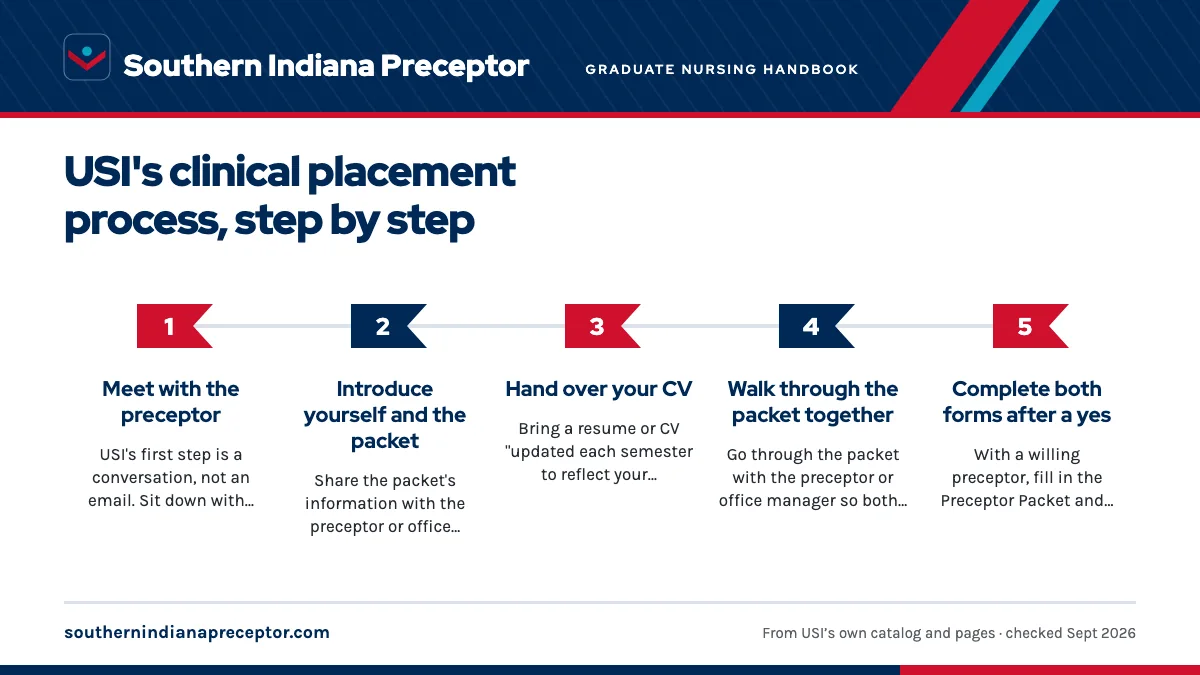
The Clinical Experience page (modified July 30, 2026) lists the steps below. Quoted words are USI's; the notes explain what each step asks of you.
- Meet with the preceptorUSI's first step is a conversation, not an email. Sit down with the clinician you hope will precept you, ideally at the site where you would train.
- Introduce yourself and the packetShare the packet's information with the preceptor or office manager, introduce yourself and "explain the need for clinical experience relative to your specialty."
- Hand over your CVBring a resume or CV "updated each semester to reflect your education and experience." The instructions page suggests one page in total, with a professional photo.
- Walk through the packet togetherGo through the packet with the preceptor or office manager so both of you know what it asks of them.
- Complete both forms after a yesWith a willing preceptor, fill in the Preceptor Packet and the agreement request (older pages say MOU or affiliation agreement) together.
- Pass on the Preceptor Orientation PacketThe preceptor's signature confirms they have read the orientation packet. USI keeps it offline: request it from usi1nursing@usi.edu and forward it with the Preceptor Packet.
- Collect the signaturesLeave the packet so the Preceptor Agreement and agreement request come back signed, and explain that nothing starts until the program has both.
- Email both forms to USISend the completed agreement request and Preceptor Packet to usi1nursing@usi.edu from your USI email, with the subject line "[Student First and Last Name] Preceptor Packet."
- Raise a problem earlyWith no preceptor or no agreement contact, let course faculty or the Nursing Clinical Coordinator know no later than 6 weeks before the course or semester begins.
- Wait for the confirmation email"DO NOT INITIATE CLINICAL PRACTICE" until an email confirms the paperwork was returned and accepted. Both documents must be approved before you take part as a USI student.
What to put in the preceptor's hands
The Preceptor Packet Instructions page (modified May 14, 2026) lists what your preceptor should receive. It doubles as a packing list for the first meeting.
- The Roles and Responsibilities of preceptor, student and faculty
- The Preceptor Packet itself (Form G, updated 07/2026)
- The Preceptor Orientation Packet, which USI sends you on request
- The initial request for the education agreement, after you check with usi1nursing@usi.edu whether the facility already has one with USI
- The clinical hours your course requires, expressed as weekly hours across the semester
- Your updated CV or resume with a professional photo, ideally one page
Mention one more thing at that meeting: the preceptor will be asked to confirm your hours online in what USI calls its third-party repository, which for clinical logs means Typhon. Knowing that up front saves a surprise in week one.
What happens after you press send
Form G's office-use box shows the review in sequence. USI verifies your license and the preceptor's, checks whether a Clinical Education Agreement already exists and when it expires or renews, records faculty approval with a signature and date, notes whether the rotation is an elective, sends the "Green Light Email" and loads the preceptor and site into Typhon.
The agreement runs on a parallel track. Your request is not the contract: USI drafts the Clinical Education Agreement from it and emails it to the signer the site names in Part 2, a person the office manager or education coordinator identifies. The form is blunt that students may not sign it themselves, and USI must hold the signed copy before it approves the site. The Clinical Education Agreement guide covers existing agreements and signers.
When the approval lands, the green light guide lists what else must be in place before you see patients, from current DISA items to a schedule in your clinical faculty's hands.
Timing the ten steps
Work backward from Form G's heading: the completed packet is due "6 weeks prior to the clinical rotation's start date." A second handbook page, University Clinical Requirements, asks for agency, preceptor and site surveys to be finalized one month before clinicals and for a missing placement to be reported at least 4 weeks before the semester. The earlier date is the safer target, and course faculty or the Nursing Clinical Coordinator can confirm which one governs your term.
The cycle also repeats. A current Preceptor Agreement covers just the one course and term entered in Part One; the 2019 form, by contrast, lasted a year and could be renewed for a second. An FNP student moving from NRSG 643 in Fall to NRSG 645 in Spring and NRSG 647 in Summer should expect paperwork for each course, and the deadlines guide maps the dates.
Approval starts a second clock. Hours have to start no later than Week 3 and keep going every week, holidays and gaps between sessions earn nothing, and clinical faculty need your schedule before your first shift.
Details that hold a packet up
Each of these is easy to get right before you send, and each can stall a review once the packet is in.
- Handwritten or scanned pages. USI wants every field typed and the file sent as a PDF, which it says keeps processing moving.
- A personal email account, or a subject line that differs from the one USI specifies.
- A preceptor who misses a rule: an unencumbered license, board certification matching your track, and a year or more of advanced practice. PMHNP students need a PMHNP or a licensed psychiatrist and nobody else, as the preceptor requirements explain.
- No named signer in Part 2 of the agreement request, which leaves USI nobody to send the contract to.
- Guessing about an existing agreement instead of asking usi1nursing@usi.edu first.
- A relative or partner as preceptor, which the handbook rules out.
USI allows no clinical experience before the confirmation email, however ready your preceptor is to begin.
How our placement desk speeds up steps one to seven
Steps one through seven are where the weeks disappear: finding a clinician who fits your track, getting on their calendar, and chasing the details that four parts of Form G and the agreement request require. That stretch is our work. We search your community for clinicians who satisfy USI's rules for your NRSG course, confirm their interest, and gather the preceptor's license, certification, DEA and time in practice, answers for the site survey, and who at the site signs contracts.
You walk into the meeting with a preceptor who has already agreed in principle and a packet ready to type. Steps eight to ten stay with you, because USI wants the email from your USI account, and we stay close until the green light comes back. See how it works for the full sequence, or use the form below to start on your next course.
Questions USI students ask
Can I start clinical hours while USI reviews my Preceptor Packet?
No. The Clinical Experience page warns against starting clinical practice before an email confirms the paperwork was returned and accepted. USI has to approve the packet and the agreement before then, and Form G's office box shows the green light email and the Typhon set-up following faculty approval.
Where do I get the Preceptor Orientation Packet?
It is available only on request. Email usi1nursing@usi.edu for a copy, then forward what you receive together with Form G. Because the preceptor's signature on Form G confirms they have read and understood the orientation packet, it needs to reach them before they sign anything.
Who reviews my packet once I email it?
The handbook gives approval of preceptors and sites to the Graduate Clinical Liaison, the 2026-27 catalog names the graduate nursing clinical liaison, and Form G's office box carries a faculty signature line. The forms arrive at the Graduate Nursing Program mailbox, and questions about a review go to the Nursing Clinical Coordinator at usi1nursing@usi.edu.
Is the Request for USI Clinical Education Agreement the same as the MOU?
Yes. The form is labeled "Formerly Known as Memorandum of Understanding," and older handbook pages call it the MOU or affiliation agreement. It is a request rather than the contract: USI drafts the Clinical Education Agreement from it and emails that agreement to the person the site names as its signer.
What should my CV show for the first preceptor meeting?
USI asks for a resume or CV updated each semester to reflect your education and experience, and the instructions suggest one page with a professional photo. Put your RN experience, your USI track and the course you need a preceptor for near the top, so an office manager can see at a glance where you fit.
Related pages
Last checked 2026-09-25
We check these pages against USI's own bulletin, program pages and Graduate Nursing Handbook. Your handbook, course faculty and the Nursing Clinical Coordinator have the final word.
- University of Southern Indiana Graduate Nursing Handbook: Clinical Experience
- University of Southern Indiana Preceptor Packet (Form G, updated 07/2026)
- University of Southern Indiana Request for USI Clinical Education Agreement
- University of Southern Indiana Graduate Nursing Handbook: University Clinical Requirements and Clinical Evaluation
USI makes the search your job. We make it the easy part.
Tell us your USI track, your city and your next clinical semester. We find preceptors who fit the NRSG course and fill the Preceptor Packet and Clinical Education Agreement request with typed, complete details, well before USI's 6-week window.
- Preceptors matched to the course: family primary care for FNP, acute care teams for AGACNP, PMHNPs and psychiatrists for PMHNP
- Preceptor license, certification, years of practice and the site's agreement signer ready for the packet
- Fall, Spring and Summer planned together, close to home in a state USI enrolls
Start your placement plan
Track, city and clinical start is all we need to begin.