USI's online MSN PMHNP: credits, clinical hours and preceptors
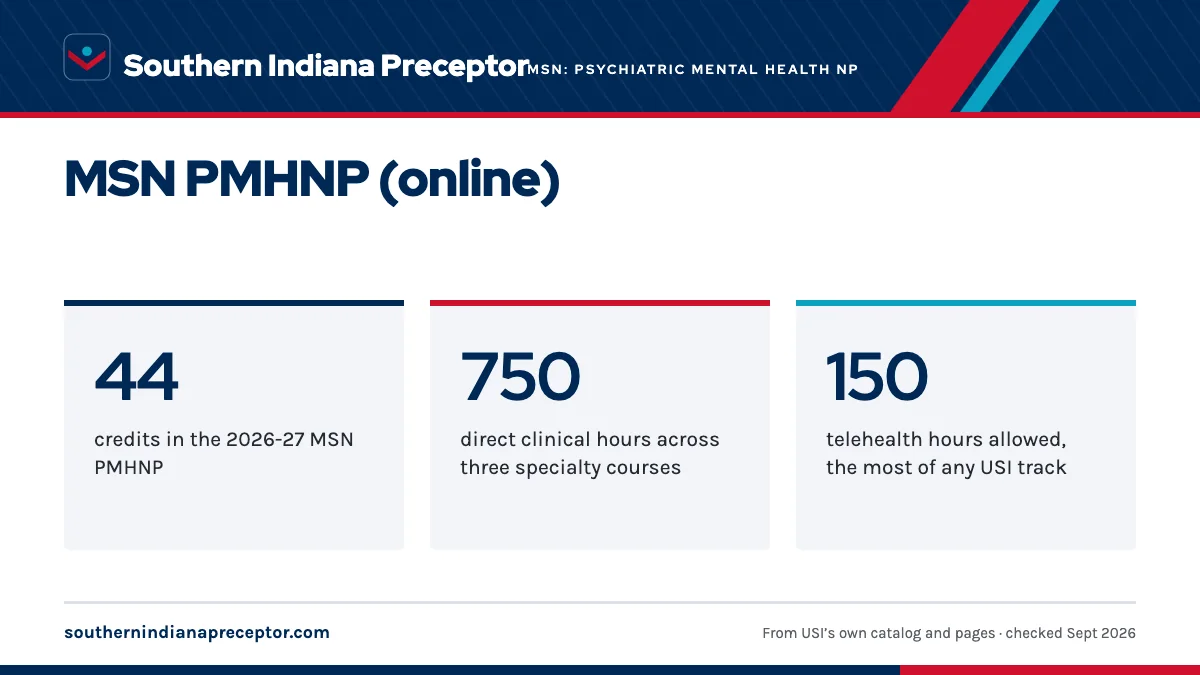
At the University of Southern Indiana, the online Psychiatric Mental Health Nurse Practitioner MSN runs 44 credits, and its 750 direct clinical hours sit entirely inside three specialty courses: NRSG 653, NRSG 655 and NRSG 657. You line up your own preceptors, USI will approve only a psychiatric NP or a psychiatrist, and nearly every hour is outpatient care.
Plan your PMHNP clinicals
Your city and the Fall you start NRSG 653 are enough to begin.
The program at a glance
USI's 2026-27 Graduate Bulletin lists the track as Psychiatric Mental Health Nurse Practitioner (PMHNP), 44 hours, and calls it the Family Psychiatric Mental Health Nurse Practitioner program, which is why every specialty title reads "Family Psychiatric/Mental Health Care Across the Lifespan." The degree is fully online and admits in January, May and August, and every course must be passed with a B or higher.
| Block | Courses | Credits |
|---|---|---|
| MSN nursing core | NRSG 601 to NRSG 606 | 16 |
| Clinical core (the 3Ps) | NRSG 621, NRSG 622, NRSG 623 | 9 |
| PMHNP specialty | NRSG 651, NRSG 653, NRSG 655, NRSG 657 | 19 |
| Total | 44 |
To be admitted you need a BSN from a program holding national and regional accreditation, at least a 3.0 GPA, a C or higher in undergraduate statistics and an RN license carrying no encumbrances. A year of full-time RN practice, or 2,000 hours within the last five years, is strongly recommended in the bulletin and handbook; the program page calls it recommended but not required.
Where the 750 hours fall
Only the three numbered specialty courses carry direct hours. NRSG 651 is didactic, NRSG 623 relies on i-Human cases that USI books as indirect time, and the core courses have no clinical component.
| Course | Credits | Term | Direct hours | Setting |
|---|---|---|---|---|
NRSG 651 Introduction | 2 | Summer | None | Didactic |
NRSG 653 Specialty I | 6 | Fall | 200 | Outpatient, across the 16-week term |
NRSG 655 Specialty II | 6 | Spring | 250 | Primarily outpatient |
NRSG 657 Specialty III | 5 | Summer | 300 | Outpatient mental health |
| Total | 19 | 750 |
USI publishes no graduate sample plan, but term offerings and prerequisites fix the order: NRSG 623 and NRSG 651 in a Summer, then the three clinical courses in Fall, Spring and Summer. Each has its own page with dates and setting rules: NRSG 653, NRSG 655 and NRSG 657.
One wording slip to ignore: the Specialty Track Overview gives the PMHNP total as "750 direct credit hours." The Course Requirements page confirms the figure means clinical hours.
Who can precept a USI PMHNP student
This track has the tightest preceptor rule at USI. The Course Requirements page restricts clinical to "a PMHNP or a licensed psychiatrist," so physician assistants, who may precept USI's FNP and AGACNP students, are excluded here, as are family NPs and physicians outside psychiatry.
Beyond the track rule, each preceptor must hold a license without encumbrances wherever they practice, be certified in the specialty, bring twelve months or more of advanced practice, and sign USI's agreement; family members and partners are excluded. They must be on site while you see patients, teach you one to one, and sign a Preceptor Agreement acknowledging there is no remuneration for the role.
Before your first patient, USI must approve both the preceptor and the site through the Graduate Clinical Liaison, with a Clinical Education Agreement signed by the site. The Preceptor Packet and the agreement request are separate documents, and the site, not you, signs the agreement.
Telehealth in the PMHNP track
PMHNP and FNP are the only USI tracks allowed telehealth hours, and PMHNP gets the larger share: up to 150 hours, or 20 percent of 750. As recently as January 2026 the handbook capped PMHNP telehealth at 126 hours of a 630-hour track, and no other track could use it.
Each telehealth hour must be a live visit in which you sit beside your preceptor at the approved clinic while the patient connects from elsewhere. Phone-only calls, email, recorded messages and joining from home or another clinic are excluded, your RN license must cover the patient's state, and acceptance of the hours rests with the course coordinator. See the telehealth page for the full rule.
Finding your preceptors: USI's rule
USI places the search with you. Its Graduate Nursing Handbook makes each student responsible for lining up preceptors and sites near where they live, and the Graduate Clinical Liaison must approve both before any hours start. The 2026-27 bulletin phrases it more gently, saying students are encouraged to find preceptors with help from the clinical liaison; the finding your own preceptor page compares the two.
For each course you complete the Preceptor Packet (Form G) with your preceptor and send a Request for USI Clinical Education Agreement for the site, typed, as PDFs, from your USI email. If nothing turns up, the handbook's three requests are to email the program mailbox (usi1nursing@usi.edu), rule out a preceptor at your own employer, and share every organization you have approached so staff avoid repeating your calls. The handbook also notes that some students turn to a third-party placement organization at their own cost.
Admission states and licensure
Where you live decides whether you can enroll. USI's disclosure table, headed "Updated Fall 2025," carries an Enrollment Not Allowed column, and for the MSN nurse practitioner rows it reads as below.
| Column or issue | States |
|---|---|
| Enrollment Not Allowed | AL, AZ, DE, LA, MA, MN, MS, ND, NV, NY, OK, OR, PA, WY, plus DC, GU, CNMI, PR and VI |
| Listed as both Meets and Does Not Meet | MA |
| In neither licensure column, and not banned | CO |
| Does Not Meet only | LA |
Two entries need care. Massachusetts is marked as both meeting and failing requirements, and Colorado is missing from both licensure columns while staying off the ban list, which leaves Colorado applicants without an answer. Read the current licensure disclosure and ask USI's Office of Online and Adult Learning before you apply or relocate.
Clinical hours in any state also require an RN license there with no encumbrance. A move to a state outside USI's approved list stops your coursework unless you are on active military duty, so tell the Program Chair and APRN Director what you plan before you go.
What changed for 2026-27
The PMHNP track was rebuilt for 2026-27. Direct hours rose from 630 to 750, and every graduate course moved from the NURS prefix to NRSG. The 2025-26 specialty was NURS 661 Psychopharmacology plus NURS 662, NURS 663 and NURS 664 at 135, 225 and 270 hours; the new sequence runs NRSG 651 through NRSG 657 at 200, 250 and 300.
Credits held at 44. Earlier bulletins gave other totals again: 645 clinical hours in 2023-24 and 630 in 2024-25. If a plan of study, an older handbook printout or an old USI listing shows a different figure, go by the current handbook. For the reasons behind the rebuild in all three NP tracks, see the 750-hour page.
Why USI PMHNP students choose us
The PMHNP track needs the most narrowly defined preceptor in USI's catalog, three semesters in a row, in outpatient psychiatry, close to where you live. That is the search our placement desk runs every day. We look for board-certified PMHNPs and psychiatrists in your area and in a state USI enrolls, weigh each one against USI's standards for licensure, certification and years in practice, and confirm the practice can host the hours each course needs.
Then we handle the legwork USI's forms call for: preceptor license, certification, DEA and years at the practice for Form G, the site survey, and the contact who signs affiliation agreements for the practice, so each packet reaches USI complete and typed well inside the 6-week window. We plan Fall, Spring and Summer as one placement, keep your telehealth hours in view against the 150-hour limit, and remain on call to find a successor if a preceptor withdraws. Share your city and the term you begin through the form below.
Questions USI students ask
Can I start the USI MSN PMHNP in January or May?
Yes. USI's program page lists January, May and August starts, with application deadlines the November, April and July before. The clinical courses still run in a fixed Fall, Spring and Summer order, so your start term mainly changes when you reach NRSG 653. Your plan of study from USI shows the exact semester your first clinical course falls in.
Does my psychiatrist preceptor need board certification?
Yes. USI's rule is that every preceptor holds certification in their specialty area, alongside an unencumbered license, a year or more of advanced practice and a signed university agreement. For a psychiatrist, that means certification in psychiatry; for an NP, board certification as a PMHNP matching your track.
Will I ever need to travel to the USI campus in Evansville?
No campus residency is built into the MSN schedule. The bulletin keeps the option open, though: USI can call a student to campus to show clinical competency, and faculty also assess through conference calls, site visits and recorded video. Treat a campus visit as possible rather than scheduled, and watch your syllabi each semester.
Which certification exam does the USI PMHNP prepare students for?
USI reports its PMHNP graduates' board results for the ANCC certification exam. Whether that certification leads to an APRN license in your state is a separate question, which USI's Professional Licensure Disclosure answers state by state for the MSN PMHNP. Check your own state's row before you enroll.
Can I do PMHNP clinicals outside the state where I live?
USI expects clinicals in your own community, but the rule that matters is licensure: your RN license, with no encumbrance, has to cover each state you do clinical hours in, and for telehealth the patient's state as well. You also practice within the scope rules of the state where the clinical takes place. The site still needs USI approval and an agreement.
Related pages
Last checked 2026-09-25
We check these pages against USI's own bulletin, program pages and Graduate Nursing Handbook. Your handbook, course faculty and the Nursing Clinical Coordinator have the final word.
- University of Southern Indiana 2026-2027 Graduate Bulletin: MSN, Psychiatric Mental Health Nurse Practitioner
- University of Southern Indiana: MSN Psychiatric Mental Health Nurse Practitioner program page
- University of Southern Indiana Graduate Nursing Handbook: Course Requirements
- University of Southern Indiana Graduate Nursing Handbook: University Clinical Requirements and Clinical Evaluation
- University of Southern Indiana Professional Licensure Disclosure
USI makes the search your job. We make it the easy part.
Tell us your USI track, your city and your next clinical semester. We find preceptors who fit the NRSG course and fill the Preceptor Packet and Clinical Education Agreement request with typed, complete details, well before USI's 6-week window.
- Preceptors matched to the course: family primary care for FNP, acute care teams for AGACNP, PMHNPs and psychiatrists for PMHNP
- Preceptor license, certification, years of practice and the site's agreement signer ready for the packet
- Fall, Spring and Summer planned together, close to home in a state USI enrolls
Start your placement plan
Track, city and clinical start is all we need to begin.