NRSG 657: the 300-hour Summer course that finishes the PMHNP track
NRSG 657 Family Psychiatric/Mental Health Care Across the Lifespan III is the last and largest clinical course in the University of Southern Indiana PMHNP track: 300 direct hours "in outpatient mental health settings," taken in Summer. It brings your total to 750, and its final evaluation decides whether you finish on schedule.
Get your placement plan
Tell us your USI program and where you live. A placement advisor replies with the preceptor and site options that fit your course.
What NRSG 657 requires
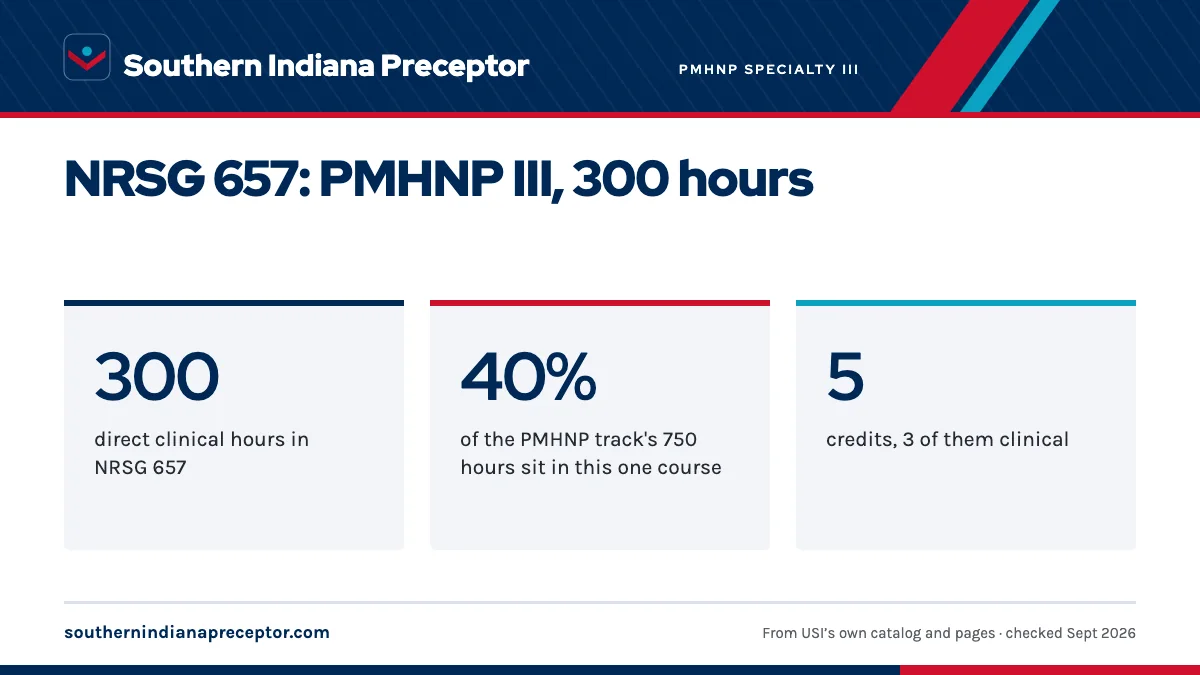
The 2026-27 bulletin lists NRSG 657 at 5 credits with a 2-3 (Clinical) split, the only PMHNP course where clinical outweighs lecture. It follows the Spring course and runs in Summer, and the Course Requirements page sets 300 direct hours "in outpatient mental health settings." It closes the 19-credit specialty block that begins with NRSG 651, for MSN and certificate students alike; the MSN PMHNP page lays out the full sequence.
The preceptor rule does not change for the last course: a PMHNP or a licensed psychiatrist, board-certified, with at least a year of advanced practice and a signed USI agreement. What changes is the scale. Four in every ten of your 750 hours happen here, and they have to fit a summer calendar whose exact dates you should pin down early.
Fitting 300 hours into Summer
USI's calendar has two standard summer sessions for 2026-27, plus cross-term courses that set their own dates. No public USI page says which part of term NRSG 657 follows, so take your exact start and end dates from the course schedule in myUSI and from the syllabus, then plan backward from them.
Those dates drive everything else. Form G wants the packet 6 weeks before the rotation starts, clinical has to begin by week 3 and continue every week, and university holidays and days out of session earn no hours.
| Date | What it means |
|---|---|
| Early April 2027 | About 6 weeks before a May 17 start: the Form G window for a new preceptor |
| Fri, May 7 | Spring term, and NRSG 655, ends |
| Mon, May 17 | First Summer session begins |
| Mon, May 31 | Memorial Day, no clinical hours |
| Thu, Jun 17 | First Summer session ends |
| Fri, Jun 18 | Juneteenth, no clinical hours |
| Mon, Jun 28 | Second Summer session begins |
| Mon, Jul 5 | Independence Day observed, no clinical hours |
| Fri, Jul 30 | Second Summer session ends |
The handbook sets weekly ceilings for FNP (no more than 40 in the third course) and AGACNP (up to 36) but publishes none for PMHNP. Ask course faculty what weekly load they will accept before you and your preceptor build a schedule around long weeks.
Outpatient mental health, named outright
This course's setting language is the most specific of the three. Where Spring allowed primarily outpatient work, NRSG 657 names "outpatient mental health settings," so plan every hour for an outpatient psychiatric practice, a community mental health clinic or a similar site USI has approved.
If your Spring preceptor is continuing, check that the Form G on file lists NRSG 657 and the Summer term, because the current agreement covers only the course and term in Part One. If you are moving to a new practice for the final course, the new site needs its own Clinical Education Agreement, and a psychiatric group that already has one in place with USI moves faster. usi1nursing@usi.edu can confirm whether a given practice has one.
Closing out all 750 hours
Check your Typhon totals before Summer begins. Fall and Spring should show 450 direct hours with preceptor co-signatures, and your telehealth hours so far should be tallied against the 150-hour track limit, so you know how much of the final 300 can be virtual.
If the term runs short, the options narrow quickly. Course faculty can approve rescheduled hours inside the semester when something unforeseen happens, but no hours count once courses are out of session. An incomplete (IN) goes only to a student whose work is passing, at the instructor's discretion, and it must be cleared within one calendar year or it turns into an F.
Raise any shortfall with faculty at midterm, not in the final week. The behind on hours page and the delayed graduation page cover what students do when the numbers slip.
The final evaluation
The end-of-course evaluation in NRSG 657 is the last one in the track, and it carries full weight: a Does not meet in any domain at the final point fails the course. The midterm rating leaves you time to fix a weak domain, so read it closely and ask faculty what Meets looks like in the clinic.
Your preceptor's second Preceptor Feedback Form, the final faculty email and the final phone call all fall in the closing weeks. The call is yours to arrange, so put it on your preceptor's calendar early in the term. A Pass in clinical and a B or better in the didactic component complete the course and the specialty sequence.
Faculty can also check your competency through conference calls with you and your preceptor, site visits or video recordings, and USI may ask a student to come to campus to demonstrate clinical competency. Treat any such request as part of the course.
Board review and certification
By Summer you already hold the Barkley Board Review, which USI requires PMHNP students to buy in the second half of Specialty II. The Specialty III course pages mention it again, purchased through the university, so expect board preparation to run alongside your final 300 hours. i-Human, by contrast, is not required here: USI lists it for NRSG 623 and the first two specialty courses only.
After graduation, the psychiatric track leads to national board certification, and USI reports its PMHNP results for the ANCC exam. Whether that certification leads to a license where you live depends on your state; USI's licensure disclosure lists the states where the program meets requirements and the ones where residents cannot enroll.
NRSG 857 and the older NURS 664
BSN-to-DNP psychiatric students take NRSG 857, the 800-level twin, with the same 300 hours and the same preceptor rule. For them it completes the 750 specialty hours inside a 1,510-hour doctorate, with DNP project hours still to come or running alongside. Its companions are NRSG 851, NRSG 853 and NRSG 855, and the BSN-to-DNP page places all four in the doctoral plan.
Under the 2025-26 curriculum, the final PMHNP course was NURS 664, with 270 hours, finishing a 630-hour track. The 2026-27 rebuild added 30 hours to the last course and 120 to the track overall, which is why plans of study written for earlier cohorts show smaller numbers. Plan to the current figure of 300, whatever an older document says.
Why PMHNP students choose us for NRSG 657
The final course is where a preceptor gap costs a graduation date. We plan it from the start of your specialty year, so the Summer preceptor is known well before Spring ends, and we look for outpatient mental health practices with the capacity for 300 hours in a compressed term. The Summer plan is built around the hours you still need after Spring, including how much telehealth room you have left.
Our placement desk checks every PMHNP or psychiatrist against USI's rules, collects the license, certification, DEA and site survey details, and confirms who signs agreements for the practice, so your packet lands at USI complete and typed ahead of the April window. If a preceptor leaves mid-Summer, your placement advisor is already working on the replacement. Share your city and term using the form below.
Questions USI students ask
How many hours a week will NRSG 657 take?
It depends on how long your section runs, which your myUSI schedule shows. If it spans the full summer, from mid-May to the end of July, 300 hours works out to roughly 27 a week before holidays. A shorter section means more. USI publishes no weekly cap for PMHNP courses, so confirm the load faculty will accept before you commit to a schedule.
Can I finish NRSG 657 hours after the summer term ends?
Not as regular clinical hours. The handbook allows no clinical hours when courses are not in session. If you are passing but a small amount of work remains, the instructor may grant an incomplete, which you must clear within one calendar year. Raise any shortfall early; faculty can approve rescheduled hours only within the semester.
Do I need a different preceptor for NRSG 657 than for NRSG 655?
No. USI sets no rule requiring a change between courses, and staying with a preceptor who knows your work is often the smoothest route. The paperwork still has to cover the course: confirm that your Preceptor Packet lists NRSG 657 and the Summer term, or file a new one at least 6 weeks before the rotation.
Does NRSG 657 have its own telehealth limit?
The limit applies to the whole PMHNP track: up to 150 telehealth hours across all 750, with no separate per-course figure published. Whatever you used in NRSG 653 and NRSG 655 reduces what remains for NRSG 657, and the course coordinator still decides whether to accept telehealth hours in each course.
What happens if I fail the final evaluation in NRSG 657?
A final Does not meet in any domain fails the course, and without a Pass in clinical the course grade is an F. From there, the Graduate Nursing Handbook's progression and readmission policies apply, and the Graduate Chair and APRN Director is the role to contact. The grades and progression page explains the rules.
Related pages
Last checked 2026-09-25
We check these pages against USI's own bulletin, program pages and Graduate Nursing Handbook. Your handbook, course faculty and the Nursing Clinical Coordinator have the final word.
- University of Southern Indiana Graduate Nursing Handbook: Course Requirements
- University of Southern Indiana 2026-2027 Graduate Bulletin: MSN, Psychiatric Mental Health Nurse Practitioner
- University of Southern Indiana Graduate Nursing Handbook: University Clinical Requirements and Clinical Evaluation
- University of Southern Indiana Academic Calendar
- University of Southern Indiana Student and Program Outcomes (Nursing)
USI makes the search your job. We make it the easy part.
Tell us your USI track, your city and your next clinical semester. We find preceptors who fit the NRSG course and fill the Preceptor Packet and Clinical Education Agreement request with typed, complete details, well before USI's 6-week window.
- Preceptors matched to the course: family primary care for FNP, acute care teams for AGACNP, PMHNPs and psychiatrists for PMHNP
- Preceptor license, certification, years of practice and the site's agreement signer ready for the packet
- Fall, Spring and Summer planned together, close to home in a state USI enrolls
Start your placement plan
Track, city and clinical start is all we need to begin.