Grades and progression in USI graduate nursing: clinical Pass, B or better, withdrawals and incompletes
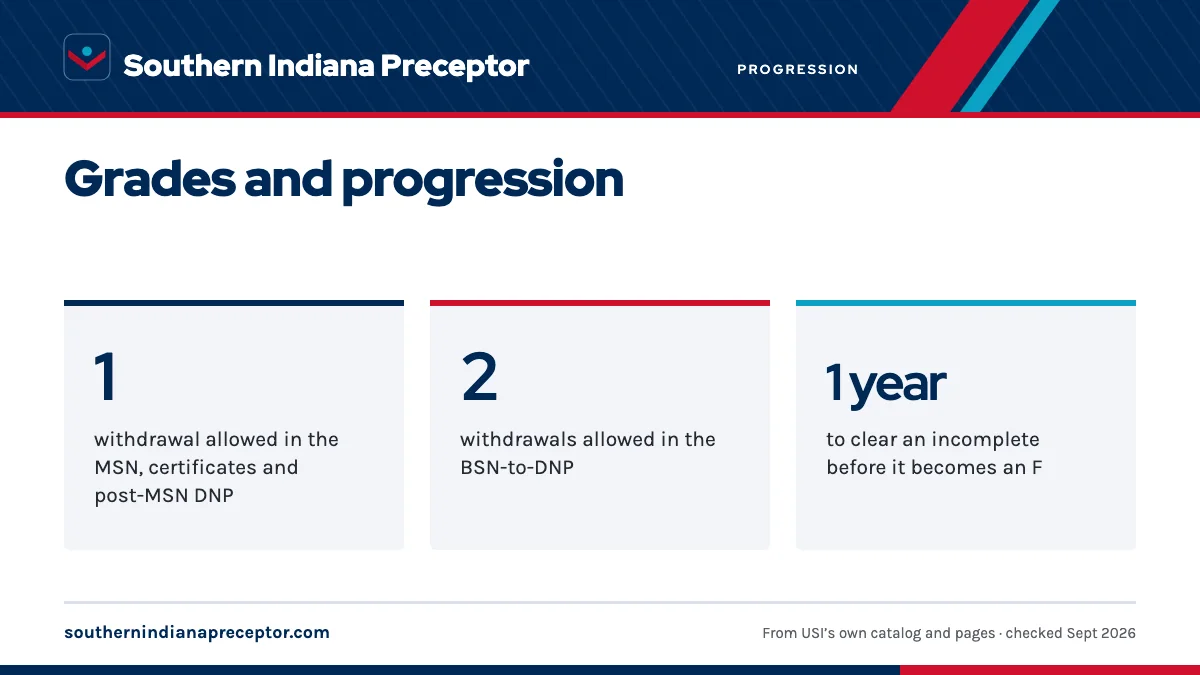
In USI's graduate nursing programs, a clinical course counts only when both halves clear their bar: Pass on the clinical side and at least a B on the didactic side. Without the Pass, the course goes on your record as an F. Withdrawals are capped at one for MSN, certificate and post-MSN DNP students and two for BSN-to-DNP students, and an incomplete must be cleared within a calendar year.
Get your placement plan
Tell us your USI program and where you live. A placement advisor replies with the preceptor and site options that fit your course.
The two-part grade in clinical courses
USI's Progression and Withdrawal Policies judge clinical-based courses twice: once on clinical performance, which is Pass or not, and once on the didactic grade, which must reach a B. Fall short on the clinical side and the entire course becomes an F, whatever your exam average. Outside clinical courses the B floor still holds for every graduate nursing course, and the bulletin restates it for both the MSN and the DNP.
That makes the clinical half binary. Logged hours, preceptor feedback and faculty evaluations cannot lift a weak didactic grade, and a strong didactic grade cannot rescue a clinical failure. Treat each half as its own pass mark.
DNP project courses work differently. The bulletin grades NRSG 801, NRSG 803 and NRSG 805 as Pass or No Pass, so doctoral students meet a pass/no-pass standard for the project and letter grades elsewhere.
What turns the clinical component into a fail
Twice per clinical course, at the halfway point and at the close, clinical faculty score each domain of your performance as Does not meet, Meets or Exceeds. A Does not meet in any domain on the final evaluation results in failure of the course. The midterm is your warning point: it is the moment to ask faculty exactly what the final evaluation needs to show, while half a semester remains.
Other clinical rules feed the same result. Your hours must be under way by Week 3 and keep going every week, each course has a minimum number of direct hours, and your preceptor's co-signed Typhon entries and feedback forms are part of the record faculty weigh. The evaluations page explains the ratings and the seven preceptor-faculty touchpoints each semester.
Dropping a Fall or Spring course after week 9 is a withdrawal with evaluation: a student who is failing at that point can leave with an F rather than a W.
Withdrawals and the progression cap
You can withdraw with a W within the withdrawal period on USI's academic calendar. In Fall and Spring, drops in weeks 2 through 9 are without evaluation; from week 10, the grade depends on where you stand: a W if passing, possibly an F if failing. The semester calendar gives the 2026-27 dates.
Graduate nursing adds its own cap. A second withdrawal stops progression for MSN, Post-MSN APRN Certificate and Post-MSN DNP students, and a third does the same for BSN-to-DNP students. Several withdrawals inside one semester are tallied together as one event, and a student coming back after a withdrawal petitions to continue using Appendix A of the Graduate Nursing Handbook.
Because each NP specialty course runs once a year, withdrawing from a clinical course usually means waiting twelve months to take it again, which moves your graduation with it. Delayed graduation covers how students plan around that.
Incomplete grades
An incomplete (IN) may be given only at the end of a term, to a student whose work is passing but who has a small amount left unfinished. You must remove it within one calendar year or it reverts to an F, and the instructor can set a shorter limit when granting it. USI's online and adult learning office adds that students petition for an incomplete under special circumstances and that the course instructor decides.
Clinical hours make incompletes delicate. Because USI bars clinical work while courses are out of session, an IN in a clinical course needs a clear plan from course faculty for when and how the remaining hours will be completed. Ask for that plan in writing before the term closes, and share it with your preceptor.
Rules outside your grades that can stop progression
Some of the fastest ways to lose a semester have nothing to do with exams or evaluations:
- Compliance: if DISA items miss their approval due dates, USI issues a Performance Improvement Plan and may drop you from the course administratively. Nothing may expire before the semester ends.
- BLS and ACLS: a lapsed BLS card stops clinicals until the renewal is verified, and AGACNP students must also keep ACLS current.
- Background check and drug screen: failing to submit them, even with negative results, may jeopardize enrollment or progression. New charges must be reported to the Program Chair immediately, and a positive drug screen makes a student ineligible to apply to any Kinney College program for one year.
- RN license: staying enrolled requires an RN license without encumbrance, held in each state where your clinical hours happen.
- Where you live: a move to a state outside the graduate program's recognized list means you cannot continue coursework, unless you are on active military status.
- Time: Post-MSN APRN Certificate students must finish within three years.
Due dates and the Performance Improvement Plan are explained on the DISA compliance page.
Changing specialty or coming back
A request to switch specialty track goes in writing to the Graduate Chair and APRN Director. To return after a withdrawal, you petition using Appendix A. USI's progression page also makes clear that readmission to the nursing program is not automatic, so a break in enrollment is best planned with your advisor before it begins. Keep your RN license and DISA record current while you are away, since USI requires both to be current for enrollment and clinical work.
Students who pause because a preceptor fell through face the same rules as anyone else. USI wants to hear from you, through course faculty or the Nursing Clinical Coordinator at usi1nursing@usi.edu, six weeks or more before the course starts if no preceptor is in place, and raising it that early keeps more options open than a withdrawal in week 3. Can't find a preceptor lists USI's own steps.
How we protect your progression
Many clinical-course problems start before the first shift: a preceptor who backs out, a packet that arrives incomplete, a start that slips past Week 3. USI students choose us to deal with those risks early. Your placement advisor secures preceptors who meet USI's rules for each course, gathers every Form G and agreement detail so the packet goes in complete and early, and plans all three clinical semesters ahead so each course begins with an approved site.
When a preceptor leaves mid-semester, the replacement search begins right away, which keeps weekly hours flowing and gives your midterm evaluation real work to judge. Grades and approvals belong to USI; readiness on the placement side is ours. Get started or use the form below.
Questions USI students ask
Do withdrawals from two courses in the same semester count twice?
No. USI's graduate progression policy treats all course withdrawals within the same academic semester as one withdrawal event. That matters because the cap is one withdrawal for MSN, certificate and post-MSN DNP students and two for BSN-to-DNP students. A withdrawal in a later semester counts as a separate event.
Does a Does not meet rating at midterm fail the course?
The handbook ties course failure to a Does not meet in any domain on the final evaluation, not the midterm one. A midterm Does not meet is a serious signal but leaves time to improve. Talk with clinical faculty right away about what the final evaluation needs to show, and involve your preceptor in the plan.
What happens if a DISA document expires during the semester?
USI's health requirements forbid any document from expiring before the semester is over. Missing an approval due date is treated as not being prepared for clinical: USI issues a Performance Improvement Plan contract and can drop you from the course. Renew early, and check that each expiration date runs past the final day of the term.
Is there a time limit to finish the MSN or DNP?
USI's progression page sets a three-year limit for Post-MSN APRN Certificate students. For the MSN and the DNP, your advisor or the handbook's progression policies will confirm the limit that applies to you; plan clinical semesters with it in mind, since each specialty course runs once a year.
Can I return to USI's graduate nursing program after leaving?
Possibly. A student returning after a withdrawal petitions using Appendix A of the Graduate Nursing Handbook, and USI states that readmission is not automatic. Speak to your advisor before you leave, keep your RN license unencumbered and your compliance record current, and ask how a return would fit the once-a-year clinical course schedule.
Related pages
Last checked 2026-09-25
We check these pages against USI's own bulletin, program pages and Graduate Nursing Handbook. Your handbook, course faculty and the Nursing Clinical Coordinator have the final word.
- University of Southern Indiana Graduate Nursing Handbook: Progression and Withdrawal Policies
- University of Southern Indiana Graduate Nursing Handbook: University Clinical Requirements and Clinical Evaluation
- University of Southern Indiana 2026-2027 Graduate Bulletin: grading and withdrawal rules
- University of Southern Indiana Online and Adult Learning: Policies and Statements
USI makes the search your job. We make it the easy part.
Tell us your USI track, your city and your next clinical semester. We find preceptors who fit the NRSG course and fill the Preceptor Packet and Clinical Education Agreement request with typed, complete details, well before USI's 6-week window.
- Preceptors matched to the course: family primary care for FNP, acute care teams for AGACNP, PMHNPs and psychiatrists for PMHNP
- Preceptor license, certification, years of practice and the site's agreement signer ready for the packet
- Fall, Spring and Summer planned together, close to home in a state USI enrolls
Start your placement plan
Track, city and clinical start is all we need to begin.