The USI Preceptor Packet (Form G), part by part
The Preceptor Packet is the University of Southern Indiana's two-page Form G, and it has to reach usi1nursing@usi.edu typed, as a PDF, 6 weeks before your rotation begins. It holds five parts: you, your preceptor, the site, a site survey and the signed Preceptor Agreement. Here is each part, who holds the answers, and what USI does next.
Get your placement plan
Tell us your USI program and where you live. A placement advisor replies with the preceptor and site options that fit your course.
What Form G is and what travels with it
USI calls this document the Preceptor Packet, and its footer labels it Form G, updated 07/2026. Page one covers the student, the preceptor, the site and the survey. Page two carries the Preceptor Agreement and a box that only USI's office completes.
Form G never goes in alone. It shares an email with the Request for USI Clinical Education Agreement, the one-page form that starts the site's contract (how that agreement works). Before anything is signed, the handbook's Preceptor Packet Instructions page asks you to hand the preceptor a small bundle:
- USI's Roles and Responsibilities document
- The Preceptor Packet itself
- The Preceptor Orientation Packet, which you request from usi1nursing@usi.edu because it is not posted online
- The Request for USI Clinical Education Agreement, once you have asked usi1nursing@usi.edu whether the facility already holds one
- Your course's clinical hours, framed as the weekly hours needed across the semester
- A CV or resume, updated this semester, with a professional photo (one page is suggested)
The same page tells you to warn the preceptor that they will verify your time electronically in USI's third-party system. For clinical logs that system is Typhon.
The five parts at a glance
Each part draws on a different person's knowledge. Knowing who holds which answer saves a second trip to the office.
| Part | What it asks for | Who usually has the answer |
|---|---|---|
| One: Student | Your details, your nursing license number and state, and the USI course number(s), term(s) and year(s) | You |
| Two: Preceptor | License number and state, DEA, board certification and the certifying board, years at the current practice | The preceptor |
| Three: Site | Site details, whether it belongs to a larger entity, whether it is a telemedicine site | The office manager |
| Four: Preceptor/Site Survey | Patient volume, exam rooms, patient mix, and whether you may record in, enter in or dictate to the EHR | Preceptor and office manager together |
| Five: Preceptor Agreement | The signed agreement for the course and term in Part One, with the Orientation Packet acknowledgement | The preceptor |
Leave the office-use box under Part Five blank; it belongs to USI.
Parts One and Two: you and your preceptor
Part One looks like a name-and-address block, yet two of its fields decide whether the rest holds together. Your nursing license number and state should match the state where the hours will happen, since USI requires an RN license without encumbrances for each state your clinical hours touch. The course field wants the 2026-27 numbering, such as NRSG 643 or NRSG 653, plus the term and year. An old NURS number or the wrong term describes a different rotation.
Part Two is where USI tests the preceptor against its rules: an unencumbered license where they practice, certification in their specialty, and a minimum of one year as an advanced practice provider. The form asks for the license number and state, a DEA number, whether they are board certified and by which board, and their years at the current practice. Get these in writing the day the preceptor agrees. Whether a given clinician fits your track is set out on the preceptor requirements page.
Parts Three and Four: the site and the survey
Part Three describes the practice. Past the address lines it asks two yes-or-no questions with consequences. One is whether the site belongs to a larger entity; if it does, ask the office manager right away who signs agreements for the parent organization, because that person's name goes on the agreement request. The other is whether it is a telemedicine site. Only FNP and PMHNP students may count telehealth hours, and only with the preceptor physically beside them at the approved site (telehealth rules).
Part Four, the Preceptor/Site Survey, is how faculty judge whether the practice can teach. It covers patient volume, the number of exam rooms, the patient mix, and whether a student may record in, enter in or dictate to the electronic health record. Fill it in with the office manager, who usually knows the room count and charting rules better than a clinician between patients. Course faculty are charged with assessing the space and the suitability of patients at every site, and this survey is the first picture of the practice they see.
Part Five: the Preceptor Agreement
Part Five, on page two, is the preceptor's own agreement with USI. In signing, the preceptor accepts the teaching role with USI's graduate nursing students and acknowledges the Preceptor Orientation Packet. USI treats that signature as proof the orientation material was read, so request the packet from usi1nursing@usi.edu before the signing meeting, not after (orientation and roles).
Read the scope line closely. The 07/2026 form says the agreement is valid for the course, semester and year listed in Part One. The 2019 edition of Form G said one year, renewable for a second. Taken at its word, the current version means each new course or term needs its own signed Part Five, even with the same preceptor. If you plan to stay with one preceptor from NRSG 645 into NRSG 647, ask the Nursing Clinical Coordinator whether a new packet is needed, and prepare one unless told otherwise.
What USI does with it: the office-use box
The box at the foot of page two maps the path your packet takes after it arrives. It records:
- License Verified (S) and License Verified (P): your license and your preceptor's are checked
- CEA, with Auto-renewed? and an expiration date: the site's Clinical Education Agreement is confirmed as signed and current
- Approved as Preceptor, with an approval date and a faculty signature
- Elective Rotation?: a field USI completes for its own records
- Green Light Email Sent: the message that clears you to start
- Typhon (P) and Typhon (Site): the preceptor and the practice are set up in Typhon for your logs
None of that moves until every part above the box is complete and readable. Until the green light arrives, clinical practice does not start, whatever the preceptor's calendar says. The approval email page covers that wait.
Sending it: typed, PDF, USI email, exact subject
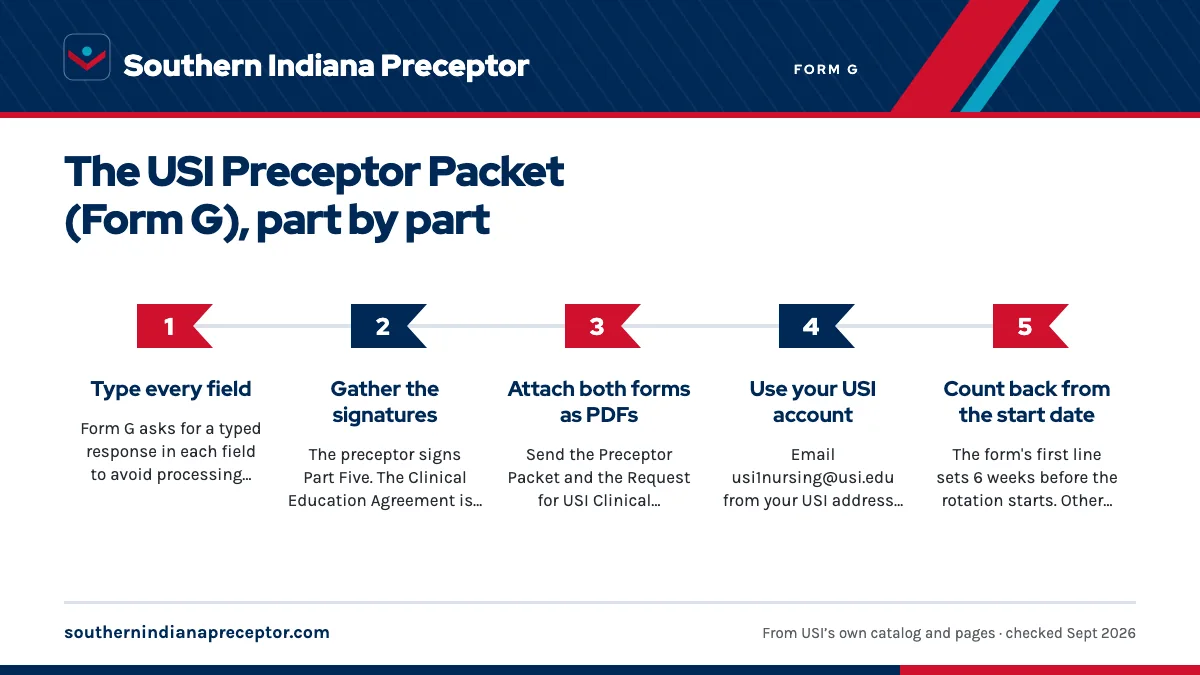
- Type every fieldForm G asks for a typed response in each field to avoid processing delays. A scan of handwriting is the delay that line is warning about.
- Gather the signaturesThe preceptor signs Part Five. The Clinical Education Agreement is signed later by the person the site names, once USI emails it to them.
- Attach both forms as PDFsSend the Preceptor Packet and the Request for USI Clinical Education Agreement as PDF attachments, and keep your own copies.
- Use your USI accountEmail usi1nursing@usi.edu from your USI address. The subject line is your first and last name followed by the words Preceptor Packet.
- Count back from the start dateThe form's first line sets 6 weeks before the rotation starts. Other handbook pages say one month or 4 weeks; the deadlines page sets out that conflict with 2026-27 dates.
Type the packet and send it as a PDF. The form asks for both in writing, and it is the easiest delay to avoid.
Why USI students trust us with Form G
When our placement desk lines up a preceptor for a USI student, the packet is part of the search from day one. Before we introduce a preceptor, we confirm what Part Two asks: license and state, certification and certifying board, DEA, years in practice, and a year or more as an advanced practice provider. We put the Part Three and Part Four questions to the office manager, and we find out who signs affiliation agreements so the agreement request is ready alongside the packet.
You receive those answers typed and matched to the field names on the 07/2026 form, well inside the 6-week window. You still send the packet from your USI email, and USI still verifies, approves and sends the green light. The difference is that what reaches usi1nursing@usi.edu is complete, and your preceptor already knows what they are signing. Tell us your course and term through the contact form.
Questions USI students ask
Where do I find the current USI Preceptor Packet?
Use the Form G PDF marked updated 07/2026, linked from the Clinical Experience section of the Graduate Nursing Handbook. Avoid a copy saved from an earlier semester: the 2019 edition set a different agreement term, and older handbooks paired it with a separate survey sheet and a meeting checklist.
Can the office manager complete the Preceptor Packet instead of the preceptor?
Mostly, yes. The handbook tells you to complete the packet and the agreement request with the preceptor or the office manager, and the manager is often the better source for site details and the survey. The Preceptor Agreement in Part Five is different: it is the preceptor's own signature, confirming they accept the role and have read the Preceptor Orientation Packet.
Can I handwrite Form G and scan it?
The form asks you to type a response in every field and send it as a PDF attachment, to avoid processing delays. Most PDF readers let you type straight into the fields or add text boxes. A handwritten scan invites questions about unreadable license numbers, which is exactly the delay the instruction is there to prevent.
Is the Preceptor Packet the same thing as the Clinical Education Agreement?
No. The Preceptor Packet is about the person who teaches you and the practice where you will see patients, and the preceptor signs it. The Clinical Education Agreement is the contract between USI and the site, signed by whoever the site names. You send the packet and the agreement request together, but USI treats them as two separate approvals, and both must be in place before hours start.
Related pages
Last checked 2026-09-25
We check these pages against USI's own bulletin, program pages and Graduate Nursing Handbook. Your handbook, course faculty and the Nursing Clinical Coordinator have the final word.
- University of Southern Indiana, Preceptor Packet (Form G, updated 07/2026)
- University of Southern Indiana Graduate Nursing Handbook: Clinical Experience
- University of Southern Indiana Graduate Nursing Handbook: Preceptor Packet Instructions
- University of Southern Indiana Graduate Nursing Handbook: Clinical Practice FAQs
USI makes the search your job. We make it the easy part.
Tell us your USI track, your city and your next clinical semester. We find preceptors who fit the NRSG course and fill the Preceptor Packet and Clinical Education Agreement request with typed, complete details, well before USI's 6-week window.
- Preceptors matched to the course: family primary care for FNP, acute care teams for AGACNP, PMHNPs and psychiatrists for PMHNP
- Preceptor license, certification, years of practice and the site's agreement signer ready for the packet
- Fall, Spring and Summer planned together, close to home in a state USI enrolls
Start your placement plan
Track, city and clinical start is all we need to begin.