The Preceptor Orientation Packet and who does what in a USI rotation
The University of Southern Indiana keeps its Preceptor Orientation Packet off the website: you request it from usi1nursing@usi.edu and pass it to your preceptor with the Preceptor Packet, and their signature confirms they have read it. Around it, the handbook's Clinical Roles and Responsibilities page splits the work three ways, between your preceptor, you and course faculty. Knowing that split before day one means the semester's calls and evaluations surprise nobody.
Get your placement plan
Tell us your USI program and where you live. A placement advisor replies with the preceptor and site options that fit your course.
Getting the Orientation Packet
The Preceptor Orientation Packet is the one USI clinical document you cannot download. The Clinical Experience page tells students to ask USI1Nursing@usi.edu for it and forward it to the preceptor with the Preceptor Packet. Ask as soon as a preceptor shows real interest, write from your USI email, and give the course and term so the request is easy to match to your rotation.
It is not a courtesy copy. The handbook says the preceptor's signature on the Preceptor Packet indicates they have read and understand the Orientation Packet, and Part Five of Form G carries that acknowledgement. A preceptor who signs before receiving it has vouched for something they have not seen, so get it to them first (how Form G fits together).
USI does not publish what the Orientation Packet contains, and this page does not guess. What USI does publish is its roles and responsibilities material, which the Preceptor Packet Instructions page also lists among the documents to give your preceptor. The sections below follow that material.
What USI asks of your preceptor
A preceptor who has taught students from other programs may assume a different set of duties. USI's handbook spells out its own:
- Precept you on a one-to-one clinical basis
- Be physically present in the clinical facility while you care for patients, with procedures done under the direct supervision of a privileged clinical preceptor
- Review and co-sign your patient-encounter entries in the clinical tracking system where applicable
- Complete a Preceptor Feedback Form in Typhon at midterm and again at semester's end
- Take the faculty emails and the midterm and final phone calls that make up USI's touchpoints
- Keep an unencumbered license where they practice, current specialty certification, and a year or more in practice as an advanced provider
One point to raise before the preceptor signs: USI's malpractice policy protects its students while they act in the student role, and it does not extend to the clinician teaching them. Better that they hear it from you up front.
What falls on you
The student side of the Roles page is longer than many students expect. Part of it is paperwork and part of it is scheduling:
- Show your preceptor, the agency and faculty that you carry liability insurance, have completed OSHA and HIPAA requirements, and hold an RN license for the state where the clinicals take place
- Send your clinical schedule to clinical faculty before you attend
- Tell your preceptor and faculty immediately if you cannot meet a clinical commitment
- Stay within the advanced nursing practice scope that the host state's Nurse Practice Act allows
- Book a time that suits your preceptor for each faculty phone call, which the handbook makes your responsibility
- Demonstrate competency in site visit simulations as your syllabus directs, and on campus if faculty ask
When something unforeseen gets in the way, hours can be rescheduled within the semester, but only with course faculty approval. The evaluations page explains how your clinical performance is rated.
What course faculty do
Faculty stay involved in the rotation rather than handing it off. The Roles page says faculty, in collaboration with the preceptor, arrange clinical experiences to optimize your personal and professional development. Their listed duties include:
- Making sure appropriate agreements are signed with agencies, clinical affiliate faculty and preceptors
- Assessing whether the practice has adequate space and appropriate patients
- Scheduling site visits as needed
- Evaluating you formally at the course's midpoint and again at its close
- Approving any clinical hours that have to be rescheduled
Faculty may also check your competency on calls that include both you and your preceptor, and USI allows video recordings for the same purpose. Faculty reserve the right to require a campus visit to demonstrate clinical competency.
The seven touchpoints each semester
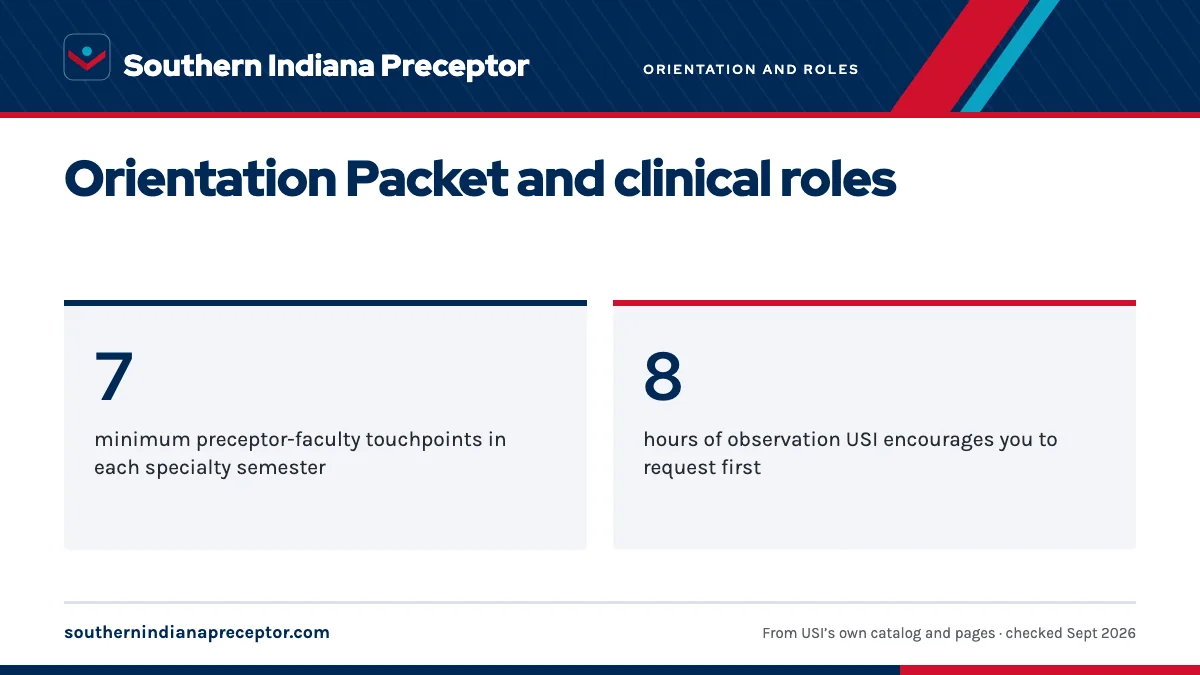
Every semester of the APRN specialty courses carries a floor of seven contacts between your preceptor and clinical course faculty. Tell your preceptor about all seven in the first week, because two of them need a slot on a clinic calendar.
| Touchpoint | When | Who makes it happen |
|---|---|---|
| Faculty email: welcome | Start of the course | Course faculty |
| Faculty email: midterm | Midterm | Course faculty |
| Faculty email: final | End of the course | Course faculty |
| Preceptor Feedback Form in Typhon | Midterm | Your preceptor |
| Preceptor Feedback Form in Typhon | End of the semester | Your preceptor |
| Phone call with faculty | Midterm | You, by booking a time with the preceptor |
| Phone call with faculty | Final | You, by booking a time with the preceptor |
You complete your own Student Feedback Forms in Typhon twice a semester as well. The Typhon page covers logging and co-signing.
The first days: observation, then patients
The FAQ suggests asking your preceptor for an 8-hour observation period at the start, before you take on patients more independently. Use that time to learn the practice's workflow, charting and patient mix. Whether those observation hours are logged toward your total is a question for course faculty; the FAQ is clear that time spent purely as an observer, without a preceptor agreement, does not count toward direct patient hours.
Two related rules shape the opening weeks. USI's FAQ rules out using a clinical site for workplace orientation, so a rotation at your employer cannot double as onboarding for your job. And other clinicians at the practice may let you watch without paperwork, though anyone there purely to watch cannot assess patients or carry out care plans. Anyone who will genuinely precept you must have their own Preceptor Agreement approved first (additional preceptors and observers).
How we prepare preceptors to say yes with confidence
Preceptors make firmer commitments when they know the job before agreeing to it. When our placement desk approaches clinicians for a USI student, we walk them through what USI asks: one-to-one teaching, physical presence in the facility, co-signed Typhon entries, a pair of feedback forms and a pair of faculty calls each term, and an Orientation Packet to read and acknowledge. By the time you meet, the conversation is about fit and schedule, not surprises.
You get a preceptor who understands a USI rotation, the Form G details already gathered, and a prompt to request the Orientation Packet so it reaches the preceptor before the signing. If a preceptor has to step away mid-semester, we begin on a replacement straight away (when a preceptor drops out). Begin with the contact form.
Questions USI students ask
Where can I download USI's Preceptor Orientation Packet?
You cannot; it is not posted online. Ask USI1Nursing@usi.edu for a copy, then pass it to your preceptor along with the Preceptor Packet, as the Clinical Experience page directs. Ask from your USI email, name your course and term, and allow time for a reply before your preceptor's signing meeting, since their signature confirms they have read it.
Does USI's malpractice insurance cover my preceptor?
No. USI's FAQ is explicit that the university's malpractice insurance does not cover preceptors. It applies to you as a student in the advanced practice nurse role, and you must give the preceptor, the agency and faculty proof of liability insurance. Preceptors who ask about their own coverage should check with their employer or their own insurer.
Who schedules the faculty phone calls with my preceptor?
You do. USI requires two phone calls between clinical course faculty and your preceptor each specialty semester, one at midterm and one at the final, and the handbook puts the scheduling on you: finding a slot for each call that works for the preceptor. Put both on the preceptor's calendar early, before clinic calendars book up.
Does my USI preceptor have to be with me the whole time?
USI requires the preceptor to be physically present in the clinical facility while you provide care, and procedures must be done under the direct supervision of a privileged clinical preceptor. Precepting is one-to-one. In FNP and PMHNP telehealth encounters, the patient is the only one off site; you and your preceptor share the approved clinical location.
Related pages
Last checked 2026-09-25
We check these pages against USI's own bulletin, program pages and Graduate Nursing Handbook. Your handbook, course faculty and the Nursing Clinical Coordinator have the final word.
- University of Southern Indiana Graduate Nursing Handbook: Clinical Roles and Responsibilities
- University of Southern Indiana Graduate Nursing Handbook: Clinical Experience
- University of Southern Indiana Graduate Nursing Handbook: University Clinical Requirements and Clinical Evaluation
- University of Southern Indiana Graduate Nursing Handbook: Clinical Practice FAQs
USI makes the search your job. We make it the easy part.
Tell us your USI track, your city and your next clinical semester. We find preceptors who fit the NRSG course and fill the Preceptor Packet and Clinical Education Agreement request with typed, complete details, well before USI's 6-week window.
- Preceptors matched to the course: family primary care for FNP, acute care teams for AGACNP, PMHNPs and psychiatrists for PMHNP
- Preceptor license, certification, years of practice and the site's agreement signer ready for the packet
- Fall, Spring and Summer planned together, close to home in a state USI enrolls
Start your placement plan
Track, city and clinical start is all we need to begin.