Precepting a University of Southern Indiana nurse practitioner student
Thank you for considering it. Precepting a University of Southern Indiana student means teaching one graduate student one-to-one in your own practice for a semester: you sign USI's Preceptor Packet, read its orientation packet, co-sign the student's logs in Typhon, and stay in touch with course faculty through two feedback forms, three emails and two phone calls. Here is the whole picture, so you can say yes knowing exactly what is involved.
Open to precepting?
Tell us your specialty and location, and we will match you with a USI student whose course fits your practice.
What USI asks of a preceptor
USI's online NP students live across the states the university enrolls, and most complete their clinical hours with clinicians in their own communities. USI approves every preceptor and site, signs a Clinical Education Agreement with the practice, and assigns course faculty who evaluate the student. Your part is the teaching.
The roles page asks preceptors to precept the student on a one-to-one clinical basis and to be on site in person whenever the student is seeing patients, with procedures under your direct supervision. Around that, the commitments fit on a short list:
- Review and sign the Preceptor Packet (Form G) for each course you precept.
- Read the Preceptor Orientation Packet, which the student brings you.
- Co-sign the student's patient encounter entries in Typhon.
- Complete a Preceptor Feedback Form at midterm and at the end of the semester.
- Take two phone calls with course faculty, at midterm and final, which the student arranges around your schedule.
Who can precept
The university's bar is the same for everyone who teaches its graduate students: a license in good standing where you practice, current specialty certification, twelve months or more as an advanced provider in your specialty, and no family or romantic connection to the student. If you are an NP or a PA, your board certification must also fit the student's track.
Which professions qualify depends on the track. A family practice NP, PA or primary care physician can take an FNP student from the first clinical course, and specialists become eligible from the second course on. NPs, PAs and physicians (MD or DO) working in acute care teach the acute care track. The psychiatric track accepts only PMHNPs and licensed psychiatrists. The details are on who can precept a USI student and PA and physician preceptors.
The paperwork, start to finish
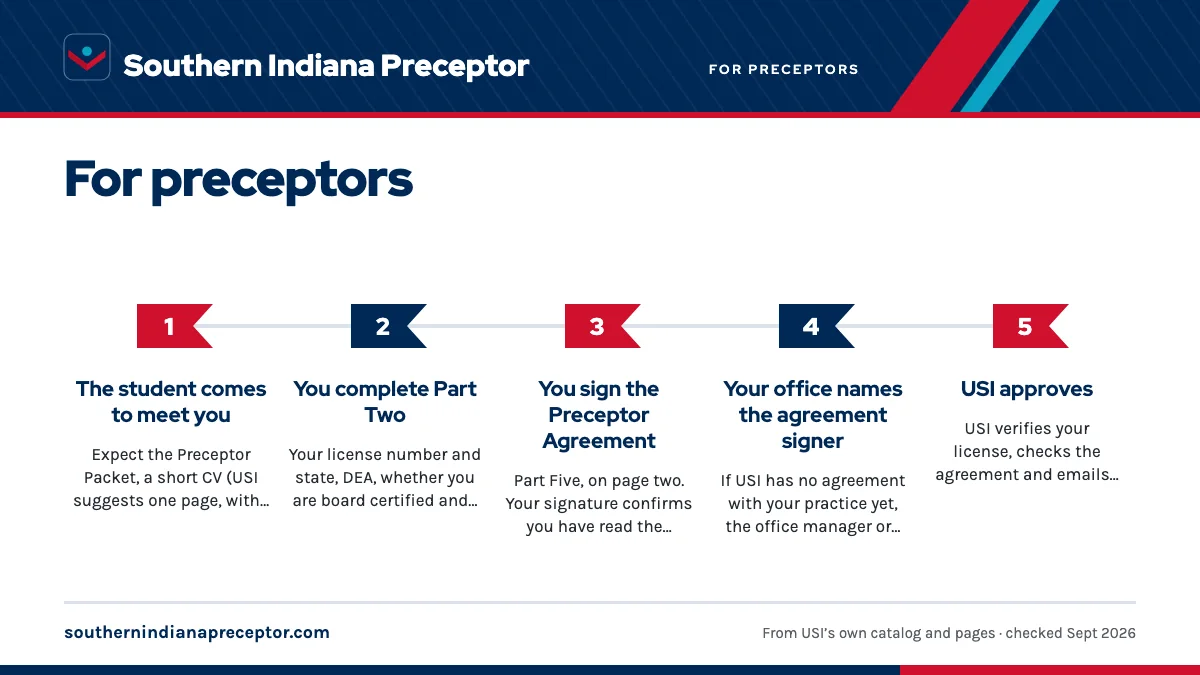
- The student comes to meet youExpect the Preceptor Packet, a short CV (USI suggests one page, with a professional photo) and a note of how many hours a week the course requires.
- You complete Part TwoYour license number and state, DEA, whether you are board certified and by which board, and your years at the current practice. Your office adds the site details and a short survey describing how many patients you see, your exam rooms, the kinds of patients, and how the student may use the EHR.
- You sign the Preceptor AgreementPart Five, on page two. Your signature confirms you have read the Preceptor Orientation Packet, and the agreement applies only to the course and term named on the form.
- Your office names the agreement signerIf USI has no agreement with your practice yet, the office manager or education coordinator fills in who is authorized to sign affiliation agreements for the practice. USI emails the Clinical Education Agreement to that person; students are not permitted to sign it.
- USI approvesUSI verifies your license, checks the agreement and emails the student an approval. The student begins only after that email arrives.
During the semester
Clinical starts by week 3 of the course and continues weekly. The student tells you the hours the course needs: 200, 250 or 300 across three specialty semesters that run Fall, Spring and Summer. USI encourages students to spend their first 8 hours with you observing before they see patients more independently. Clinical days never fall on university holidays or when courses are out of session.
The student logs each encounter in Typhon, and you review and co-sign those entries, which is how USI electronically verifies the student's time. Across the semester there are at least seven touchpoints between you and course faculty:
| Touchpoint | When | How |
|---|---|---|
| Welcome email | Start of the semester | From course faculty |
| Midterm email | Midterm | From course faculty |
| Midterm Preceptor Feedback Form | Midterm | You complete it in Typhon |
| Midterm call | Midterm | Phone, arranged by the student |
| Final email | End of the semester | From course faculty |
| Final Preceptor Feedback Form | End of the semester | You complete it in Typhon |
| Final call | End of the semester | Phone, arranged by the student |
Evaluation stays with faculty
You give feedback; course faculty assign the grade. Faculty complete formal clinical evaluations twice, at midterm and at the course's close, rating the student Does not meet, Meets or Exceeds, and the clinical part of the course is Pass/Fail. Your feedback forms and calls are how faculty see the student's day-to-day practice. The clinical evaluations page covers the scale.
Faculty may also schedule site visits when needed, hold conference calls with you and the student, or use video recordings to evaluate competency. If a concern comes up between touchpoints, contact course faculty directly.
Practical points worth knowing
The Preceptor Agreement states that there is no remuneration for precepting. USI's malpractice insurance covers the student in the student role but does not extend to the preceptor. If a colleague in your practice would like to share the teaching, they sign an additional Preceptor Agreement of their own, which USI approves before they precept.
USI has held a Preceptor Workshop offering continuing education for its clinical partners; its 2024 edition invited clinical faculty, education partners, clinical instructors and fieldwork educators. Ask the Nursing Clinical Coordinator at usi1nursing@usi.edu about the next one. The same mailbox answers questions about the forms, the orientation packet or an existing agreement with your organization.
How we make precepting easy for you
When a USI student comes to you through us, the groundwork is done before your first conversation. The student knows the course, the weekly hours and the schedule they need, and the placement desk has the packet fields prepared for you to confirm rather than a blank form to start from. Your office gets a clear, short list of what the site survey and agreement request require.
We welcome clinicians who are open to precepting and match them with students whose course fits the practice and whose timing fits the clinic calendar. If you would like to hear from USI students, choose "I'm a preceptor" in the form below and tell us your specialty and location.
Questions USI students ask
How much time does precepting a USI student take?
The student's course sets the hours: 200, 250 or 300 over a semester, starting by week 3. Beyond clinic time, you co-sign Typhon entries, complete two feedback forms and take two phone calls with faculty at midterm and final, which the student schedules at a time that suits you.
Am I covered by USI's malpractice insurance as a preceptor?
No. USI's malpractice policy extends to students acting in the student role of an advanced practice nurse, and its clinical FAQ is explicit that preceptors fall outside that coverage. If you have questions about how that fits your own practice, ask the Nursing Clinical Coordinator before you sign.
Do I need an Indiana license to precept a USI student?
No, unless you practice in Indiana. USI looks for a license in good standing in whichever state or territory you practice in. The student is the one who must be licensed in your state, because USI requires students to hold an unencumbered RN license wherever they do clinical hours.
Can I precept the same USI student for more than one course?
Yes, and students value that continuity. Each Preceptor Agreement now covers only the course and term written on it, so expect to confirm or sign again for each later course unless USI tells the student otherwise. The student prepares the paperwork and brings it to you.
Who signs the Clinical Education Agreement for my practice?
The person your office names on the request form as the signer of affiliation agreements, identified by your office manager or education coordinator. USI emails the agreement to that person for review and signature. If USI already has an agreement with your organization, this step may already be complete.
Related pages
Last checked 2026-09-25
We check these pages against USI's own bulletin, program pages and Graduate Nursing Handbook. Your handbook, course faculty and the Nursing Clinical Coordinator have the final word.
- University of Southern Indiana Preceptor Packet (Form G, updated 07/2026)
- University of Southern Indiana Graduate Nursing Handbook: Clinical Roles and Responsibilities
- University of Southern Indiana Graduate Nursing Handbook: University Clinical Requirements and Clinical Evaluation
- University of Southern Indiana Graduate Nursing Handbook: Clinical FAQs
- University of Southern Indiana Request for USI Clinical Education Agreement
USI makes the search your job. We make it the easy part.
Tell us your USI track, your city and your next clinical semester. We find preceptors who fit the NRSG course and fill the Preceptor Packet and Clinical Education Agreement request with typed, complete details, well before USI's 6-week window.
- Preceptors matched to the course: family primary care for FNP, acute care teams for AGACNP, PMHNPs and psychiatrists for PMHNP
- Preceptor license, certification, years of practice and the site's agreement signer ready for the packet
- Fall, Spring and Summer planned together, close to home in a state USI enrolls
Start your placement plan
Track, city and clinical start is all we need to begin.