CastleBranch (now DISA) at USI: your clinical compliance record
At the University of Southern Indiana, your clinical clearance lives in CastleBranch, the compliance platform that now carries the DISA name. Your background check, drug screen, immunizations, TB screening, life support cards and signed behavior agreement all sit in that one account, and each item has to stay valid through the final day of the semester.
Get your placement plan
Tell us your USI program and where you live. A placement advisor replies with the preceptor and site options that fit your course.
One compliance system, three names on USI pages
USI's own pages call this platform by several names, which confuses almost every new student. The Kinney College Handbook says "The Kinney College uses CastleBranch as a secure online system for student submission of documentation and faculty monitoring of results." The undergraduate handbook writes "DISA (formerly CastleBranch)", a nursing-home partner page writes "DISA/CastleBranch", and the Graduate Nursing Handbook usually says only "the University's designated third-party agency."
All of these point to one account. The graduate Health Requirements page labels its link "DISA Health Website" while sending you to a castlebranch.com address, and the Kinney College Infection Control Policy keeps medical records and program-required documents in CastleBranch. On this site we write CastleBranch (DISA) so the name matches whichever USI page you have open.
Watch one more naming trap. The graduate handbook also uses "third-party repository" for your clinical log, which is Typhon. A line about a lapsed BLS card being verified in the repository means DISA; a line about your preceptor verifying your time means Typhon.
What your CastleBranch (DISA) record holds
Picture the record as the file faculty open before you see a single patient. For a graduate nursing student it carries these items:
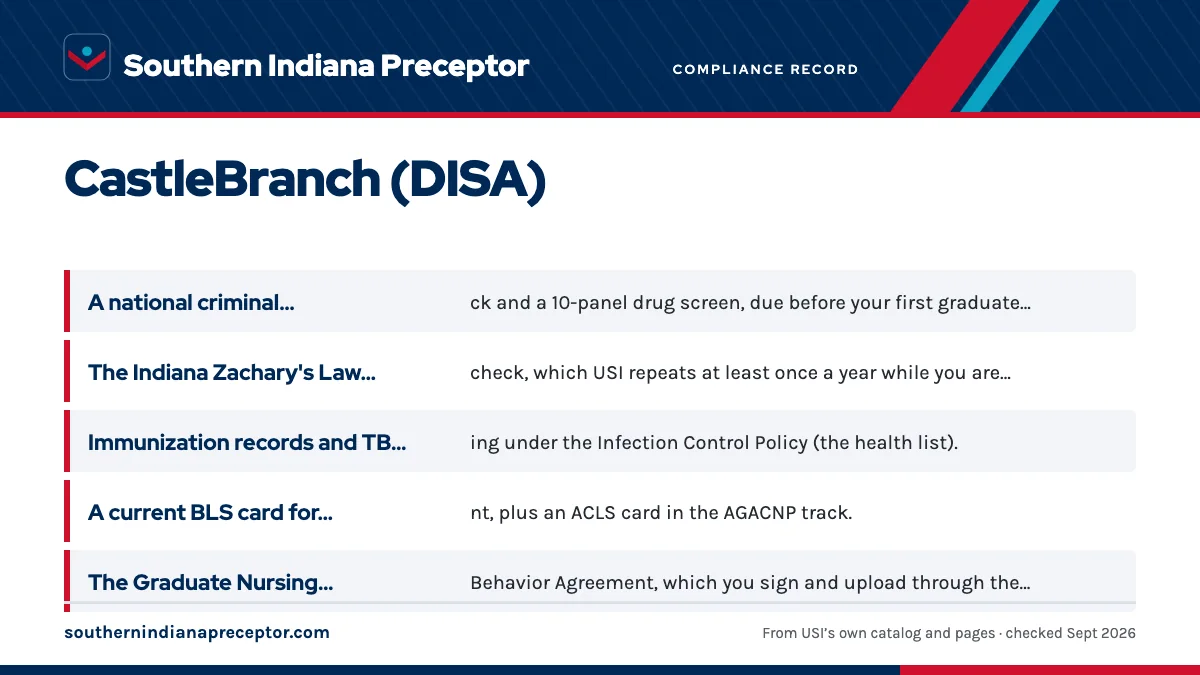
- A national criminal background check and a 10-panel drug screen, due before your first graduate nursing course (how that clearance works).
- The Indiana Zachary's Law registry check, which USI repeats at least once a year while you are enrolled.
- Immunization records and TB screening under the Infection Control Policy (the health list).
- A current BLS card for every student, plus an ACLS card in the AGACNP track.
- The Graduate Nursing Professional Behavior Agreement, which you sign and upload through the repository.
HIPAA and OSHA training also renew each year, and graduate students may submit certificates their employer issued. Those items, along with student liability coverage, are on the BLS, ACLS, HIPAA and OSHA page.
Due dates and the last-day-of-term test
The background check and drug screen come first: USI wants both on file before you enroll in your first graduate nursing course. Every other item is approved against due dates the program sets each semester, and your BLS card (plus ACLS for AGACNP) must be current when each semester opens.
The rule that trips students up is on the handbook's Health Requirements page: "No documentation can expire before the end of the semester." So the question for each item is whether its date reaches the final day of the term, not the first. Fall 2026 runs from August 17 to December 11, which means a BLS card that lapses in November fails the test even though it was valid on day one. Spring 2027 runs January 11 to May 7, and the 2026-27 calendar page has the summer sessions.
Yearly items pile up quietly: the flu shot, the registry check, HIPAA and OSHA all come due every twelve months. Put each renewal on the same calendar you use for the Fall, Spring and Summer clinical sequence.
What a late or incomplete record can cost
USI spells out the consequence. A student whose documents are not approved by the due dates "will be given a Performance Improvement Plan contract for not being prepared for clinical and may be administratively dropped from the course." In a clinical course that bites hard, because hours must begin by week 3 and continue every week you are registered.
Losing a specialty course can also push back the ones after it, since the MSN specialty courses run in a Fall, Spring and Summer order. How USI counts withdrawals toward progression is covered on the grades and progression page.
A clean result that never reached DISA still counts as missing: USI warns that failing to submit required information, even with negative results, may put enrollment or progression at risk.
Who runs the account, and outside checklists
The account is yours to open, fill and keep current. The undergraduate handbook says outright that BSN students "are required to purchase and complete all DISA requirements by the assigned due date." The Graduate Nursing Handbook describes the designated agency without spelling out the purchase, so if you are unsure what a graduate account involves, ask the Nursing Clinical Coordinator at usi1nursing@usi.edu before your first due date.
Faculty monitor what you post, and the Infection Control Policy keeps medical-status records inside CastleBranch rather than in course files. Health insurance and any costs from a clinical exposure stay with you as the student.
Hospital systems can add a layer of their own. Deaconess, for example, says it manages rotations and student compliance in myClinicalExchange once it approves a student, with the school's clinical coordinator requesting the rotation there. Your DISA record remains USI's; a site's system is a second checklist, and the Evansville preceptors page describes how local systems handle NP students.
Why USI students plan their placement with us
Clearance and placement run on one clock, so we plan them together. Tell us your program, your state and the semester your clinicals begin, and we pace the preceptor search so your Preceptor Packet and Clinical Education Agreement request reach USI complete, typed and early, well inside the 6-week window, while your DISA items are moving through approval.
We collect everything the packet asks about your preceptor: license, board certification, years in practice, DEA details, site information and the person who signs agreements for the site. When a site runs its own onboarding system, we tell you what it expects at the matching stage, so week one holds no surprises. We plan all three specialty semesters at the start and stay on call to find a replacement if a preceptor steps away. See how it works or use the form below.
Questions USI students ask
Is DISA the same as CastleBranch for USI nursing students?
Yes. The platform USI's Kinney College Handbook calls CastleBranch now operates under the DISA name, which is why the undergraduate handbook writes "DISA (formerly CastleBranch)" and the graduate handbook labels a castlebranch.com link as the DISA Health Website. You keep one account for the program, usually described in the graduate handbook as the designated third-party agency.
Can I start clinical hours while a DISA item is still pending?
Plan on waiting. The handbook bars clinical work during a BLS lapse until the renewal is verified in the repository, and records not approved by the due dates can bring a Performance Improvement Plan and a course drop. Your preceptor and site also need USI's approval email first. If one item is stuck, tell your course faculty before your planned start.
Will USI accept compliance records from my hospital job?
For graduate students the handbook names one clear substitute: HIPAA and OSHA certificates issued through your employer can replace USI's yearly modules. An outside drug screen counts only if it covered at least 10 panels within the prior three months. Everything else goes into your own DISA account under USI's rules, so ask the Nursing Clinical Coordinator before leaning on any other employer document.
Who can see the documents I upload to CastleBranch?
USI describes CastleBranch as a system for student submission of documentation and faculty monitoring of results, so program faculty review what you post. The Kinney College Infection Control Policy adds that records about your medical status and program-required documents are maintained by CastleBranch, which keeps them in one controlled place instead of scattered across emails.
What should I check in DISA before each new semester?
Compare every expiration date with the last day of the coming term. Renew the yearly items (flu shot, HIPAA, OSHA and the Zachary's Law check) before they lapse, confirm your BLS or ACLS card runs past finals, and make sure your RN license is current in the state where your clinical site sits.
Related pages
Last checked 2026-09-25
We check these pages against USI's own bulletin, program pages and Graduate Nursing Handbook. Your handbook, course faculty and the Nursing Clinical Coordinator have the final word.
- University of Southern Indiana, Kinney College Handbook: Overview of Clinical / Fieldwork Expectations
- University of Southern Indiana, Graduate Nursing Handbook: Clinical Practice Requirements
- University of Southern Indiana, Kinney College Infection Control Policy 2026-2027 (PDF)
- University of Southern Indiana, BSN Handbook: Mandatory Requirements for All Students
USI makes the search your job. We make it the easy part.
Tell us your USI track, your city and your next clinical semester. We find preceptors who fit the NRSG course and fill the Preceptor Packet and Clinical Education Agreement request with typed, complete details, well before USI's 6-week window.
- Preceptors matched to the course: family primary care for FNP, acute care teams for AGACNP, PMHNPs and psychiatrists for PMHNP
- Preceptor license, certification, years of practice and the site's agreement signer ready for the packet
- Fall, Spring and Summer planned together, close to home in a state USI enrolls
Start your placement plan
Track, city and clinical start is all we need to begin.