Three routes to a USI clinical placement, compared
A University of Southern Indiana NP student can land an approved preceptor three ways: search alone, ask USI for help after reporting difficulty, or hire a third-party placement organization. Every route finishes at the same Preceptor Packet, agreement and approval email. The differences lie in who carries the search, how many of your weeks it uses and what you pay.
Get your placement plan
Tell us your USI program and where you live. A placement advisor replies with the preceptor and site options that fit your course.
The finish line is the same on every route
However the preceptor is found, USI checks the result the same way. The preceptor must hold an unencumbered license and specialty certification and have practiced as an advanced provider for a year or more. The site enters a Clinical Education Agreement with USI, the Graduate Clinical Liaison approves, and the confirmation email comes before any hours.
So the real comparison is about the search: who runs it, how early it starts and how closely it fits USI's rules for your course. After that, everyone follows the same ten-step process.
One more constant: the preceptor precepts you one-to-one while physically present, co-signs your Typhon entries and completes Preceptor Feedback Forms at midterm and at the end of the semester. Whoever finds the preceptor should make sure they are ready for that role.
The three routes side by side
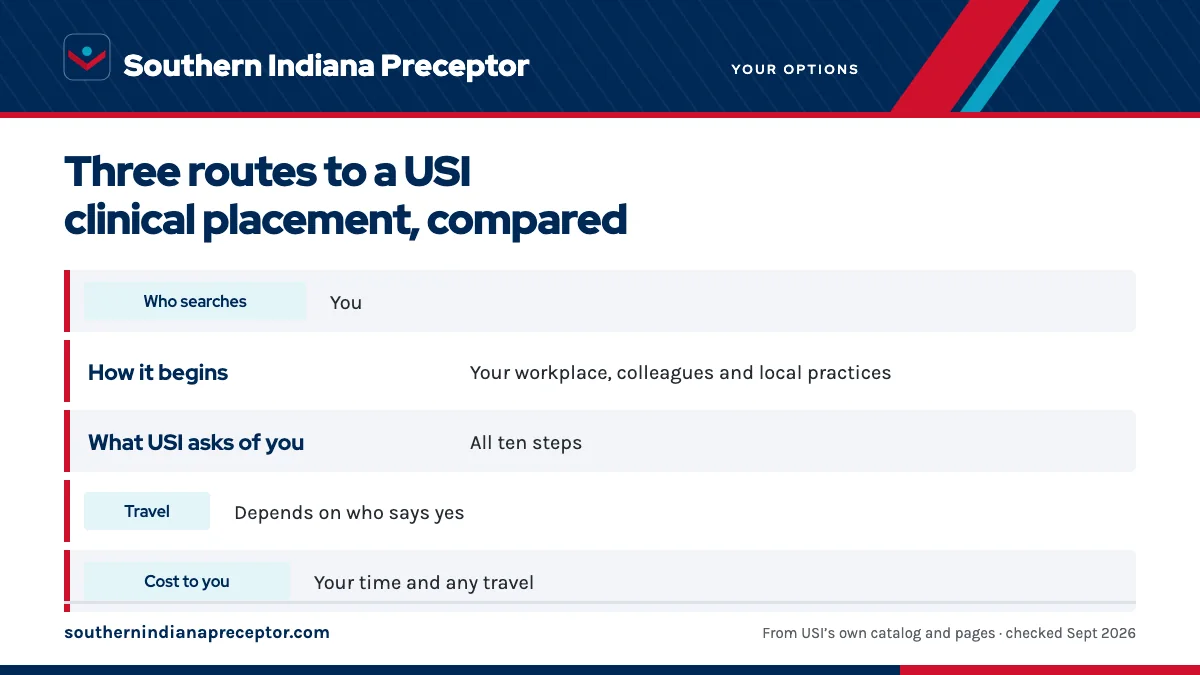
Read across a row to see where the routes part ways. The cost row covers the search only; USI's own clinical purchases, such as Typhon, apply to everyone.
| Your own search | USI's help when stuck | A placement organization | |
|---|---|---|---|
| Who searches | You | You, with faculty and staff collaborating | The organization, on your behalf |
| How it begins | Your workplace, colleagues and local practices | An email to the Nursing Clinical Coordinator | Your track, course and location sent to the service |
| What USI asks of you | All ten steps | Confirm no workplace option, share your contact list, stay in touch | All ten steps, sent from your USI email |
| Travel | Depends on who says yes | USI notes a placement may require travel | Depends on the search; ours begins close to home |
| Cost to you | Your time and any travel | Your time and any travel | A service fee, plus any travel |
| Suits you when | You have strong local contacts and time | Your own leads have run out | Time is tight or you want all three semesters planned |
The sections below take each route in turn, with the USI rules that shape it.
Route one: your own search
This is the route USI's handbook assumes. You know your region, your employer and your colleagues, and a preceptor who already knows your work can be the easiest yes you will get.
The cost is time. Each lead needs a credential check against USI's rules, a meeting, the packet, the agreement request and a named signer, and the cycle repeats across Fall, Spring and Summer as your hours climb from 200 to 250 to 300. Keep a log of every practice you approach, because USI asks for that list if you later need its help. Our guide to finding your own preceptor lays out a search order to follow, starting with your employer and the preceptor types your track allows.
Route two: USI's help once you report difficulty
When your own search stalls, USI asks you to write to usi1nursing@usi.edu, the Nursing Clinical Coordinator's mailbox, confirm you have no preceptor option at your workplace, send the organizations you have already tried and keep communicating. Faculty and staff then collaborate with you, building on your list rather than repeating it.
Timing matters here, and USI's pages give two figures. The Clinical Experience page says to report no preceptor or agreement contact at least 6 weeks before the course or semester; the University Clinical Requirements page says at least 4 weeks before the semester. Work to the earlier one. This route keeps the search in your hands with extra support, and the result may involve travel. The can't find a preceptor guide covers the email step by step.
Route three: a third-party placement organization
USI's handbook anticipates this route. It tells students "there might be need to utilize third party clinical placement organizations," and it places those fees on the student. The third-party placement page reads the full paragraph in context.
What this route changes is who carries the search. A good organization matches a preceptor to your NRSG course, screens the credentials USI reviews, and hands you the preceptor and site details the packet asks for. It can change the timing too, since a service that starts well before the 6-week window leaves room for the site's signer to return the agreement. What stays the same is everything USI controls: you submit from your USI email, the Graduate Clinical Liaison reviews, and USI approves.
Mixing the routes
The routes combine well. You can start at your workplace, keep a contact log, and bring in help once the calendar gets tight. If you have already written to the Nursing Clinical Coordinator, keep them posted when a placement comes through, which USI asks for.
Share your log with whoever helps. It keeps two parties from calling the same office, and it shows which practices have already said no and why. Note which preceptors were ineligible, too, such as a PA for a PMHNP course, so nobody approaches them again. For a course that is close to starting, the need a preceptor fast guide sets priorities for the weeks you have left.
Why students who choose route three choose us
We run route three the way USI's own process expects it to run. Our placement desk searches your community for preceptors who fit your track and course, checks every credential against USI's rules before you meet, and hands you the details for Form G and the agreement request, typed and ready, well inside the 6-week window.
For PMHNP students that means PMHNPs and psychiatrists in outpatient settings; for AGACNP, acute care teams; for FNP, family primary care first, with specialty options in the later courses. We plan Fall, Spring and Summer together and stay on call through each semester. The how it works page shows every step, and cost explains what shapes a quote.
Questions USI students ask
Can I start on my own and bring in help later?
Yes, and it is a sensible order. Your own leads, especially at your workplace, are worth trying first. Keep a record of each practice you contact and its answer, then share that record with USI or a placement service so the next round of outreach reaches new offices instead of repeating yours.
Should I tell USI I am using a placement organization?
USI asks students who have reported difficulty to keep communicating and to share the news when a placement is found, so keep the Nursing Clinical Coordinator in the loop. It avoids duplicate calls to the same practice, and your Preceptor Packet will arrive in the same inbox whichever route found the preceptor.
Which route gets me approved fastest?
USI's review runs the same way on every route, so the speed difference lies in the search. Whichever route reaches a willing, eligible preceptor first comes out ahead, so the date you begin counts for more than the route you pick. Finding a preceptor well ahead of the 6-week packet deadline leaves time for the agreement signer to act.
Does any route let me skip the Preceptor Packet?
No. Every route ends with the Preceptor Packet (Form G) and the Request for USI Clinical Education Agreement, emailed from your USI account. If the site already has an agreement with USI, the contract step may already be covered, so ask usi1nursing@usi.edu before you send the request.
Related pages
Last checked 2026-09-25
We check these pages against USI's own bulletin, program pages and Graduate Nursing Handbook. Your handbook, course faculty and the Nursing Clinical Coordinator have the final word.
USI makes the search your job. We make it the easy part.
Tell us your USI track, your city and your next clinical semester. We find preceptors who fit the NRSG course and fill the Preceptor Packet and Clinical Education Agreement request with typed, complete details, well before USI's 6-week window.
- Preceptors matched to the course: family primary care for FNP, acute care teams for AGACNP, PMHNPs and psychiatrists for PMHNP
- Preceptor license, certification, years of practice and the site's agreement signer ready for the packet
- Fall, Spring and Summer planned together, close to home in a state USI enrolls
Start your placement plan
Track, city and clinical start is all we need to begin.