USI's note on third-party clinical placement organizations
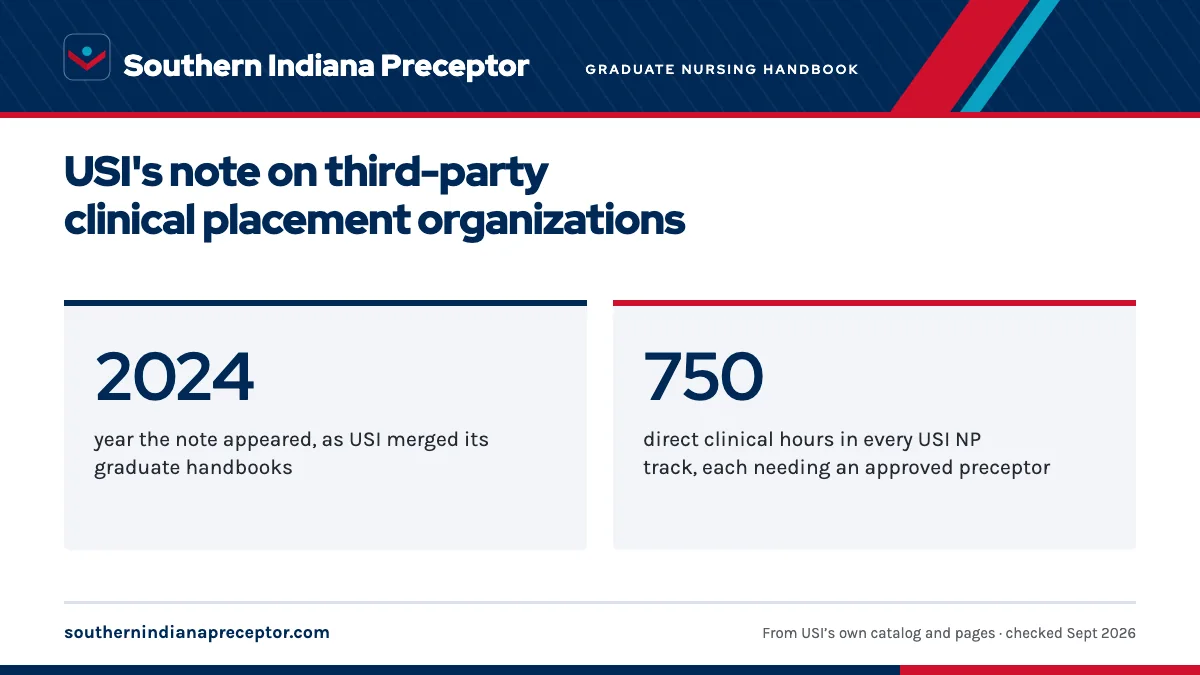
Since late 2024, the University of Southern Indiana's Graduate Nursing Handbook has told graduate students that securing a placement may take travel or a third-party clinical placement organization, and that the student pays for either. It is a practical heads-up rather than a requirement, and it leaves USI's approval of every preceptor and site exactly where it was.
Get your placement plan
Tell us your USI program and where you live. A placement advisor replies with the preceptor and site options that fit your course.
The paragraph, word for word
It appears on the handbook's University Clinical Requirements and Clinical Evaluation page, last modified August 6, 2026:
"Graduate faculty and staff will collaborate with the student to secure a clinical placement, but it may require travel to access these opportunities. Please be aware that there might be need to utilize third party clinical placement organizations which may incorporate organizational fees associated with securing a placement, including fees for placement services or administrative expenses from external agencies. These fees for third party placement or travel are the sole responsibility of the student."
Three ideas are packed into it. USI's faculty and staff will work with you when a placement is hard to secure. The answer may sit farther from home than you hoped. And an outside organization may be part of the answer, at your own expense, whether it charges for the placement service itself or passes along administrative costs from other agencies.
When it appeared, and what came before
Archived copies of USI's page date it closely. The paragraph is in the first capture of the Graduate Nursing Handbook page, taken November 5, 2024, and reads the same in captures from August 2025 and February 2026. It is absent from the separate MSN handbook page captured August 5, 2024. It arrived, in other words, when USI folded its MSN and BSN-to-DNP handbooks into a single Graduate Nursing Handbook that fall.
Earlier handbooks carried a lighter version of the same message. In 2023 they told students USI would "work with you to obtain a clinical placement," while warning that reaching a site might mean travel, and paid outside help went unmentioned. The 2021 MSN handbook page had no note of this kind at all.
The catalog still reads differently. The 2026-27 Graduate Bulletin says students are encouraged to identify preceptors with the clinical liaison's assistance, and it leaves outside organizations out. Where the two disagree, the current handbook and the Nursing Clinical Coordinator are the places to confirm.
What the note says, and what it leaves open
Read closely, the paragraph is narrower than a quick skim suggests.
- It is conditional. "There might be need" describes a possibility, not a step every student takes.
- It names no organization and recommends none. The choice, if you make one, is yours.
- It leaves approval untouched. The Graduate Clinical Liaison still approves every preceptor and site, the site still signs a Clinical Education Agreement with USI, and no hours begin before the confirmation email.
- It keeps the search with you. The same page still makes the student responsible for identifying preceptors and sites in their own community.
- It sits beside USI's help, not in place of it. The requests for stuck students (write to the Nursing Clinical Coordinator, confirm there is no option at your workplace, share the organizations you have tried) appear right alongside it.
What it means for your clinical plan
Treat the note as a planning input. Your NP track has three direct-care courses across Fall, Spring and Summer, and each needs an approved preceptor, a signed agreement and a Preceptor Packet in USI's hands 6 weeks before the rotation. Post-master's certificate students carry the full load too, since USI credits no clinical hours from an earlier degree. The clinical hours guide shows the split by track.
The note names two costs: travel and outside placement fees. A preceptor close to home keeps the first in check. Deciding early whether you want outside help keeps you inside the 6-week window if your own search runs long. And whatever route you take, the packet, the agreement request and the approval email are identical, as the options comparison sets out side by side.
Using a placement service well
If you bring in outside help, a few habits keep everything smooth on USI's side.
- Start early. The further ahead of the window a search begins, the more choice you have in preceptor, site and schedule.
- Give the exact course.
NRSG 643family primary care calls for a different preceptor thanNRSG 637acute care orNRSG 653outpatient psychiatry. - Ask for what Form G needs: the preceptor's license, certification and years in practice, the site survey answers and the site's agreement signer, not just a name.
- Keep sending the packet yourself, from your USI email, with USI's subject line.
- Tell the Nursing Clinical Coordinator when a placement is found. USI asks students who reported difficulty to share that news.
- Keep your own items current: DISA records, BLS (plus ACLS for AGACNP) and an unencumbered RN license in the clinical state.
The guide to choosing a placement service goes further into what a service should deliver for a USI student.
Why USI students who choose a service choose us
We built our service around the documents this note sits beside. Every search starts from your USI track and NRSG course, every preceptor is checked against USI's license, certification and experience rules before you meet, and every packet reaches you typed, complete and early.
We plan all three specialty semesters at once, look close to home first so travel stays manageable, and remain on call through the semester if a preceptor has to step away. USI approves every preceptor and signs every agreement; our job is to make sure what reaches USI is right the first time. If you have already started searching, send us your contact log so our outreach adds new names instead of repeating yours. The cost page explains how we quote, and how it works walks through each step.
Questions USI students ask
Does USI require students to use a placement company?
No. The handbook presents outside organizations as something a student may end up needing, not as a required step. The student stays responsible for identifying preceptors and sites, faculty and staff collaborate when a placement is hard to find, and USI's own help for stuck students still applies. Bringing in an organization is your decision.
Will USI reimburse a placement organization's fee?
Plan on paying it yourself. The handbook places those fees, and travel costs, on the student. Several other clinical costs also sit with you under USI's rules, including the Typhon, i-Human and Barkley Board Review purchases, which is why a written quote from any outside service makes budgeting for the year easier.
Does USI approve a preceptor that a placement service finds?
Through the same process as any other. The preceptor completes the Preceptor Packet, the site's signer receives a Clinical Education Agreement, the liaison and faculty review it, and you begin only after the confirmation email. How a preceptor was found changes none of the license, certification or experience rules they must meet.
Does the note apply to DNP, NEL and HSL students?
It sits in the Graduate Nursing Handbook, which serves all of USI's graduate nursing programs. NEL and HSL students follow the same approval process for practicum sites, and DNP students identify their own project practice partners. The Graduate Chair and APRN Director or the Nursing Clinical Coordinator can confirm how it applies to your courses.
How does this work for students living in Alaska?
Differently. For Alaska residents, USI's graduate program makes every preceptor choice itself, and independent selection is off the table. APRN students also apply for a preceptorship through the Alaska Board of Nursing and pay its registration fee, while NEL and HSL students skip that prior authorization. The Alaska rule page has the details.
Related pages
Last checked 2026-09-25
We check these pages against USI's own bulletin, program pages and Graduate Nursing Handbook. Your handbook, course faculty and the Nursing Clinical Coordinator have the final word.
- University of Southern Indiana Graduate Nursing Handbook: University Clinical Requirements and Clinical Evaluation
- University of Southern Indiana Graduate Nursing Handbook page (archived November 5, 2024)
- University of Southern Indiana MSN handbook clinical requirements page (archived August 5, 2024)
- University of Southern Indiana 2026-2027 Graduate Bulletin: MSN Family Nurse Practitioner
USI makes the search your job. We make it the easy part.
Tell us your USI track, your city and your next clinical semester. We find preceptors who fit the NRSG course and fill the Preceptor Packet and Clinical Education Agreement request with typed, complete details, well before USI's 6-week window.
- Preceptors matched to the course: family primary care for FNP, acute care teams for AGACNP, PMHNPs and psychiatrists for PMHNP
- Preceptor license, certification, years of practice and the site's agreement signer ready for the packet
- Fall, Spring and Summer planned together, close to home in a state USI enrolls
Start your placement plan
Track, city and clinical start is all we need to begin.