USI's post-MSN DNP: one 35-credit plan, two concentrations
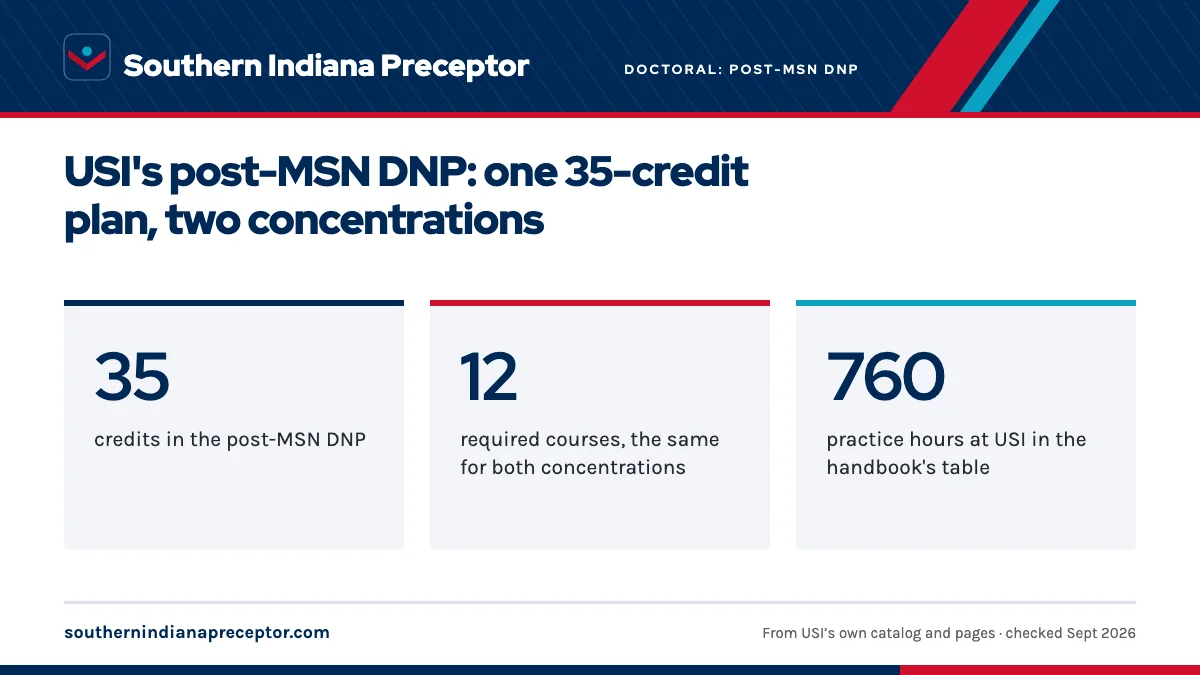
The University of Southern Indiana's online post-MSN Doctor of Nursing Practice is 35 credits in 12 required courses, offered in two concentrations: Advanced Nursing Practice for nurse practitioners and Organizational and Systems Leadership for nurses from non-clinical backgrounds. You need 1,000 post-baccalaureate practice hours, up to 500 of which can come from your MSN, and the handbook puts the USI share at 760.
Find your DNP project site
Tell us your concentration, your city and your project idea.
Two concentrations, one plan of study
USI's program pages pitch Advanced Nursing Practice at nurse practitioners and OSL at students with a non-clinical background, but the bulletin is explicit that the plan of study is the same, with every student enrolling in the 12 required DNP courses. Your concentration shapes your project, not your course list.
| Course | Credits | Practice hours |
|---|---|---|
NRSG 703 Theoretical and Conceptual Foundations of Nursing Practice | 3 | 25 |
NRSG 705 Evidence Appraisal and Translation for Advanced Nursing | 3 | none listed |
NRSG 707 Strategic Information Systems for Nursing | 3 | none listed |
NRSG 709 Healthcare Policy and Advocacy | 3 | 50 |
NRSG 711 Strategic Leadership for Healthcare | 3 | 40 |
NRSG 713 Applied Statistics for Evidence-Based Nursing Practice | 3 | none listed |
NRSG 715 Health Promotion and Population Health | 3 | 30 |
NRSG 801 DNP Project I | 2 | 125 |
NRSG 803 DNP Project II | 3 | 200 |
NRSG 805 DNP Project III | 3 | 175 |
NRSG 807 Healthcare Resource Utilization | 3 | 40 |
NRSG 809 Advanced Systems-Based Project Planning in Nursing | 3 | 75 |
| Total | 35 | 760 |
Six core courses carry 260 embedded hours between them, and the three project courses carry the other 500. None of the 12 is an NP specialty clinical course, so your practice hours center on the core courses and the DNP project. BSN-prepared nurses who need the specialty itself take the BSN-to-DNP route instead.
Admission and your hours worksheet
You apply with a nursing master's from a school holding national and regional accreditation, a graduate GPA of 3.00 or more, a graduate research course passed with a B or higher, RN licensure without encumbrance and a resume or CV, and faculty may ask to interview you. Starts come each August (the program page names August 2027, applications by July, then August 2028), and USI estimates two years or a little more.
After admission USI prepares a worksheet analysis and plan of study for you, mapping how you will reach the required practice hours. Keep it close. It is the one document written for your own hours, and it is the place to settle the conflicts described below.
Bringing practice hours from your MSN
The doctorate needs 1,000 post-baccalaureate practice hours in total, and your MSN can supply as many as 500 of them. Nationally certified APRNs prove those hours simply, by sending their board certification to the Chair of Graduate Nursing. Other nurses use USI's MSN hour documentation form, signed by the chair or a designee at the school where they earned the master's.
Nurses from leadership, education or other non-clinical master's programs should look closely at one more rule. Arrive with under 240 MSN clinical hours and the shortfall is made up inside the project courses, which means your project site will host more of your time. The DNP practice hours page sets out every route.
USI's figures disagree: 760 or 715
Two USI documents describe the post-MSN hours differently. The handbook's table gives 260 hours embedded in six courses plus 500 in the project courses, a USI total of 760. The 2026-27 bulletin instead refers to 215 hours built into courses alongside 500 for the project, which implies 715.
Neither page explains the 45-hour difference, and both are current. Plan to the handbook's 760 unless your worksheet analysis says otherwise, and get the figure that applies to you confirmed in writing by the Chair of Graduate Nursing. Either way, the project courses carry the largest share, so the site hosting your project matters more than any other placement decision in this program.
Intensives, transfer credit and progression
Coursework is online, and the program pages promise "synchronous online intensives twice a year." The handbook describes the same format as a hybrid method with virtual intensives and makes attendance at each one mandatory, so request those days off work the moment the dates are announced.
Transfer is less clear. The program pages say USI will "accept up to 42 credit hours from your MSN to help accelerate your DNP," while the bulletin and handbook cap transfer at 40 percent of the credits the degree requires. The two statements may describe different things, recognition of the MSN versus transfer of doctoral courses, so ask admissions how each applies to your transcript.
Every course needs a B or better. A second withdrawal ends progression for post-MSN students, although all withdrawals taken in one semester are treated as one.
The DNP project at a site near you
Your project can run at a health care organization in your own town, according to USI's program pages, which suits working nurses in the online program. USI assigns you a primary faculty mentor; you find one or more practice partners at the site, record them on USI's Practice Partner form, then take the proposal through committee review and IRB requirements.
Its 500 hours split 125, 200 and 175 across the three project courses. The proposal is shown as a poster in the middle course, the project wraps up in the last one, and the results go out by conference talk or journal submission along with an Executive Summary. See the practice partner page for each step.
Where post-MSN DNP students can enroll
Residency limits differ by concentration, and the disclosure table does not map neatly onto the post-MSN program.
| Row | Enrollment Not Allowed | Other issue |
|---|---|---|
| DNP, Advanced Nursing Practice | AL, AZ, CO, DE, LA, MA, MN, MS, NV, NY, OK, PA, WA, WY, plus DC, AS, GU, CNMI and PR | ND marked as both Meets and Does Not Meet |
| DNP, Organizational and Systems Leadership (labeled BSN to DNP) | CO, DE, MN, MS, NY, OK, PA, WY, plus DC, AS, GU and CNMI | Licensure columns read N/A |
The table has no row of its own for the post-MSN OSL concentration; its only OSL row carries the BSN to DNP label. North Dakota's double listing in the Advanced Nursing Practice row is also left unresolved. Check the current licensure disclosure and ask USI which list covers you before you apply.
Relocating mid-program to a state USI does not serve ends online coursework, with active military status the only exception, so raise any planned move early with the Program Chair and APRN Director.
Why post-MSN DNP students choose us
In the post-MSN DNP, your most important placement is the project site: the organization and practice partner that host at least 500 hours of your work across three semesters. Our placement desk looks at nearby health systems, clinics and agencies with a stake in your topic, finds leaders there ready to serve as practice partner, and explains USI's partner form and review calendar to them ahead of your formal request.
If your MSN left you short of 240 clinical hours, we look for a site with room for the extra time from the start. We plan the search around your worksheet analysis and the intensive dates, and we stay on call if a partner's role changes midway. Tell us your concentration and city using the form below.
Questions USI students ask
Which post-MSN DNP concentration should a nurse practitioner choose?
USI's program pages describe Advanced Nursing Practice as designed for nurse practitioners and OSL as designed for students with a non-clinical background. Since both follow the same 12-course plan, the choice mostly frames your DNP project. USI's graduate nursing office can advise on which fits your goals before you apply.
How long does USI's post-MSN DNP take?
USI's program pages list it as 2+ years, with an August start. The 35 credits run across Fall, Spring and Summer terms, and the three project courses are offered in Fall and Spring. A plan with extra practice hours, for students whose MSN had fewer than 240 clinical hours, may need more time in the project courses.
Do I need a clinical preceptor for the post-MSN DNP?
The post-MSN plan has no NP specialty clinical courses, which is where USI's Preceptor Packet process applies. Your practice hours center on the DNP project, with a partner you recruit and a mentor from the faculty. For hours embedded in core courses, each syllabus sets the activity and any site it requires.
Are the post-MSN DNP intensives held on campus?
No. USI describes them as synchronous online intensives, twice a year, and the handbook calls them virtual. Attendance at each intensive is mandatory, so plan time away from work for every session. Watch your course announcements for the dates. The handbook uses the same virtual format for the BSN-to-DNP, so the rule is consistent across USI's DNP routes.
Can I transfer DNP courses from another university?
The bulletin and handbook allow up to 40 percent of the degree's total credit hours to transfer from another accredited nursing program, provided it holds both national and regional accreditation. The program pages separately mention accepting up to 42 credit hours from your MSN. Ask admissions to review your transcript before you enroll, because the two rules may not mean the same thing.
Related pages
Last checked 2026-09-25
We check these pages against USI's own bulletin, program pages and Graduate Nursing Handbook. Your handbook, course faculty and the Nursing Clinical Coordinator have the final word.
- University of Southern Indiana 2026-2027 Graduate Bulletin: DNP, Advanced Nursing Practice (Post-MSN)
- University of Southern Indiana 2026-2027 Graduate Bulletin: DNP, Organizational and Systems Leadership (Post-MSN)
- University of Southern Indiana Graduate Nursing Handbook: BSN-DNP and Post MSN-DNP
- University of Southern Indiana: DNP, Advanced Nursing Practice program page
- University of Southern Indiana Professional Licensure Disclosure
USI makes the search your job. We make it the easy part.
Tell us your USI track, your city and your next clinical semester. We find preceptors who fit the NRSG course and fill the Preceptor Packet and Clinical Education Agreement request with typed, complete details, well before USI's 6-week window.
- Preceptors matched to the course: family primary care for FNP, acute care teams for AGACNP, PMHNPs and psychiatrists for PMHNP
- Preceptor license, certification, years of practice and the site's agreement signer ready for the packet
- Fall, Spring and Summer planned together, close to home in a state USI enrolls
Start your placement plan
Track, city and clinical start is all we need to begin.