USI DNP practice hours: the 1,000-hour floor and each route's total
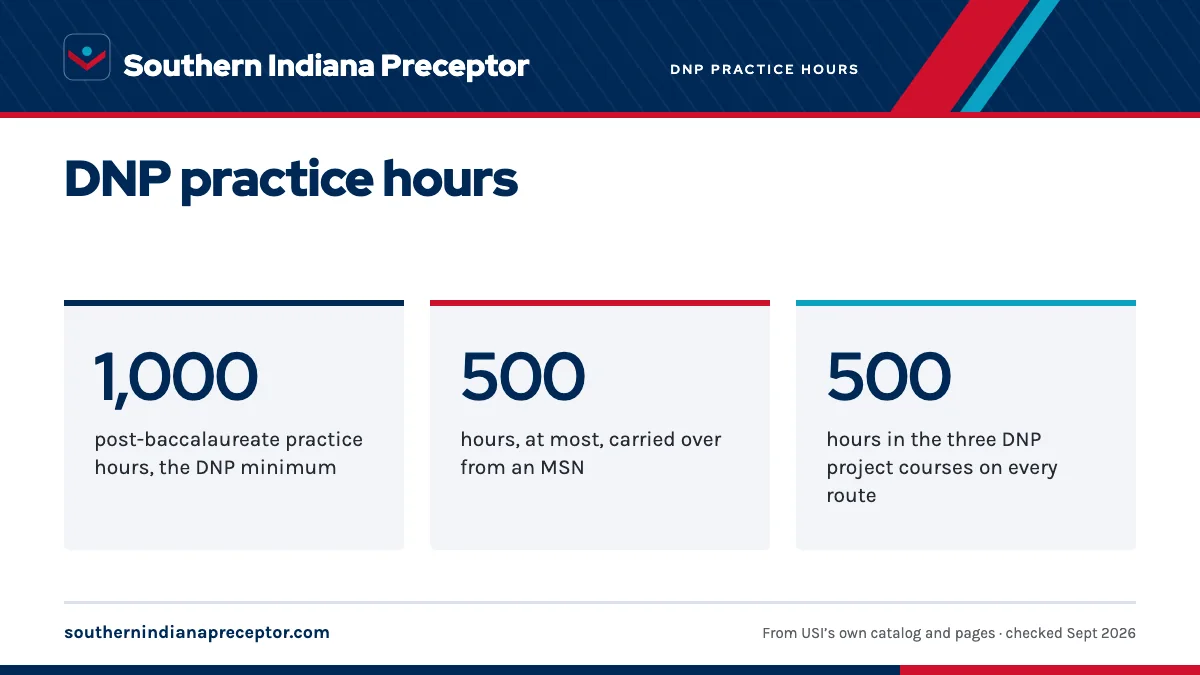
USI requires at least 1,000 post-baccalaureate practice hours for the Doctor of Nursing Practice. Post-MSN students may bring up to 500 from their MSN and complete 760 at USI under the handbook's table; BSN-to-DNP students complete 1,510 in the nurse practitioner tracks and 1,005 in Organizational and Systems Leadership. USI's own sources disagree on two of those figures, and this page shows both versions.
Get your placement plan
Tell us your USI program and where you live. A placement advisor replies with the preceptor and site options that fit your course.
The rule behind every DNP route
The Graduate Nursing Handbook's DNP page sets one floor for everyone: 1,000 practice hours after the bachelor's degree. Up to 500 of them may transfer from a previous MSN. The rest are earned at USI, partly in hours embedded in core courses and partly in the three DNP project courses.
How you document the MSN share depends on your background. APRNs with national board certification validate the 500 by sending a copy of that certification to the Chair of Graduate Nursing. Everyone else submits the MSN Practice Hour Documentation Form, titled "DNP Practice Hours," signed by the department chair or a designee at the school that granted the MSN.
A third rule catches nurses whose master's had little clinical time. Post-master's students who enter with fewer than 240 clinical hours from their MSN complete additional practice hours within the DNP project courses.
Hours by course and route
Six core courses carry the same embedded hours on every route, 260 in all. What sits on top differs: the NP specialty's 750 for BSN-to-DNP nurse practitioner students, four leadership rows for OSL, and 500 project hours for everyone.
| Course | Post-MSN DNP | BSN-to-DNP (FNP, AGACNP, PMHNP) | BSN-to-DNP (OSL) |
|---|---|---|---|
NRSG 703 | 25 | 25 | 25 |
NRSG 709 | 50 | 50 | 50 |
NRSG 711 | 40 | 40 | 40 |
NRSG 715 | 30 | 30 | 30 |
NRSG 807 | 40 | 40 | 40 |
NRSG 809 | 75 | 75 | 75 |
| Specialty I, II, III | n/a | 200, 250, 300 | n/a |
NRSG 761 | n/a | n/a | 40 |
NRSG 861 | n/a | n/a | 30 |
| "NRSG 856" (as printed) | n/a | n/a | 75 |
NRSG 867 | n/a | n/a | 100 |
NRSG 801 / NRSG 803 / NRSG 805 (project) | 125 / 200 / 175 | 125 / 200 / 175 | 125 / 200 / 175 |
| Handbook total | 760 | 1,510 | 1,005 |
The post-MSN column is 260 embedded plus 500 project hours, or 760 completed at USI. The arithmetic also explains the 240-hour threshold: 240 MSN hours plus 760 at USI makes exactly 1,000, so anyone arriving with less must make up the gap inside the project courses.
Conflict one: 760 or 715 for the post-MSN DNP
The 2026-27 Graduate Bulletin describes post-MSN hours differently from the handbook. It says every post-MSN student receives a worksheet analysis with a plan of study to reach "500 hours combined with the 215 hours integrated in courses," and that 500 hours are dedicated to the DNP project. The handbook's six embedded courses add up to 260, not 215, for a USI total of 760 rather than 715.
Both documents are live, and neither explains the 45-hour gap. Your worksheet analysis is the document written for your own plan, so read it against the handbook table and ask the Chair of Graduate Nursing to reconcile any figure that does not match before you schedule project hours. The post-MSN DNP page covers the rest of that route.
Conflict two: 1,005 or 1,000 for BSN-to-DNP OSL
USI's OSL program page says the route has "70 credit hours with 1,000 practice hours." The handbook table totals 1,005. The web figure may simply be rounded, but the handbook's leadership rows have a problem of their own: one lists 75 hours for "NRSG 856," a number that does not appear in the OSL curriculum.
The 2026-27 OSL courses are NRSG 861, NRSG 863, NRSG 865 and NRSG 867, while NRSG 855 belongs to the psychiatric NP track. The row most likely means NRSG 865, but USI has not confirmed it. Until the handbook is corrected, plan to the higher 1,005 and check with your faculty mentor or the Chair of Graduate Nursing. The OSL page covers that route in full.
Logging DNP practice hours
Every hour in the project courses has to be recorded. The handbook asks for each activity, its date, the course objectives it serves, the program outcomes and the DNP Essentials it addresses. The bulletin names the record the Doctor of Nursing Practice Hour Tracking form.
Use the current version. A tracking document dated February 2024 is still on USI's website with pre-2026 course numbers, listing the project as NURS 866, NURS 874 and NURS 875 at 125, 200 and 175 hours. The hours per project course are unchanged; the numbers are now NRSG 801, NRSG 803 and NRSG 805.
BSN-to-DNP specialty hours are logged differently, in Typhon, exactly as MSN clinical hours are, with preceptor co-signatures and Preceptor Feedback Forms. The Typhon page explains that system.
Where the project hours are earned
The 500 project hours happen at the organization hosting your DNP project, with a practice partner you identify and a faculty mentor USI assigns. USI's DNP program pages say the project can be implemented at a health care site in your hometown, which keeps these hours local even though the coursework is online.
The hours are spread across three courses: 125 in NRSG 801, 200 in NRSG 803 and 175 in NRSG 805, the course by which the project must be finished. Proposal approval and IRB requirements come before implementation, and your log ties every activity to the objectives of the course it falls in. The practice partner page explains the form and the review steps.
Why DNP students choose us
DNP hours depend on two kinds of placement: specialty preceptors for BSN-to-DNP nurse practitioner students, and a willing organization and practice partner for every student's project. Our placement desk handles both. We find PMHNPs, FNPs and acute care clinicians who meet USI's preceptor rules for the specialty courses, and we search for health care organizations near you that can host a project for three semesters.
We keep the hour plan in view as we work, so a project site that needs to absorb extra hours for a student with a light MSN, or a specialty preceptor who must cover 300 hours in Summer, is matched to that load from the start. Tell us your route and your city with the form below, and your placement advisor will map the search to your semesters.
Questions USI students ask
Does my NP board certification cover the 500 MSN hours for USI's DNP?
Yes, that is how USI validates them for APRNs. If you hold national board certification, you send a copy to the Chair of Graduate Nursing and it stands in for documentation of the 500 MSN hours. Nurses without APRN certification use the MSN Practice Hour Documentation Form signed at their MSN school instead.
What if my MSN had fewer than 240 clinical hours?
USI's handbook says post-master's DNP students who enter with fewer than 240 clinical hours from their MSN complete additional practice hours within the DNP project courses. Your worksheet analysis shows how many. Plan for a project site and practice partner that can host the extra time, since those hours run through NRSG 801, NRSG 803 and NRSG 805.
Do BSN-to-DNP specialty hours count toward the 1,000-hour minimum?
Yes. They are post-baccalaureate practice hours, so the 750 specialty hours count toward the floor along with the 260 embedded hours and the 500 project hours. That is why the BSN-to-DNP nurse practitioner total of 1,510 sits so far above 1,000: the specialty alone covers three quarters of the minimum. The clinical hours planner sets every USI program side by side.
Which figure wins when USI's bulletin and handbook disagree?
USI does not say. For the post-MSN route, your personal worksheet analysis is the working document, and the handbook is the more detailed source on hours. Plan to the higher figure in each conflict (760 for post-MSN, 1,005 for OSL) and ask the Chair of Graduate Nursing to confirm in writing before you rely on a lower one.
Can DNP project hours happen at my own workplace?
USI publishes no rule against it and says the project can be implemented at a health care site in your hometown. The DNP Project Practice Partner form asks for your partner's relationship to you, so disclose it plainly, and agree with your faculty mentor that project work is kept distinct from your paid role before hours begin.
Related pages
Last checked 2026-09-25
We check these pages against USI's own bulletin, program pages and Graduate Nursing Handbook. Your handbook, course faculty and the Nursing Clinical Coordinator have the final word.
- University of Southern Indiana Graduate Nursing Handbook: BSN-DNP and Post MSN-DNP
- University of Southern Indiana 2026-2027 Graduate Bulletin: DNP, Advanced Nursing Practice (Post-MSN)
- University of Southern Indiana: DNP, Organizational and Systems Leadership (BSN to DNP)
- University of Southern Indiana MSN Practice Hour Documentation (DNP Practice Hours)
USI makes the search your job. We make it the easy part.
Tell us your USI track, your city and your next clinical semester. We find preceptors who fit the NRSG course and fill the Preceptor Packet and Clinical Education Agreement request with typed, complete details, well before USI's 6-week window.
- Preceptors matched to the course: family primary care for FNP, acute care teams for AGACNP, PMHNPs and psychiatrists for PMHNP
- Preceptor license, certification, years of practice and the site's agreement signer ready for the packet
- Fall, Spring and Summer planned together, close to home in a state USI enrolls
Start your placement plan
Track, city and clinical start is all we need to begin.