BLS, ACLS, HIPAA, OSHA, liability coverage and your USI badge
Every graduate nursing student at the University of Southern Indiana keeps a current Basic Life Support card, and AGACNP students add Advanced Cardiac Life Support. HIPAA and OSHA training renew each year, with employer certificates accepted. USI's malpractice coverage protects you in the student role, and a clinical name badge identifies you at the site.
Get your placement plan
Tell us your USI program and where you live. A placement advisor replies with the preceptor and site options that fit your course.
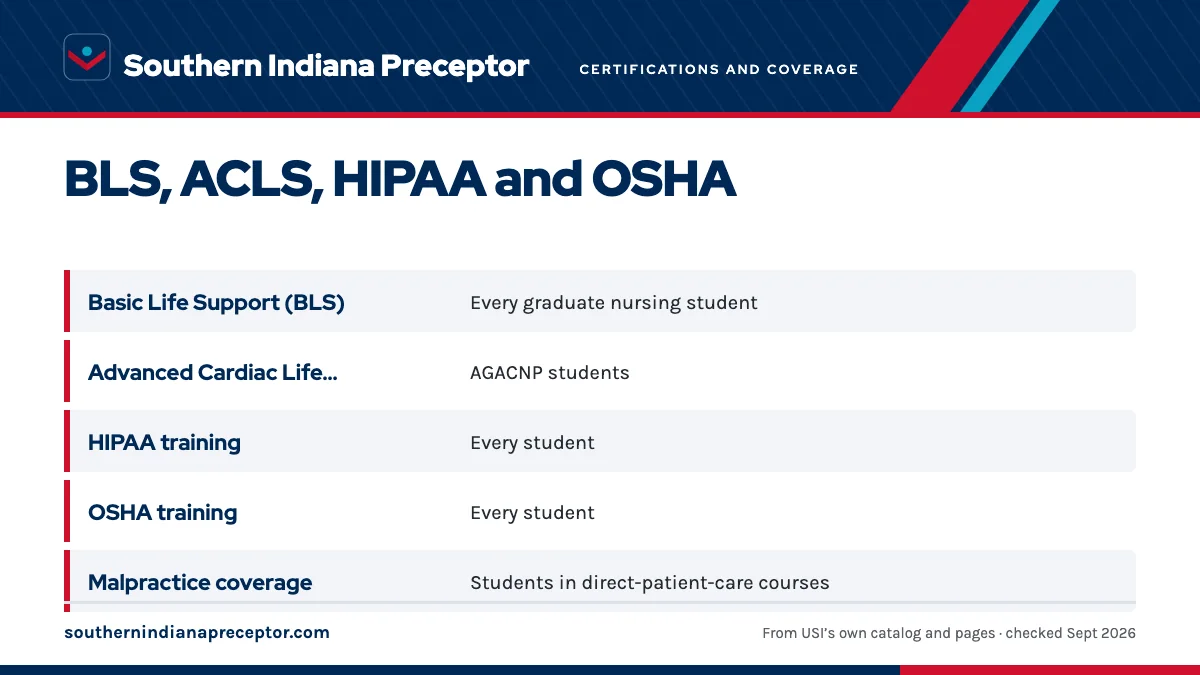
The checklist at a glance
These items sit beside your immunizations and background check but follow their own rhythm. Some renew yearly, some must be current every term, and two are about protection rather than training.
| Item | Who needs it | Timing |
|---|---|---|
| Basic Life Support (BLS) | Every graduate nursing student | Current at the start of each semester and through its last day |
| Advanced Cardiac Life Support (ACLS) | AGACNP students | Current at the start of each semester and through its last day |
| HIPAA training | Every student | Yearly; an employer certificate is accepted |
| OSHA training | Every student | Yearly; an employer certificate is accepted |
| Malpractice coverage | Students in direct-patient-care courses | Applies while you work in the student role |
| Clinical name badge | Students in clinical courses | Ordered before you start at a site |
| Automobile insurance | Anyone driving to a site | Throughout clinicals |
BLS for every student, ACLS for AGACNP
The graduate handbook is short on this one: "All students are required to have current Basic Life Support Certification." If your card lapses, you may not attend clinicals until the renewal is recorded and verified in the compliance repository, which is CastleBranch (DISA) (how that record works). Because no document may expire before the semester ends, a card dated to run out in week ten already fails when the term opens.
AGACNP students carry a second card: "All students in the AGACNP program are required to have current Advanced Cardiac Life Support (ACLS)." That fits the acute care settings of NRSG 633, NRSG 635 and NRSG 637, where the third course prefers critical care or hospitalist sites. The AGACNP program page covers those courses.
The handbook lists ACLS only for AGACNP. If an FNP or PMHNP site asks for it anyway, treat that as the site's own requirement and settle it with the site before your start date.
HIPAA and OSHA every year
USI's HIPAA and OSHA modules are completed and uploaded every year. Graduate students have an easier route: the handbook accepts annual HIPAA certification through an employer as an alternative, and it treats OSHA the same way. For working RNs this usually means uploading the certificate your hospital or clinic already issued.
Check two things before you rely on an employer certificate. Its date has to carry you through the end of the semester, and it has to show your name and the completion date clearly enough for faculty to verify it.
Proof matters at the site too. USI's roles and responsibilities ask you to provide the preceptor or agency and faculty with proof of liability insurance, satisfactory completion of OSHA and HIPAA requirements, and your nursing license for the state where the clinical experience takes place. Keep those files ready to send.
Malpractice coverage: who it protects
USI's handbook says students "are covered in the student role of advanced practice nurse by University malpractice insurance." USI charges that coverage to students enrolled in courses with direct patient care; the Graduate Bulletin lists it as the Health Professions Insurance Fee, so the student carries it.
The coverage has a boundary on each side. It follows your student role, not the RN job you may hold at the same building. And it does not reach your preceptor: the handbook FAQs state that preceptors are not covered by USI's malpractice insurance. A preceptor who asks about coverage should hear that clearly at the first meeting; the preceptor orientation and roles page covers what else they receive.
Your clinical name badge and the drive to the site
A clinical name badge is required. You order it with the Graduate Nursing Clinical Name Badge Order Form, and the payment and your photo go to the Eagle Access Card Office, so the badge is the student's responsibility from start to finish. Order it early enough that it arrives before your first clinical day.
Travel is also yours to arrange. The handbook says personal travel is required for all clinical courses, that liability for driving to and from clinical sites falls on the owner of the vehicle, and that automobile insurance is required. A site closer to home shortens that drive on every clinical day, which is one reason students start their search locally (finding your own preceptor).
Why students hand the search to us
Certifications are your job; the preceptor search is where we do our best work. We look for preceptors who fit your USI course as close to home as the specialty allows, confirm the credentials Form G asks for (license, board certification, years in practice, DEA and site details), and send the packet information back typed and complete so it reaches USI well before the 6-week mark.
For AGACNP students we target acute care settings that fit the course, and for every track we plan Fall, Spring and Summer together, staying on call if a preceptor drops mid-course. We also brief each preceptor on what USI asks of them, from one-to-one precepting to co-signed Typhon entries and the midterm and final calls with faculty. See how it works or use the form below.
Questions USI students ask
Does USI accept my hospital's HIPAA and OSHA training?
Yes, for graduate students. The handbook accepts annual HIPAA certification through an employer as an alternative to USI's module, and the same applies to OSHA. Upload a certificate that shows your name and completion date and that stays current through the end of the semester you are entering.
Do FNP or PMHNP students need ACLS at USI?
USI's handbook requires ACLS only for students in the AGACNP program. Every graduate student needs current BLS. If an FNP or PMHNP clinical site asks for ACLS, that is the site's own rule, so settle it with the site's office manager or education coordinator before your start date.
Is my preceptor covered by USI's malpractice insurance?
No. The handbook FAQs say preceptors are not covered by the University of Southern Indiana's malpractice insurance, while students are covered while functioning in the student role of advanced practice nurse. If a preceptor asks, give that answer plainly at the first meeting so nothing is assumed later.
What happens if my BLS card expires during the semester?
It should not get that far: USI allows no document to expire before the semester ends, so renew before the term begins. If a card does lapse, you cannot attend clinicals until the renewal has been recorded and verified in CastleBranch (DISA), which costs you clinical days in a course that expects weekly hours.
Where do I get my USI clinical name badge?
Fill out the Graduate Nursing Clinical Name Badge Order Form from USI's site. The payment and your photo go to the Eagle Access Card Office, which produces the badge. Order it well before your first clinical day so you arrive at the site wearing it.
Related pages
Last checked 2026-09-25
We check these pages against USI's own bulletin, program pages and Graduate Nursing Handbook. Your handbook, course faculty and the Nursing Clinical Coordinator have the final word.
- University of Southern Indiana, Graduate Nursing Handbook: Clinical Practice Requirements
- University of Southern Indiana, Graduate Nursing Handbook: FAQs
- University of Southern Indiana, Graduate Nursing Clinical Name Badge Order Form (PDF)
- University of Southern Indiana, 2026-2027 Graduate Bulletin: Fees
USI makes the search your job. We make it the easy part.
Tell us your USI track, your city and your next clinical semester. We find preceptors who fit the NRSG course and fill the Preceptor Packet and Clinical Education Agreement request with typed, complete details, well before USI's 6-week window.
- Preceptors matched to the course: family primary care for FNP, acute care teams for AGACNP, PMHNPs and psychiatrists for PMHNP
- Preceptor license, certification, years of practice and the site's agreement signer ready for the packet
- Fall, Spring and Summer planned together, close to home in a state USI enrolls
Start your placement plan
Track, city and clinical start is all we need to begin.