How USI evaluates your clinical courses
In each APRN specialty semester at the University of Southern Indiana, course faculty rate your clinical performance twice, at midterm and at the end, as Does not meet, Meets or Exceeds. Your preceptor adds two feedback forms in Typhon, faculty and preceptor connect at least seven times, and the clinical component is graded Pass or Fail alongside a B or better in the didactic work.
Get your placement plan
Tell us your USI program and where you live. A placement advisor replies with the preceptor and site options that fit your course.
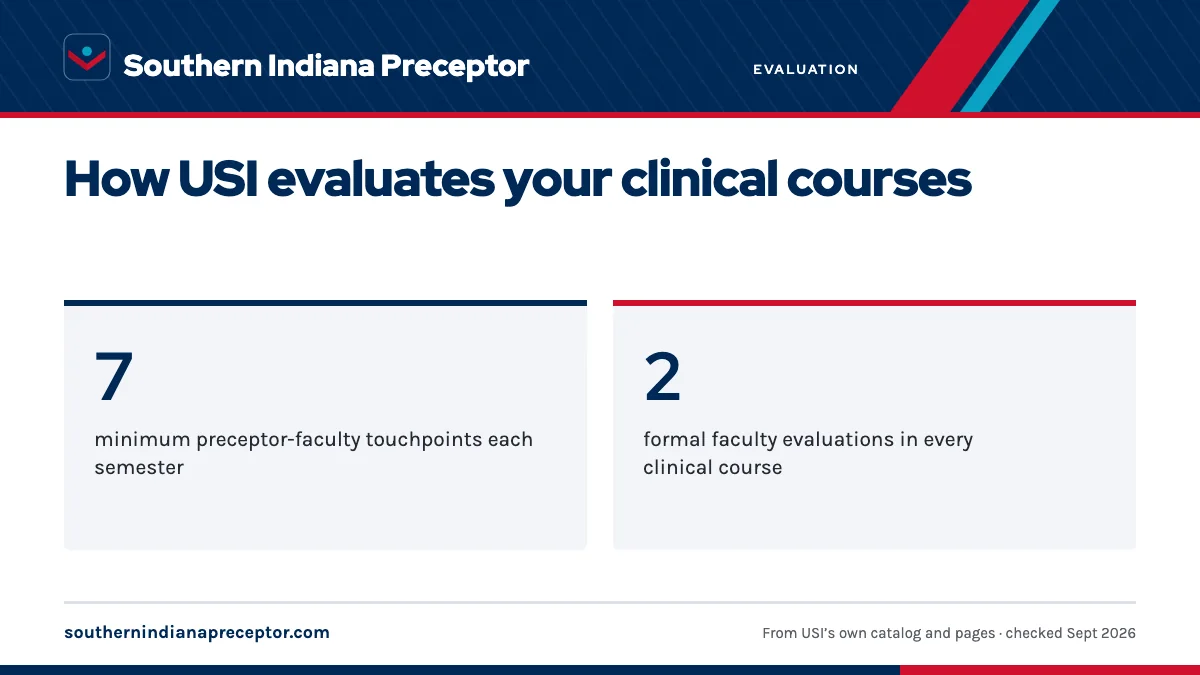
Two formal evaluations each semester
The University Clinical Requirements and Clinical Evaluation page sets the schedule: "Clinical course faculty will complete formal clinical evaluations of students twice per semester, at midterm and at the end of the course." Each area of performance is marked Does not meet, Meets or Exceeds.
The two evaluations carry different weight. The midterm tells you where you stand while there is still half a semester to change it. The final decides the course: a rating of Does not meet in any domain at the end results in failure of the course, regardless of how the rest of the evaluation reads.
USI's pages do not list the evaluation domains themselves; they appear in your course syllabus and evaluation tool. Read them in week one, so you know what faculty will be rating before the midterm arrives rather than after.
The seven touchpoints between preceptor and faculty
In each semester of the APRN specialty courses, USI builds in a minimum of seven contacts between your clinical preceptor and your course faculty. Three belong to faculty, two to your preceptor, and two depend on you to arrange.
| Touchpoint | How many | When | Who makes it happen |
|---|---|---|---|
| Preceptor Feedback Form in Typhon | 2 | Midterm and end of semester | Your preceptor completes it |
| Faculty email to the preceptor | 3 | Welcome, midterm and final | Course faculty send them |
| Phone call between faculty and preceptor | 2 | Midterm and final | You set a time that works for both |
The calls are the part students forget. The handbook says "It is the student's responsibility to secure a mutually-agreeable time with their preceptor for each of these calls." Book the midterm and final calls when you set your clinical schedule, not the week they are due.
What your preceptor contributes
Faculty, not your preceptor, complete the formal ratings, but the preceptor's view reaches faculty through several channels. They complete the two Preceptor Feedback Forms inside Typhon, review and co-sign your encounter entries, receive the three faculty emails and join the two calls you schedule.
You complete Student Feedback Forms twice a semester as well, also in Typhon. Between those formal points, keep the conversation open: USI asks students to report to both preceptor and faculty immediately if they cannot meet a clinical commitment, and hours can be rescheduled with faculty approval when something unforeseen happens.
Explaining these duties at the first meeting saves confusion at midterm. The preceptor orientation and roles page covers what USI sends preceptors and what each person is responsible for.
Other ways faculty confirm your competency
The midterm and final ratings are not the only evidence faculty use. USI says faculty validate clinical competency through several venues, including conference calls with preceptors and students, and that video recordings may be used to evaluate clinical competency. Faculty also schedule site visits as needed, and the catalog adds virtual learning and education sessions to the list.
Syllabi can call for competency demonstrations in site visit simulations, and faculty may require a visit to campus to demonstrate clinical competency. What those look like, and how to prepare for them, is on the campus competency visits page.
The practical upshot is that any clinical day can become evidence. Keep your Typhon entries accurate, be ready for a faculty call that includes your preceptor, and treat a scheduled site visit as part of the evaluation rather than a courtesy stop.
Pass or Fail, plus a B
A clinical course carries two grading tests at once. USI's Progression page says graduate students must achieve a Pass in the clinical component in addition to a B or better in the didactic component, and a student who does not receive a Pass in the clinical component receives a letter grade of F in the course.
Strong exam scores cannot rescue a failed clinical, and a clinical Pass cannot lift a didactic grade below B, since USI requires a B or better in every graduate nursing course. How a failed course affects progression, withdrawals and readmission is covered on the grades and progression page.
The final evaluation is where a single Does not meet ends the course, so treat a midterm rating in any weak area as a warning with a deadline attached.
Keeping the semester on track, with us in your corner
Hours pacing feeds straight into evaluation: clinicals must begin by week 3 and continue weekly, and a slow start leaves little room to show growth before the final. Keep Typhon current, send your schedule to clinical faculty before you attend, and raise problems early (behind on hours).
USI students choose us because the preceptors we introduce know the evaluation side of the role before they sign: the feedback forms, the faculty emails, the midterm and final calls. When we introduce a preceptor, we note the days and times they prefer for calls, which makes booking the midterm and final conversations simple. We plan all three specialty semesters, and if a preceptor leaves mid-course we stay on call to find a replacement fast (when a preceptor drops out). Start through the form below.
Questions USI students ask
Can I fail a USI clinical course after a good midterm evaluation?
Yes. The midterm is a checkpoint; the final evaluation decides the course. A final rating of Does not meet in any domain results in failure of the course, whatever the midterm said. Use the midterm feedback to work on every area rated below Meets, and ask faculty how to show progress before the end.
Who schedules the midterm and final calls with my preceptor?
You do. USI's handbook makes it the student's responsibility to secure a mutually agreeable time with the preceptor for each call. Faculty handle the three emails and your preceptor completes the two feedback forms, but the calls happen only if you set them up.
What grade do I get if I pass the exams but not the clinical?
An F in the course. USI requires both a Pass in the clinical component and a B or better in the didactic component for clinical-based graduate courses, and a student who does not receive a Pass in the clinical component receives a letter grade of F.
Does my preceptor grade me?
Course faculty complete the formal midterm and final evaluations. Your preceptor informs them through two Preceptor Feedback Forms in Typhon, co-signed encounter entries, the faculty emails and the two calls you arrange. Faculty can also use conference calls, video recordings and site visits to confirm your competency.
Do these evaluation rules apply in all three NP tracks?
The seven touchpoints apply in each semester of the APRN specialty courses, which covers the FNP, AGACNP and PMHNP sequences across all three routes: MSN, BSN-to-DNP and post-master's certificate. The midterm and final evaluations and the Pass/Fail rule apply to every clinical course.
Related pages
Last checked 2026-09-25
We check these pages against USI's own bulletin, program pages and Graduate Nursing Handbook. Your handbook, course faculty and the Nursing Clinical Coordinator have the final word.
USI makes the search your job. We make it the easy part.
Tell us your USI track, your city and your next clinical semester. We find preceptors who fit the NRSG course and fill the Preceptor Packet and Clinical Education Agreement request with typed, complete details, well before USI's 6-week window.
- Preceptors matched to the course: family primary care for FNP, acute care teams for AGACNP, PMHNPs and psychiatrists for PMHNP
- Preceptor license, certification, years of practice and the site's agreement signer ready for the packet
- Fall, Spring and Summer planned together, close to home in a state USI enrolls
Start your placement plan
Track, city and clinical start is all we need to begin.