Additional preceptors, observers and observation hours at USI
A second clinician can teach you at the University of Southern Indiana once an additional Preceptor Agreement for them is completed and approved, provided they work in your primary preceptor's office or facility. Anyone else can let you observe, but observation never counts toward your direct clinical total, so the 8 hours of observation USI encourages at the start are best planned as time on top of your requirement.
Get your placement plan
Tell us your USI program and where you live. A placement advisor replies with the preceptor and site options that fit your course.
Additional preceptors at your preceptor's site
USI's clinical FAQ answers the question directly. If other licensed practitioners in your primary preceptor's office or facility have the chance to precept you, an additional Preceptor Agreement form must be completed and approved by USI before that experience begins. Every clinician who supervises your patient care has to be someone USI has checked and who has accepted its terms.
Additional preceptors usually come from ordinary clinic life. Your preceptor's partner covers a week of leave, a physician in the practice handles a procedure you need, or a heavy day splits you between two providers. Each of those clinicians needs an approved agreement of their own before the time you spend with them counts.
An additional preceptor meets the same standard as your primary: an unencumbered license, specialty certification that fits your track, at least a year as an advanced provider and no personal tie to you. For PMHNP students that means another PMHNP or a psychiatrist. The preceptor requirements page has the full list.
A preceptor somewhere else means a second site
The additional-agreement route covers clinicians in the same office or facility as your primary preceptor. A preceptor at a different location brings a different site, with its own Preceptor Packet, site details and site survey, and a Clinical Education Agreement with that organization unless USI already holds one. USI's catalog is plain that a written agreement with each agency is required before clinical experiences start.
Students add a second site for good reasons: a specialty rotation in NRSG 645, a split between two part-time preceptors, or a backup when the first site slows down. Treat it as a new placement for paperwork purposes, and give it the full 6-week lead time wherever the calendar allows.
Observers: what you may and may not do
USI lets students take part as observers without a preceptor agreement. The trade-off is strict: as an observer you may not assess patients or implement care plans, and the clinical FAQ states that observation hours do not count toward the required direct patient clinical hours.
Observation still has value. A day beside a specialist or an afternoon in a procedure suite can sharpen your clinical reasoning and your board preparation. Log it for what it is, keep it out of your direct-hour count, and check that an observer visit fits the host's own rules, since skipping USI's agreement does not skip the site's policies.
If you find yourself hoping observation will count, that is a sign the clinician should become an additional preceptor instead. Ask them whether they would sign the agreement.
The 8 observation hours at the start
USI's FAQ suggests asking your preceptor for 8 hours of watching before you take on patients with more independence. Treat it as a first shift spent watching how the practice runs, how your preceptor reasons and documents, and where you will fit.
Because USI's FAQ says observation hours do not count toward direct clinical hours, plan these 8 hours as time on top of your course requirement and ask course faculty how they want them recorded in Typhon. Fit them into your first week, since your clinical hours have to start by week 3 and keep going weekly.
This is different from job orientation. USI separately says clinical sites should not be used for workplace orientation, a point covered on clinicals where you work.
Rescheduling hours when plans change
Life interrupts clinicals. USI's rule is that, with faculty approval, clinical hours may be rescheduled during the clinical semester because of unforeseen circumstances, and any rescheduled clinical must be approved by course faculty. The phrase that matters is "during the clinical semester": you are moving hours within the term, not past its end.
Two more limits shape any new schedule. USI bars clinical hours on university holidays and on any day courses are out of session, and clinical schedules go to clinical faculty before you attend. If you cannot keep a clinical commitment, the roles page asks you to tell your preceptor and faculty immediately.
If the gap is growing rather than shifting, behind on clinical hours sets out the ways students add time within USI's rules, from extra days with an approved preceptor to a second approved site.
At a glance: what each situation needs
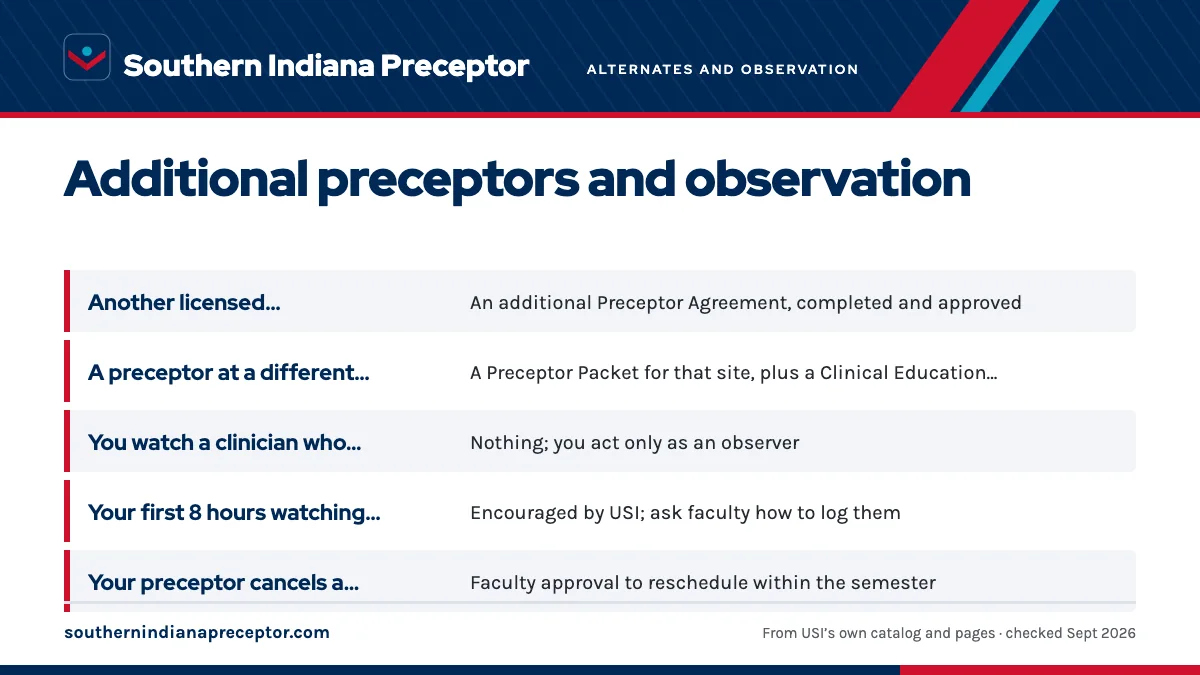
| Situation | What USI needs first | Counts toward direct hours? |
|---|---|---|
| Another licensed practitioner in your preceptor's office or facility teaches you | An additional Preceptor Agreement, completed and approved | Yes, once approved |
| A preceptor at a different location | A Preceptor Packet for that site, plus a Clinical Education Agreement if none exists | Yes, once approved |
| You watch a clinician who has no agreement | Nothing; you act only as an observer | No |
| Your first 8 hours watching your own preceptor | Encouraged by USI; ask faculty how to log them | Plan them as extra time |
| Your preceptor cancels a week | Faculty approval to reschedule within the semester | Yes, when completed as approved |
Every approved clinician also reviews and co-signs the Typhon entries for the patients you saw together, which keeps your log in step with the approvals behind it.
How we build backup into your placement
A strong placement has depth. When we place you, the placement desk asks whether other clinicians at the site would precept and collects their license, certification and practice details at the same time, so an additional Preceptor Agreement can go to USI quickly when your primary preceptor is away.
If you need a second site for a specialty rotation or a split schedule, we find one that fits the course and gather the packet and agreement details for it. And if a preceptor steps away mid-semester, we stay on call to find a replacement; see if your preceptor drops out. Tell us your course, your site and the weeks you need covered in the form below, and we plan the backup with you.
Questions USI students ask
Do observation hours count toward USI clinical hours?
No. USI's clinical FAQ says students may observe without a preceptor agreement but may not assess patients or implement care plans, and observation hours do not count toward the required direct patient clinical hours. Record them separately if your course asks, and count only time with approved preceptors toward your total.
Can I shadow a specialist for a day during my USI rotation?
Yes, as an observer. Watching needs no USI agreement, but you cannot assess patients or carry out care plans, and the time stays out of your direct total. If you want that specialist's time to count, they need an approved Preceptor Agreement, and a separate location needs its own packet and site agreement.
My preceptor's partner wants to see patients with me. What do I file?
An additional Preceptor Agreement form for that clinician, completed and approved by USI before they precept you. Until approval arrives you can observe them, but nothing you do together counts as direct hours. File it early, because a partner covering a vacation is often needed at short notice.
Can I make up missed clinical hours over a university break?
No. USI does not allow clinical hours during university holidays or when courses are not in session. Rescheduled hours must fall within the clinical semester and need course faculty approval, so plan make-up days in regular weeks and send the updated schedule to clinical faculty before you attend.
Do the 8 observation hours count toward my first 200?
USI recommends starting with 8 hours of observation alongside your preceptor, and its FAQ says observation hours do not count toward direct clinical hours. The safe plan is to treat those 8 hours as extra and confirm with course faculty how to record them.
Related pages
Last checked 2026-09-25
We check these pages against USI's own bulletin, program pages and Graduate Nursing Handbook. Your handbook, course faculty and the Nursing Clinical Coordinator have the final word.
- University of Southern Indiana Graduate Nursing Handbook: Clinical FAQs
- University of Southern Indiana Graduate Nursing Handbook: University Clinical Requirements and Clinical Evaluation
- University of Southern Indiana Graduate Nursing Handbook: Clinical Roles and Responsibilities
- University of Southern Indiana 2026-2027 Graduate Bulletin: MSN Family Nurse Practitioner
USI makes the search your job. We make it the easy part.
Tell us your USI track, your city and your next clinical semester. We find preceptors who fit the NRSG course and fill the Preceptor Packet and Clinical Education Agreement request with typed, complete details, well before USI's 6-week window.
- Preceptors matched to the course: family primary care for FNP, acute care teams for AGACNP, PMHNPs and psychiatrists for PMHNP
- Preceptor license, certification, years of practice and the site's agreement signer ready for the packet
- Fall, Spring and Summer planned together, close to home in a state USI enrolls
Start your placement plan
Track, city and clinical start is all we need to begin.