Doing USI clinical hours where you already work
The University of Southern Indiana has no rule against clinical hours at your own employer, and it treats your workplace as the first place to look: stuck students are asked to confirm they have no preceptor option at work. What USI does rule out is using a clinical site for job orientation, and every other rule, from preceptor credentials to the Clinical Education Agreement, applies exactly as it would at any other site.
Get your placement plan
Tell us your USI program and where you live. A placement advisor replies with the preceptor and site options that fit your course.
What USI says, and what it leaves open
The Graduate Nursing Handbook touches on employers in two places. The clinical FAQ answers a question about orientation with a plain no: "students should not use clinical sites for workplace orientation." And the University Clinical Requirements page asks students who cannot find a placement to confirm, first of all, that their own employer has no preceptor to offer.
Read together, those lines treat your employer as a normal, even expected, place to find a preceptor, provided the hours are real advanced practice learning. What the handbook does not settle is narrower: whether you may do clinical hours on your own unit, or under a clinician who also supervises your RN job. If either applies to you, put the question in writing to the Nursing Clinical Coordinator before the packet goes in, and keep the reply.
Why an employer is often the easiest yes
Your employer already knows your work, and the NPs, PAs and physicians there see you as a colleague rather than a stranger asking a favor. Several health systems in USI's region also say, in their own student-placement pages, that employees come first: Deaconess gives priority to its employees and to students from local schools, Franciscan Health gives priority placement to its employees, and Community Health Network prioritizes its own caregivers.
Those are each system's own policies, not promises about any USI student, but they explain why the internal route deserves the first phone call. Many large systems run a student-placement process of their own alongside USI's, with an affiliation requirement, application windows months before the semester and sometimes their own software. The Evansville tri-state page summarizes what the region's systems publish.
The orientation rule, in practice
USI's FAQ keeps it short: clinical sites are not for workplace orientation. Clinical hours exist to teach advanced practice, so time spent learning a new job, its charting system or its policies does not belong in your log, even with a preceptor at your side.
This matters most for RNs who have accepted an NP job before graduating, or who are moving to a new department inside their system. If the future employer offers to host your final course, keep the two tracks apart: the rotation follows the USI syllabus under your approved preceptor, and onboarding for the new role happens on its own time.
The same thinking applies to your paid RN shifts. USI's malpractice coverage protects you in the student role, so clinical hours work best as clearly separate student days rather than woven into shifts you are paid to work. If the lines could blur, ask course faculty before you start.
Match the unit to the course, not the other way around
The unit you know best is not always the one your course needs. An FNP student who works in an ICU will not find the family primary care that NRSG 643 requires there. A PMHNP student on an inpatient psychiatric floor faces a similar gap, because USI sets the psychiatric courses in outpatient environments, with NRSG 655 described as primarily outpatient.
The better approach is to look across your whole employer. The system that pays your salary may also run family medicine clinics, outpatient behavioral health or hospitalist services that match the course. AGACNP students who already work in a hospital may find the closest fit, since acute care is required in all three courses and NRSG 637 prefers critical care or hospitalist work.
Whichever department you use, the preceptor must meet USI's standard, including the limits on profession by track. Check who can precept you before you ask anyone.
Paperwork: your employer signs as a site like any other
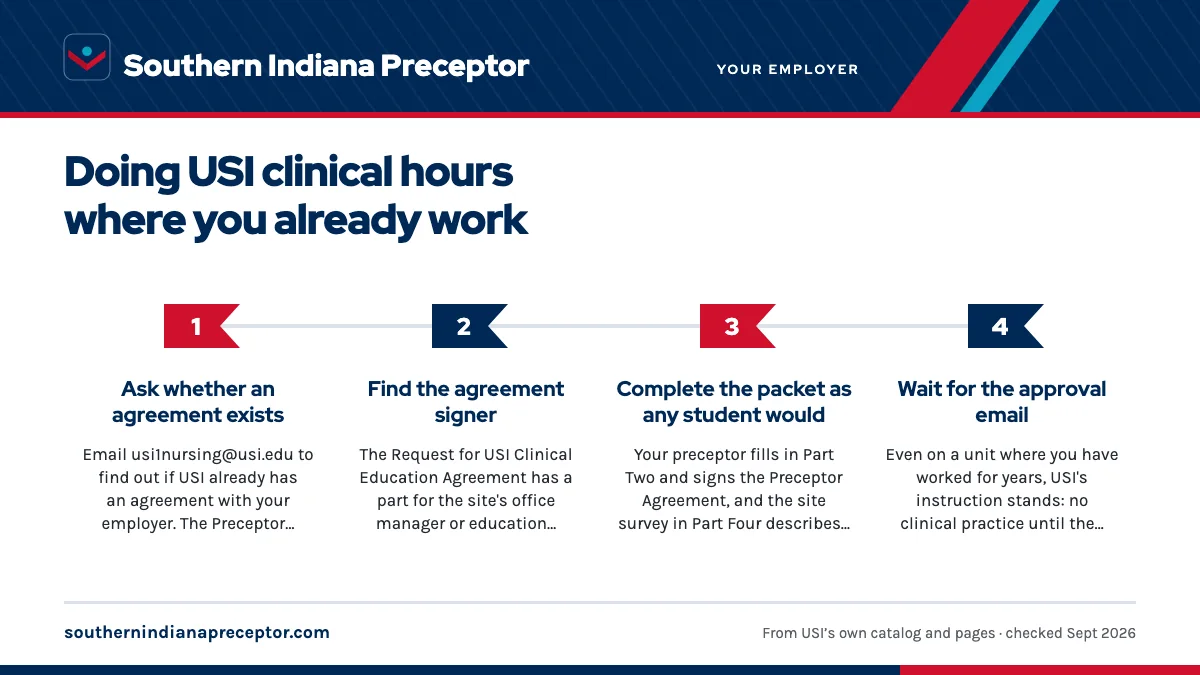
- Ask whether an agreement existsEmail usi1nursing@usi.edu to find out if USI already has an agreement with your employer. The Preceptor Packet Instructions page asks students to check this first, and a yes saves the slowest step.
- Find the agreement signerThe Request for USI Clinical Education Agreement has a part for the site's office manager or education coordinator, who names the person authorized to sign affiliation agreements. In a large system that person may sit far from your unit, so ask early. The Clinical Education Agreement page has the detail.
- Complete the packet as any student wouldYour preceptor fills in Part Two and signs the Preceptor Agreement, and the site survey in Part Four describes the practice. Being an employee does not shorten the form.
- Wait for the approval emailEven on a unit where you have worked for years, USI's instruction stands: no clinical practice until the confirmation email arrives.
The full sequence, from first meeting to approval, is on the placement process page.
When your employer says no
Plenty of employers decline: no NP on staff, a policy about precepting their own employees, a pause on new school affiliations, or a manager who cannot spare you. Get the answer in writing if you can, because it becomes the first item in what USI asks stuck students to send. The can't find a preceptor page lays out those steps.
Even when your employer says yes, plan around your job. USI's handbook notes that courses and clinical assignments can be scheduled at relatively short notice during the semester, and that clashes with a work schedule are possible. Tell your manager early which terms carry the 200, 250 and 300 hour courses, so a schedule change does not land on a clinical block.
How USI students use us alongside their employer
Many students ask their employer first and bring us in when the answer is slow, partial or no. We search outside your system for preceptors who fit your exact course, close to home, and we can line up a second site for the course your employer cannot cover, such as an outpatient psychiatric practice when your hospital has only inpatient units.
For each preceptor we find, the placement desk collects the license, certification, years of practice, DEA and site details the packet asks for, along with the name of the site's agreement signer, so the paperwork reaches USI complete. We plan all three specialty semesters together, so your job and your clinicals share a calendar that works. Share your track and city in the form below.
Questions USI students ask
Can I do my USI clinical hours on the unit where I work as an RN?
USI's handbook has no rule that forbids it, and no rule that approves it either. What it does say is that clinical sites are not for workplace orientation, and the unit must fit your course. Ask the Nursing Clinical Coordinator in writing before you submit a packet for your own unit, and keep the answer.
Can my manager or supervisor be my preceptor?
The handbook's only relationship rule excludes relatives and anyone in a relationship with you; it does not mention supervisors. Because the question is open, raise it with the Nursing Clinical Coordinator before the packet goes in. A clinician in another department of the same employer sidesteps the question entirely.
Does my employer need a Clinical Education Agreement with USI?
Yes. USI requires a written agreement with each agency before clinical experiences begin, and your employer is treated like any other site. Email usi1nursing@usi.edu to ask whether one already exists. If not, the site's office manager or education coordinator names the signer on the request form, and USI sends the agreement to that person.
Can hours during my paid shift count as clinical hours?
USI's pages do not address paid shifts directly. They do say its malpractice coverage applies to you in the student role and that clinical sites are not for job orientation, both of which point toward separate student days. Ask course faculty before counting any hour worked while you are on the clock.
What if my hospital gives its own staff priority for student placements?
Then asking internally first makes sense, and some regional systems say exactly that on their placement pages. Their processes often close months before the semester, so apply while you gather USI's paperwork, and keep an outside option moving in case the internal answer comes late.
Related pages
Last checked 2026-09-25
We check these pages against USI's own bulletin, program pages and Graduate Nursing Handbook. Your handbook, course faculty and the Nursing Clinical Coordinator have the final word.
- University of Southern Indiana Graduate Nursing Handbook: Clinical FAQs
- University of Southern Indiana Graduate Nursing Handbook: University Clinical Requirements and Clinical Evaluation
- University of Southern Indiana Graduate Nursing Handbook: Preceptor Packet Instructions
- University of Southern Indiana Request for USI Clinical Education Agreement
- University of Southern Indiana Graduate Nursing Handbook: General Information
USI makes the search your job. We make it the easy part.
Tell us your USI track, your city and your next clinical semester. We find preceptors who fit the NRSG course and fill the Preceptor Packet and Clinical Education Agreement request with typed, complete details, well before USI's 6-week window.
- Preceptors matched to the course: family primary care for FNP, acute care teams for AGACNP, PMHNPs and psychiatrists for PMHNP
- Preceptor license, certification, years of practice and the site's agreement signer ready for the packet
- Fall, Spring and Summer planned together, close to home in a state USI enrolls
Start your placement plan
Track, city and clinical start is all we need to begin.