When a missing preceptor pushes back your USI graduation
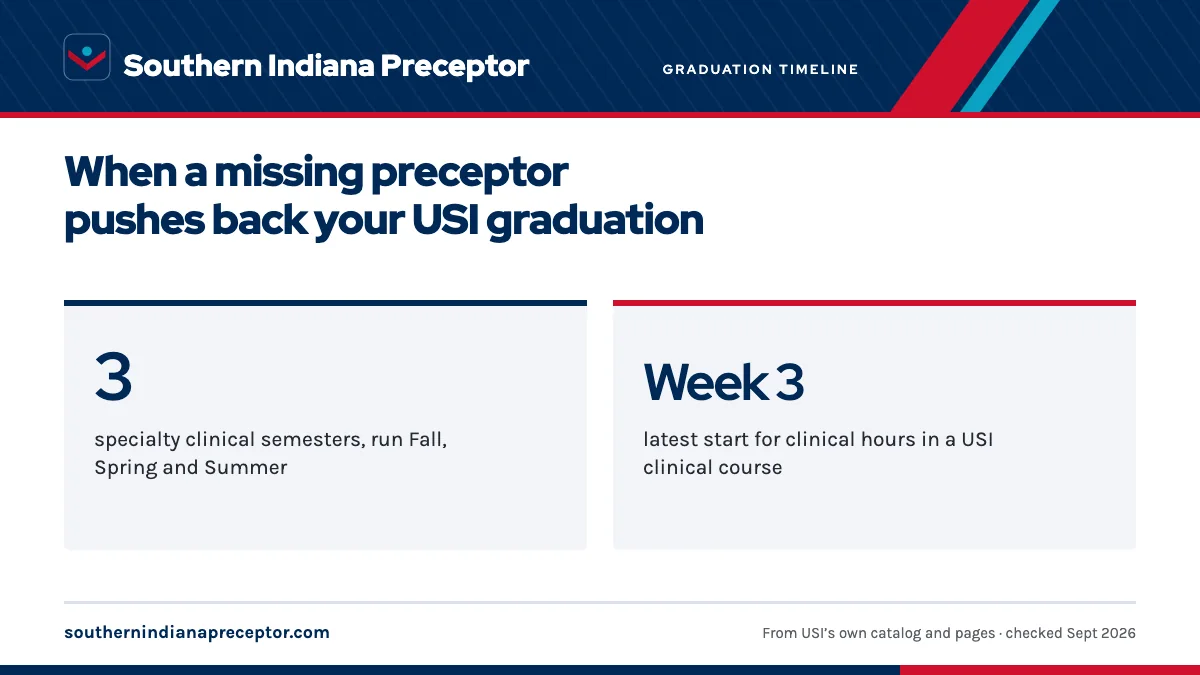
In the University of Southern Indiana's NP tracks, each specialty course is offered in one semester a year, Fall, then Spring, then Summer, so a course you cannot start usually waits a full year to come around again, and the courses after it wait with it. The damage is smallest when you act before week 3, keep your withdrawal count low, and line up preceptors for every remaining semester at once.
Get your placement plan
Tell us your USI program and where you live. A placement advisor replies with the preceptor and site options that fit your course.
Why one gap can cost a year
USI's 2026-27 catalog offers each NP specialty course in a single term. Direct hours begin in the fall course and build through spring and summer, 200, 250 and 300 hours at a time, one course per semester.
| Track | Fall | Spring | Summer |
|---|---|---|---|
| FNP | NRSG 643, 200 hours | NRSG 645, 250 hours | NRSG 647, 300 hours |
| AGACNP | NRSG 633, 200 minimum | NRSG 635, 250 minimum | NRSG 637, 300 minimum |
| PMHNP | NRSG 653, 200 hours | NRSG 655, 250 hours | NRSG 657, 300 hours |
Under that schedule, missing NRSG 643 in the fall means waiting for the next fall to take it, and NRSG 645 and NRSG 647 move back with it. A student who planned to finish in one summer finishes the following one. The BSN-to-DNP 800-level courses repeat the pattern, and post-master's certificate students take the same specialty sequence.
A missed spring or summer course works the same way: its next offering is a year out. Confirm your revised plan with your advisor, since term offerings can change between catalogs; the semester calendar page lays out the dates.
The week-3 line
USI requires clinical to begin by week 3 of a clinical course and to continue weekly while you are registered. It also bars clinical hours before the approval email, on university holidays, and at any time courses are out of session. Together, those rules mean a preceptor has to be approved and scheduled almost as soon as the semester opens.
If week 3 is close and you have no approved placement, you are at the decision point. Waiting past it buys nothing: the hours still have to fit inside the same term, under weekly limits such as 36 hours in the later AGACNP courses and 40 in NRSG 647. Talk to course faculty before the week-3 mark, not after it.
Your options when a course cannot start on time
There are three realistic paths, and course faculty should be part of choosing among them.
- Start late and catch up. If a preceptor is approved in the opening weeks, faculty may approve a schedule that fits the hours into the rest of the term. This keeps your graduation date but asks a lot of the remaining weeks; see behind on clinical hours.
- Take an incomplete. USI's bulletin allows an IN grade only at the end of a term, for passing work with a small amount left unfinished, and the instructor decides. Unfinished work left past one calendar year turns the IN into an F, and the instructor may set a shorter limit. Ask how the remaining hours would be scheduled, since USI bars clinical work while courses are out of session.
- Withdraw. A W is available within the withdrawal period on USI's academic calendar, but the handbook caps them: one is the most an MSN, post-master's certificate or post-MSN DNP student can carry and still progress, and two for BSN-to-DNP students. Every course dropped in a single semester counts together as one event, and coming back means a petition on the handbook's Appendix A form.
On the standard Fall 2026 calendar, courses dropped through October 16 are without evaluation; from the 10th week, a W is given if you are passing and an F is possible if you are failing. Check the refund schedule for your course's part of term, and see the grades and progression page for the rules behind each path.
Guarding the rest of your program
A delay reaches beyond one course. Keep your compliance record current through the extra months, because USI requires documents held by its designated third-party agency to stay valid through the end of each semester, including BLS and, for AGACNP, ACLS. Keep your RN license unencumbered in every state where you will do clinical hours.
Timed requirements move with you as well. The Barkley Board Review is purchased during the second half of your Specialty II course, and nationally normed predictor exams come in the final semester, so both shift when your sequence does.
Watch the clock on the program itself. USI's progression policy gives post-master's certificate students three years to complete; check the Progression and Withdrawal Policies page for the limit on your program. And if a delay tempts you to move, remember that relocating to a state USI does not recognize can end your coursework, and the Program Chair and APRN Director must hear about any planned move first (relocating during the program).
Who decides at USI
Course faculty approve rescheduled clinical time and decide on incompletes. The Nursing Clinical Coordinator, at usi1nursing@usi.edu, handles preceptor paperwork and is the first contact when a placement falls through. A change of specialty goes in writing to the Graduate Chair and APRN Director, and coming back after a withdrawal is a petition that the program decides.
Your academic advisor, reached through myUSI, can map a revised sequence against the catalog. Put each decision in writing from your USI email. Tell your preceptors too: one who agreed to host your spring course needs to know if that course has moved a year.
How we keep a gap from becoming a lost year
The strongest protection is a plan for all three specialty semesters from the start, which is the way every placement with us begins. We find preceptors for Fall, Spring and Summer together, confirm that each one fits its course, and have every packet ready well inside USI's 6-week window, so one late answer does not unsettle the whole sequence.
If you are already facing a delay, we work to the calendar you have now: a preceptor who can start before week 3 if the current term can still be saved, or a full plan for the next offering if it cannot. We stay on call through every semester and find a replacement if a preceptor steps away. Use the form below to start, or read how it works.
Questions USI students ask
Does missing NRSG 643 delay the rest of my FNP courses?
Under the current catalog, in practice yes. NRSG 643 is offered in the fall, NRSG 645 in the spring and NRSG 647 in the summer, and together they form one clinical sequence. If the first course moves to the next fall, the other two follow it. Your advisor can confirm the revised plan for your program.
How many times can I withdraw from a USI graduate nursing course?
The Graduate Nursing Handbook allows one for MSN, post-master's certificate and post-MSN DNP students; a second one stops progression. BSN-to-DNP students can have two. Dropping several courses in one term is treated as a single withdrawal event, and returning afterward requires a petition on the form in the handbook's Appendix A.
Can I get an incomplete if I'm short on clinical hours at USI?
Possibly. An incomplete is available only at the end of a term, when your work is passing and only a little remains, and the course instructor decides whether to grant it. After a calendar year without completion, the IN reverts to an F. Ask faculty how the remaining clinical hours would be scheduled.
Is there a deadline to finish my USI nursing program?
For post-master's certificate students, USI's progression policy sets three years to complete the requirements. For other programs, check the Progression and Withdrawal Policies page of the Graduate Nursing Handbook or ask your advisor, since a year's delay counts against whatever limit applies to you.
Does a delay change my compliance requirements?
It extends them. USI requires the documents in its designated third-party agency to stay current, with nothing expiring before the end of a semester, and BLS must be current for every clinical term, plus ACLS for AGACNP. A longer program means more renewals, so check expiry dates against your new timeline.
Related pages
Last checked 2026-09-25
We check these pages against USI's own bulletin, program pages and Graduate Nursing Handbook. Your handbook, course faculty and the Nursing Clinical Coordinator have the final word.
- University of Southern Indiana Graduate Nursing Handbook: Progression and Withdrawal Policies
- University of Southern Indiana Graduate Nursing Handbook: University Clinical Requirements and Clinical Evaluation
- University of Southern Indiana 2026-2027 Graduate Bulletin: Academic Policies
- University of Southern Indiana 2026-2027 Graduate Bulletin: MSN Family Nurse Practitioner
- University of Southern Indiana Academic Calendar
USI makes the search your job. We make it the easy part.
Tell us your USI track, your city and your next clinical semester. We find preceptors who fit the NRSG course and fill the Preceptor Packet and Clinical Education Agreement request with typed, complete details, well before USI's 6-week window.
- Preceptors matched to the course: family primary care for FNP, acute care teams for AGACNP, PMHNPs and psychiatrists for PMHNP
- Preceptor license, certification, years of practice and the site's agreement signer ready for the packet
- Fall, Spring and Summer planned together, close to home in a state USI enrolls
Start your placement plan
Track, city and clinical start is all we need to begin.