Relocating during a USI nursing program: what a move changes
The University of Southern Indiana limits its online graduate nursing programs to certain states, and a move to a state outside that group "will lead to inability to continue in coursework." Active military status is the only exception USI states. Before you sign a lease, tell the Program Chair and APRN Director, check your program's row for the new state, and plan on a new RN license, a new preceptor and a new Preceptor Packet.
Moving? Restart your search early
Tell us your program, your new state and the month you move.
What USI's relocation rule says
Three sentences on the Graduate Nursing Program page set the frame: all online graduate nursing programs "are limited to working with certain states in the U.S. only," relocating somewhere the program does not recognize ends your ability to continue, and military service on active status is exempt. The same page says the Kinney College of Nursing and Health Professions limits distance enrollment to residents of states where USI holds, or is pursuing, authorization.
The duty to speak up is yours. The handbook's academic advising page says it is the student's responsibility "to notify the Program Chair and APRN Director with intent for relocation." The word intent matters: the notice belongs before the move, while you still have options, not after you have unpacked.
The same page says the Office of Online and Adult Learning maintains an updated listing of states where USI may offer online nursing courses. The State Authorization page no longer shows such a list, so the published guide is the Enrollment Not Allowed column of USI's licensure table; ask for the office's current listing when you notify the program.
Check the new state against your own program
A state that works for one USI program can end another. The licensure table bans residents program by program, so read the row for the program you are actually enrolled in, not a general list. USI's full table, conflicts included, is on the licensure disclosure page.
Some moves that look safe are not. Relocating to Colorado, South Dakota or Washington leaves an MSN nurse practitioner student off the ban list but would bar a post-master's certificate or BSN-to-DNP APRN student. A move to North Dakota is the reverse: MSN NP and certificate students are barred, while DNP students are not, though the table lists North Dakota as both meeting and not meeting requirements for the DNP APRN rows.
Look at the curriculum columns too if you expect to be licensed in the new state. For the MSN NP tracks, Louisiana is marked Does Not Meet, Massachusetts is listed both ways, and Colorado is left blank. The table is dated "Updated Fall 2025" and has changed before, so check it again close to your moving date.
Your RN license has to follow your clinicals
USI ties clinical work to licensure in the state where it happens. USI's admission rules require a clean RN license for every state in which you will be in a clinical setting, and the Graduate Professional Behavior Agreement has you initial the same promise. For telehealth hours, your license has to match the patient's location.
Part One of the Preceptor Packet (Form G) records your license number and the state that issued it, so a new state means a new entry on every packet you file after the move. Start the license early; no clinical hour counts in a state where your license is not yet active.
Compact status shapes the work. Of the tri-state, only Illinois sits outside the Nurse Licensure Compact, so an Indiana or Kentucky multistate license stops at the Illinois line. Some states also regulate out-of-state programs: an Illinois board rule on clinical placements by out-of-state nursing programs does not say whether it covers graduate students, so let the Nursing Clinical Coordinator confirm before you plan Illinois hours. More on this at RN license for clinicals.
A move plan that protects your clinical sequence
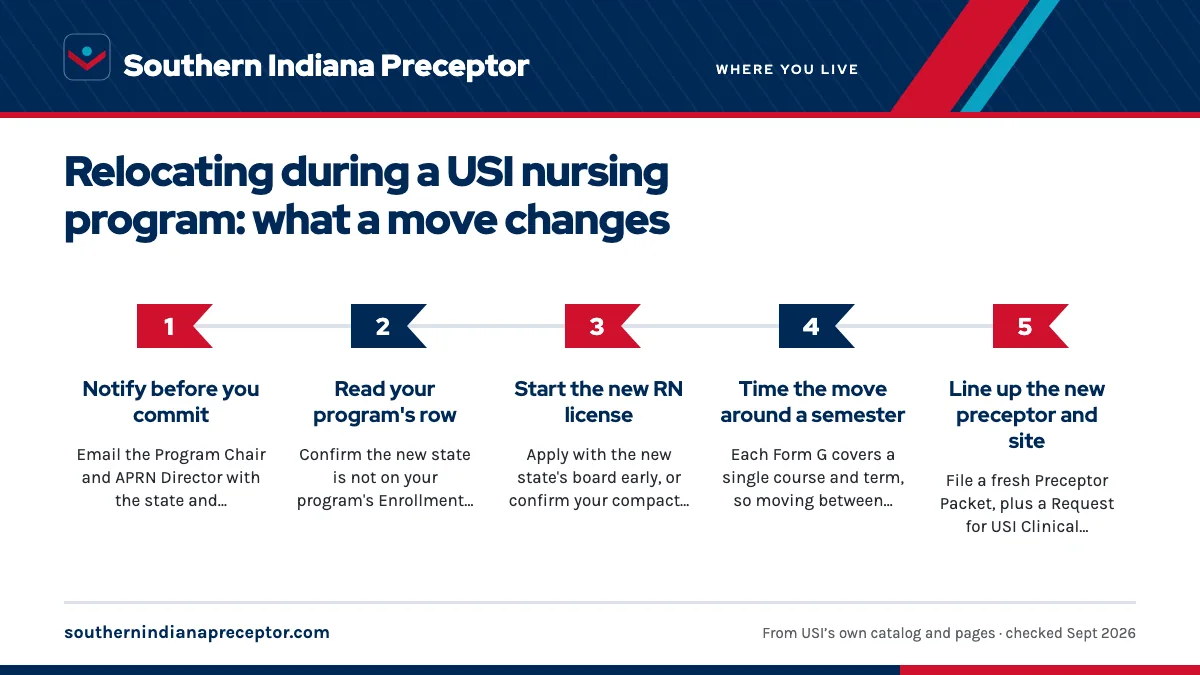
- Notify before you commitEmail the Program Chair and APRN Director with the state and approximate date, and ask for the current list of states USI can serve.
- Read your program's rowConfirm the new state is not on your program's Enrollment Not Allowed list and note any curriculum conflict.
- Start the new RN licenseApply with the new state's board early, or confirm your compact coverage, so the license is active before any clinical hour there.
- Time the move around a semesterEach Form G covers a single course and term, so moving between semesters is far easier than moving mid-course.
- Line up the new preceptor and siteFile a fresh Preceptor Packet, plus a Request for USI Clinical Education Agreement if the site has none, at least 6 weeks before the rotation.
- Wait for the approval emailNo hours at the new site until the program confirms your paperwork, and clinical must still begin by Week 3 of the course.
Your specialty's preceptor rules travel with you. A PMHNP student still needs a PMHNP or a licensed psychiatrist in the new town, and an AGACNP student still needs an acute care setting.
Moving in the middle of a semester
A mid-course move is the hardest version, because your approved preceptor and site are fixed for that course and term. USI expects you to tell the preceptor and faculty at once when a clinical commitment falls through, and course faculty can approve moving hours later in the same semester when something unforeseen happens.
If the hours cannot be finished, the grading rules take over. A withdrawal inside the calendar's withdrawal period earns a W; MSN, certificate and post-MSN DNP students can progress with at most one, BSN-to-DNP students with at most two, and all withdrawals in a single semester count once. Returning after a withdrawal means petitioning with the handbook's Appendix A.
An incomplete is the other path, at the instructor's discretion: the Graduate Bulletin allows an IN only when your work is passing and just a little remains, and it turns into an F if not cleared within one calendar year. The grades and progression page covers both routes.
Give notice while the move is still a plan: USI's rule speaks of your intent to relocate.
Special cases: Alaska, military orders and the RN-to-BSN
Moving to Alaska changes who chooses your preceptor. USI's Alaska policy says the graduate nursing program selects every preceptor, students may not select their own, and APRN students apply to the Alaska State Board of Nursing for a preceptorship; NEL and HSL students skip that board step. The Alaska preceptor rule page has the details.
Active military status is the one exception USI states to the recognized-states rule. Service members on new orders should still notify the Program Chair and APRN Director, and the licensing rule for clinical states applies to them like everyone else.
The relocation sentences quoted on this page come from graduate nursing sources. The online RN-to-BSN has its own Enrollment Not Allowed list, covering nine states, so RN-to-BSN students should check that row and ask their advisor before a move.
Why students who move choose us
A move compresses a new license, a new preceptor, a new site agreement and the same 6-week packet deadline into a few months. We check your program's row for the new state and start searching there as soon as you know the destination, so the placement takes shape while you pack.
We match you with preceptors who meet USI's rules for your specialty near your new home, assemble the Form G details and the site information the agreement request needs, and confirm who signs agreements there. Your packet goes to USI complete and typed, timed for the first semester after your move.
If you move mid-course and faculty approve a change of site, we find one near your new home quickly so your hours keep moving. Tell us your program, new state and moving month with the form below, or read about a preceptor who dropped out if the move ended your current placement.
Questions USI students ask
Can I keep my current preceptor after I move?
Only if you can still get to the site in person. USI's telehealth rules require the student and preceptor to be physically together at the approved site, and joining remotely from home or anywhere else does not count. Personal travel to clinical sites is expected, so a preceptor within driving distance can sometimes stay on, but a move beyond commuting range means a new preceptor and a new packet.
Do I need a new RN license if I move to another compact state?
USI's rule is simple: an unencumbered RN license valid in every state where you do clinical hours. A multistate compact license covers other compact states, but it cannot cover Illinois or any other state outside the compact. When your primary residence changes, confirm with the new state's board of nursing what your license status requires before you file a Preceptor Packet there.
I am active-duty military and just received new orders. What should I do?
USI names active military status as the exception to its rule that a move into an unrecognized state ends your coursework. Notify the Program Chair and APRN Director anyway, with your new duty station and dates, and confirm licensure for the state where you will do clinical hours, since that requirement applies to every student.
Who keeps the official list of states where USI can teach online nursing?
The handbook says the Office of Online and Adult Learning maintains an updated listing of states where USI may offer online nursing courses. The public version for nursing is the Enrollment Not Allowed column of the Professional Licensure Disclosure, labeled Updated Fall 2025. Ask for the current listing when you tell the program about a move.
Related pages
Last checked 2026-09-25
We check these pages against USI's own bulletin, program pages and Graduate Nursing Handbook. Your handbook, course faculty and the Nursing Clinical Coordinator have the final word.
- University of Southern Indiana Graduate Nursing Program
- University of Southern Indiana Graduate Nursing Handbook: Academic Advising and Graduate Nursing Policies
- University of Southern Indiana Graduate Nursing Handbook: Full Admission Requirements
- University of Southern Indiana Professional Licensure Disclosure
- University of Southern Indiana Graduate Nursing Handbook: Progression and Withdrawal Policies
USI makes the search your job. We make it the easy part.
Tell us your USI track, your city and your next clinical semester. We find preceptors who fit the NRSG course and fill the Preceptor Packet and Clinical Education Agreement request with typed, complete details, well before USI's 6-week window.
- Preceptors matched to the course: family primary care for FNP, acute care teams for AGACNP, PMHNPs and psychiatrists for PMHNP
- Preceptor license, certification, years of practice and the site's agreement signer ready for the packet
- Fall, Spring and Summer planned together, close to home in a state USI enrolls
Start your placement plan
Track, city and clinical start is all we need to begin.