NRSG 653: your first 200 psychiatric clinical hours at USI
NRSG 653 Family Psychiatric/Mental Health Care Across the Lifespan I is the first University of Southern Indiana PMHNP course with direct clinical hours: 200 of them, in outpatient settings, spread across the Fall semester. Only a PMHNP or a licensed psychiatrist can precept you, and the Preceptor Packet you file for this course is usually your first.
Get your placement plan
Tell us your USI program and where you live. A placement advisor replies with the preceptor and site options that fit your course.
What NRSG 653 requires
USI lists NRSG 653 at 6 credits with a 4-2 (Clinical) split, and it runs in Fall only. Two summer courses must be behind you before you can register: the health assessment course, NRSG 623, and NRSG 651, the introductory psychiatric course, which carries no direct hours of its own.
The clinical rule sits on the Graduate Nursing Handbook's Course Requirements page: 200 direct hours completed "within outpatient environments ... throughout the 16-week semester." The setting is outpatient, and the hours are meant to run through the whole term rather than being packed into a few weeks at the end.
These 200 hours open the track's 750. The 250-hour Spring course and the 300-hour Summer course follow, so the preceptor and practice you line up for Fall can carry you through all three semesters.
Who can precept you in NRSG 653
The answer is narrower than in any other USI nurse practitioner track. The Course Requirements page says PMHNP students "are only permitted to do clinical with a PMHNP or a licensed psychiatrist." Physician assistants, family NPs and non-psychiatric physicians therefore cannot fill the role, even though some of them can precept FNP and AGACNP students.
USI's general standards apply on top: the preceptor's license must be unencumbered where they work, their board certification must be current in the specialty, they need a year or more of advanced practice behind them, and they must sign the university's agreement. A relative or partner cannot precept you.
Part Four of the Preceptor Packet is a site survey: how many patients the practice sees, its exam rooms, the mix of patients, and whether a student may document in the electronic health record. For a psychiatric practice, that survey is how faculty see the ages and conditions you will meet, so complete it with the office manager instead of estimating.
The Fall calendar for NRSG 653
Fall 2026 classes start Monday, August 17, and the term closes Friday, December 11. Form G asks for the completed Preceptor Packet 6 weeks before your rotation begins, which lands a Fall packet in early July, while you are still in the summer courses. Another handbook page says one month; the deadlines page sets the two side by side.
Once the term opens, three handbook rules apply. Your hours have to start no later than the third week and keep going every week after, your clinical faculty need your schedule in hand before your first day, and university holidays or breaks in session earn nothing.
| Date | What it means for your hours |
|---|---|
| Early July 2026 | About 6 weeks before an August 17 start: the Form G window |
| Mon, Aug 17 | Classes begin |
| Week of Aug 31 | Week 3: clinical hours must be under way |
| Mon, Sep 7 | Labor Day, no clinical hours |
| Oct 5 to 6 | Fall Break, no clinical hours |
| Fri, Oct 16 | Last day to withdraw without evaluation (grade W) |
| Nov 25 to 29 | Thanksgiving break, no clinical hours |
| Fri, Dec 11 | Term ends |
Do the weekly math before you promise a preceptor any days. Two hundred hours over 16 weeks averages 12.5 a week; start in week 3 and subtract the holiday days, and the real figure edges toward 15.
What counts toward the 200 hours
Direct, supervised patient care counts. USI encourages you to request 8 hours of observation with your preceptor before you see patients more independently, but observation time sits outside the 200, and an observer without a preceptor agreement cannot assess patients or put a plan of care into action.
Telehealth can count, because PMHNP is one of the two USI tracks allowed to use it. The cap is 150 hours across the whole 750, and every visit has to be live, with student and preceptor in the same room at the approved site while the patient joins by video from somewhere else. Phone-only and asynchronous contacts earn nothing, your RN license must cover the patient's state, and the course coordinator has the final say. Details are on the telehealth page.
Every telehealth hour you use in NRSG 653 comes out of the same 150-hour allowance you would otherwise spend in Spring and Summer.
Before your first NRSG 653 patient
Nothing you do with patients counts until USI approves both the preceptor and the site, so the order below matters.
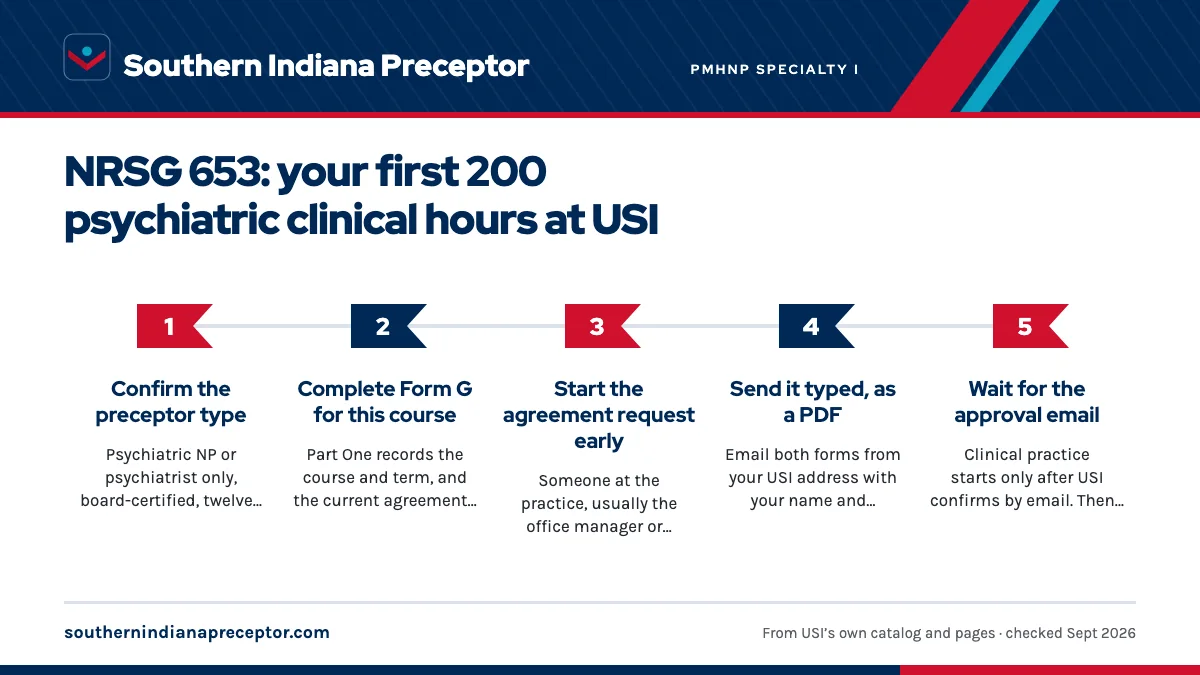
- Confirm the preceptor typePsychiatric NP or psychiatrist only, board-certified, twelve months or more into advanced practice, and licensed without encumbrance where they work.
- Complete Form G for this coursePart One records the course and term, and the current agreement covers nothing beyond them, so enter
NRSG 653and Fall accurately. - Start the agreement request earlySomeone at the practice, usually the office manager or education coordinator, identifies the authorized signer. Check with usi1nursing@usi.edu first, since an agreement with that practice may already be on file.
- Send it typed, as a PDFEmail both forms from your USI address with your name and "Preceptor Packet" in the subject line. The Preceptor Packet page covers each part.
- Wait for the approval emailClinical practice starts only after USI confirms by email. Then send your schedule to clinical faculty and set up Typhon so your preceptor can co-sign your entries.
How NRSG 653 is evaluated
Your clinical grade is Pass or Fail. You pass the course only with a Pass in clinical and at least a B on the classroom side, and a clinical Fail turns the course grade into an F.
Course faculty evaluate you formally twice, halfway through and at the close, scoring each domain as Does not meet, Meets or Exceeds; one Does not meet on the closing evaluation is enough to fail. USI also requires a minimum of seven preceptor-faculty touchpoints per semester: two Preceptor Feedback Forms in Typhon, three faculty emails (welcome, midterm, final) and two phone calls at midterm and final.
You arrange those calls, so mention them at your first meeting. The evaluations page walks through each form.
NRSG 853 and the older NURS 662
BSN-to-DNP students on the psychiatric track take NRSG 853, the 800-level version of this course. USI's handbook notes that 600-level numbers belong to the MSN and 800-level numbers to the DNP, and it gives the pair the same 200 hours and the same PMHNP-or-psychiatrist rule. The introductory course on that side is NRSG 851; the BSN-to-DNP page shows where it fits in the 1,510 total.
If you began before 2026-27, you may remember a different course. The first PMHNP clinical in the 2025-26 curriculum was NURS 662, with 135 hours, inside a 630-hour track. The rebuild moved graduate nursing to the NRSG prefix and set this course at 200, so an older plan of study that still says 135 is out of date.
Why USI PMHNP students choose us for NRSG 653
Psychiatric preceptors are the smallest pool in any USI track, and the first clinical semester is where a late start costs the most. Our placement desk searches that pool close to where you live, within USI's enrollment states, and screens each PMHNP or psychiatrist against USI's rules before you meet: license, board certification, experience and an outpatient caseload.
Every field Form G and the agreement request need, from the preceptor's license and DEA numbers to the site survey and the signer's name, is gathered before your packet goes out, typed and ahead of the July window. We plan NRSG 653, NRSG 655 and NRSG 657 as one placement and stay on call all year, ready to line up a replacement if a preceptor leaves partway through. Send your city and start term through the form below.
Questions USI students ask
Can a psychiatric physician assistant precept me in NRSG 653?
No. USI's Course Requirements page limits every PMHNP clinical course to a PMHNP or a licensed psychiatrist, and that includes NRSG 653. Physician assistants may precept USI's FNP and AGACNP students but not the psychiatric track. A family NP who treats depression in primary care does not qualify either.
Can I do NRSG 653 hours on an inpatient psychiatric unit?
The handbook places NRSG 653 hours "within outpatient environments," so build your plan around an outpatient practice or clinic. If an inpatient opportunity comes up, raise it with course faculty before you schedule a single shift. The Graduate Clinical Liaison approves every site, and hours at a site nobody approved do not count toward the 200.
How early should I look for an NRSG 653 preceptor?
Earlier than the form suggests. Form G's 6-week rule puts a Fall packet in early July, but the agreement signer, license checks and faculty approval all take time after that. USI's 2023 handbooks named January and February as the months to settle on a likely preceptor for the coming Summer and Fall, which is still a sensible target for an August start.
Does i-Human work count toward the 200 hours in NRSG 653?
No. USI makes i-Human mandatory in NRSG 623 and the first two psychiatric specialty courses but books those cases as indirect time. Your 200 NRSG 653 hours have to be real patients seen with your approved preceptor, entered in Typhon for the preceptor to co-sign where applicable.
Can I keep working full time during NRSG 653?
USI's handbook cautions that course and clinical scheduling can shift at fairly short notice and makes no promise it will avoid your work hours. With 200 hours to fit into one semester, roughly 12 to 15 a week, the practical move is to agree fixed clinic days with your preceptor and your employer before the term starts.
Related pages
Last checked 2026-09-25
We check these pages against USI's own bulletin, program pages and Graduate Nursing Handbook. Your handbook, course faculty and the Nursing Clinical Coordinator have the final word.
- University of Southern Indiana Graduate Nursing Handbook: Course Requirements
- University of Southern Indiana 2026-2027 Graduate Bulletin: MSN, Psychiatric Mental Health Nurse Practitioner
- University of Southern Indiana Graduate Nursing Handbook: University Clinical Requirements and Clinical Evaluation
- University of Southern Indiana Preceptor Packet (Form G, updated 07/2026)
- University of Southern Indiana Academic Calendar
USI makes the search your job. We make it the easy part.
Tell us your USI track, your city and your next clinical semester. We find preceptors who fit the NRSG course and fill the Preceptor Packet and Clinical Education Agreement request with typed, complete details, well before USI's 6-week window.
- Preceptors matched to the course: family primary care for FNP, acute care teams for AGACNP, PMHNPs and psychiatrists for PMHNP
- Preceptor license, certification, years of practice and the site's agreement signer ready for the packet
- Fall, Spring and Summer planned together, close to home in a state USI enrolls
Start your placement plan
Track, city and clinical start is all we need to begin.