NRSG 655: 250 Spring hours at the midpoint of the PMHNP track
NRSG 655 Family Psychiatric/Mental Health Care Across the Lifespan II asks University of Southern Indiana PMHNP students for 250 direct clinical hours in the Spring semester, "primarily in out-patient settings." It is the middle of the track's 750 hours, the course where the Barkley Board Review comes due, and the point where you decide whether your Fall preceptor carries on or you need someone new.
Get your placement plan
Tell us your USI program and where you live. A placement advisor replies with the preceptor and site options that fit your course.
NRSG 655 in brief
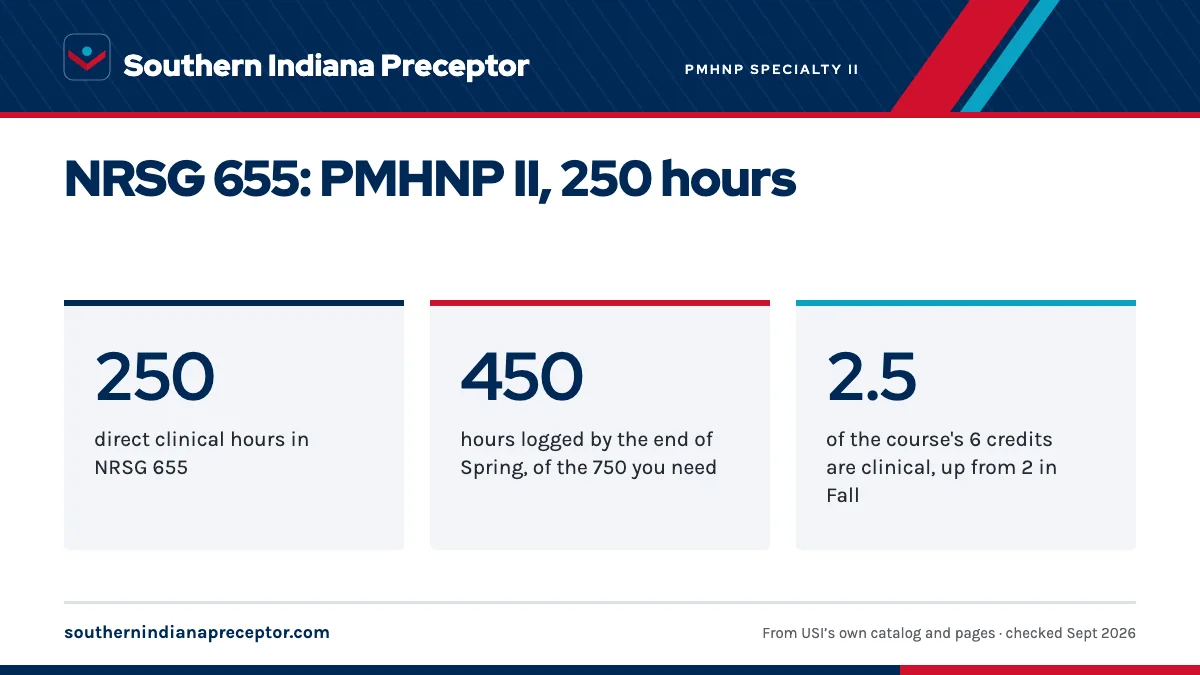
Spring is the heavier half of your first clinical year. The course keeps the same credit count as the Fall course but tilts toward clinical work, and it adds 50 hours to the load you carried in NRSG 653.
| Item | NRSG 655 |
|---|---|
| Credits | 6, listed as 3.5-2.5 (Clinical) |
| Term | Spring |
| Direct clinical hours | 250 |
| Setting | "primarily in out-patient settings" |
| Preceptor | A PMHNP or a licensed psychiatrist, nobody else |
| Purchases tied to the course | i-Human access, plus the Barkley Board Review in the second half |
| BSN-to-DNP twin | NRSG 855 |
The sequence runs 200 hours in the Fall course, 250 here and 300 in the Summer course. By the last day of Spring, Typhon should show 450 of your 750 hours, each one co-signed by an approved preceptor.
What "primarily outpatient" leaves open
USI words this course more loosely than the other two. The Fall course puts hours "within outpatient environments," the Summer course "in outpatient mental health settings," and NRSG 655 says primarily outpatient. The handbook never says how much of the 250 may fall elsewhere.
Treat outpatient as the default and any other setting as an exception you clear first. Talk to course faculty before you book time on an inpatient unit, a partial hospitalization program or a crisis service, because the Graduate Clinical Liaison approves each site and a new organization needs its own Clinical Education Agreement.
The preceptor rule stays fixed whatever the setting. Whoever supervises you on an approved inpatient day must still be a PMHNP or a licensed psychiatrist, and a hospitalist or psychiatric PA on that unit cannot sign off your hours.
Keeping your Fall preceptor, or changing
Staying with the same preceptor is the simplest path, but it still takes paperwork. The current Form G says the Preceptor Agreement "is valid for the course/semester/year listed in Part One," so look at whether your Fall packet named NRSG 655 and Spring. If it did not, file a new packet for this course. The 2019 version of the form ran for a year with an option to renew; the 2026 version is tied to course and term.
A second clinician at the same practice needs an additional Preceptor Agreement approved by USI before they take you on. A new practice means a new Preceptor Packet and, unless USI already holds an agreement with that organization, a new agreement request that the site signs, since students may not sign it themselves. The additional preceptors page and the agreement page cover both routes.
Spring 2027 dates and the packet window
Spring 2027 classes begin Monday, January 11, and the term ends Friday, May 7. Six weeks before January 11 is the end of November, so a packet for a new Spring preceptor is due while you are still logging NRSG 653 hours and working around Thanksgiving. Begin any Spring search in early Fall.
| Date | What it means |
|---|---|
| Late November 2026 | About 6 weeks before January 11: the Form G window for a new preceptor |
| Mon, Jan 11 | Classes begin |
| Mon, Jan 18 | Martin Luther King Jr. Day, no clinical hours |
| Week of Jan 25 | Week 3: clinical must be under way |
| Mar 8 to 13 | Spring Recess, no clinical hours |
| Fri, Mar 19 | Last day to withdraw without evaluation (grade W) |
| Fri, Mar 26 | University closed, no clinical hours |
| Fri, May 7 | Term ends |
Spread evenly, 250 hours over 16 weeks is about 15.6 a week, and the recess week and closures push the working weeks higher. Keep a buffer: with faculty approval, USI lets you reschedule hours lost to unforeseen circumstances, but only within the same semester.
Barkley review, i-Human and indirect work
Specialty II is where USI requires the Barkley Board Review. PMHNP, FNP and AGACNP students purchase it during the second half of the course, so for the psychiatric track it arrives in the back half of Spring. i-Human stays mandatory in NRSG 655, as it was in NRSG 623 and NRSG 653.
Neither purchase changes your direct-hour target. USI counts i-Human simulations as indirect clinical hours, and board review is study time, so the 250 still has to come from supervised patient care.
The second half of Spring stacks midterm feedback, board review and the steepest stretch of clinic hours on top of each other. Blocking study time on your calendar early keeps it from eating into clinic days. The i-Human and board review page explains both requirements.
Telehealth and evaluations at the midpoint
NRSG 655 is the natural checkpoint for telehealth. The PMHNP track allows up to 150 telehealth hours in total, 20 percent of 750, and only when you and your preceptor sit together at the approved site while the patient joins live from elsewhere. Add up what you used in Fall before you plan Spring, so the Summer course still has room if your preceptor's practice leans virtual.
Faculty rate your performance twice this semester, at midterm and at the close, and your preceptor files a Preceptor Feedback Form in Typhon at each point. A Does not meet on any domain of the closing evaluation ends the course with a failing grade, so treat the midterm rating as the early warning it is. The clinical component is still Pass or Fail, alongside a B or better in the didactic work.
NRSG 855 and the 2025-26 course it replaced
In the BSN-to-DNP psychiatric track the same course is NRSG 855, carrying the same 250 hours and the same preceptor rule under USI's 600/800 pairing. DNP students take it in the same Fall, Spring and Summer rhythm, with NRSG 853 before it and NRSG 857 after.
Before the 2026-27 rebuild, the middle PMHNP course was NURS 663, with 225 hours. The jump to 250 is smaller than the Fall course's jump from 135 to 200, but it still means an older plan of study understates your Spring load by 25 hours. USI's Preceptor Packet instructions already ask you to give your preceptor the hours the course requires and the weekly hours needed, so hand a returning preceptor the new figure in writing. The 750-hour page explains the change across every NP track.
Why PMHNP students choose us for NRSG 655
Spring is where a placement plan either holds or has to be rebuilt. If your Fall preceptor is continuing, we confirm the paperwork covers NRSG 655. If you need someone new, our placement desk looks for a PMHNP or psychiatrist near you with an outpatient caseload and room for 250 hours, and gathers the license, certification, DEA and site details the packet asks for. After a full Fall semester you know which clinic days and patient mix suit you, and we match the Spring search to that.
We work on Spring while you are still in Fall, so a new packet can reach USI typed and complete ahead of the late-November window, and we keep your Summer course in the same plan. If anything changes mid-semester, your placement advisor is on call to find a replacement. Start with the form below.
Questions USI students ask
Do I need a new Preceptor Packet for NRSG 655 if my preceptor stays the same?
Look at Part One of the packet you filed for Fall. The 2026 Form G ties the Preceptor Agreement to the course, semester and year listed there, so if NRSG 655 and Spring 2027 are missing, submit a new packet for this course. The Nursing Clinical Coordinator at usi1nursing@usi.edu can confirm what USI already has on file for your preceptor and site.
When is the Barkley Board Review due in NRSG 655?
USI requires PMHNP, FNP and AGACNP students to purchase the Barkley Board Review during the second half of their Specialty II course, which for the psychiatric track is NRSG 655. Your syllabus and course faculty set how the review is used inside the course. It sits alongside your 250 direct hours rather than counting toward them.
How many hours a week does NRSG 655 take?
USI sets a semester total of 250 direct hours for NRSG 655, not a weekly figure. Across a 16-week Spring term that averages about 15.6 a week, and more once Spring Recess, the March 26 closure and a week-3 start come out. The handbook publishes weekly caps only for the FNP and AGACNP tracks, so confirm any limit with course faculty.
What if my NRSG 655 preceptor drops out mid-semester?
Tell your course faculty right away; the handbook asks students to report immediately when they cannot meet a clinical commitment. Faculty can approve rescheduled hours within the semester. A new preceptor at the same practice needs an additional Preceptor Agreement, and a new site needs its own packet and agreement before you continue. See what to do when a preceptor drops out.
Is NRSG 655 the same course as NRSG 855?
They are twins. NRSG 655 is the MSN and post-master's certificate version and NRSG 855 is the BSN-to-DNP version, and USI's handbook gives both the same 250 direct hours and the same PMHNP-or-psychiatrist preceptor rule. Your registration and plan of study show which number applies to you.
Related pages
Last checked 2026-09-25
We check these pages against USI's own bulletin, program pages and Graduate Nursing Handbook. Your handbook, course faculty and the Nursing Clinical Coordinator have the final word.
- University of Southern Indiana Graduate Nursing Handbook: Course Requirements
- University of Southern Indiana 2026-2027 Graduate Bulletin: MSN, Psychiatric Mental Health Nurse Practitioner
- University of Southern Indiana Preceptor Packet (Form G, updated 07/2026)
- University of Southern Indiana Graduate Nursing Handbook: FAQs
- University of Southern Indiana Academic Calendar
USI makes the search your job. We make it the easy part.
Tell us your USI track, your city and your next clinical semester. We find preceptors who fit the NRSG course and fill the Preceptor Packet and Clinical Education Agreement request with typed, complete details, well before USI's 6-week window.
- Preceptors matched to the course: family primary care for FNP, acute care teams for AGACNP, PMHNPs and psychiatrists for PMHNP
- Preceptor license, certification, years of practice and the site's agreement signer ready for the packet
- Fall, Spring and Summer planned together, close to home in a state USI enrolls
Start your placement plan
Track, city and clinical start is all we need to begin.