i-Human and the Barkley Board Review: USI's simulation and exam-prep requirements
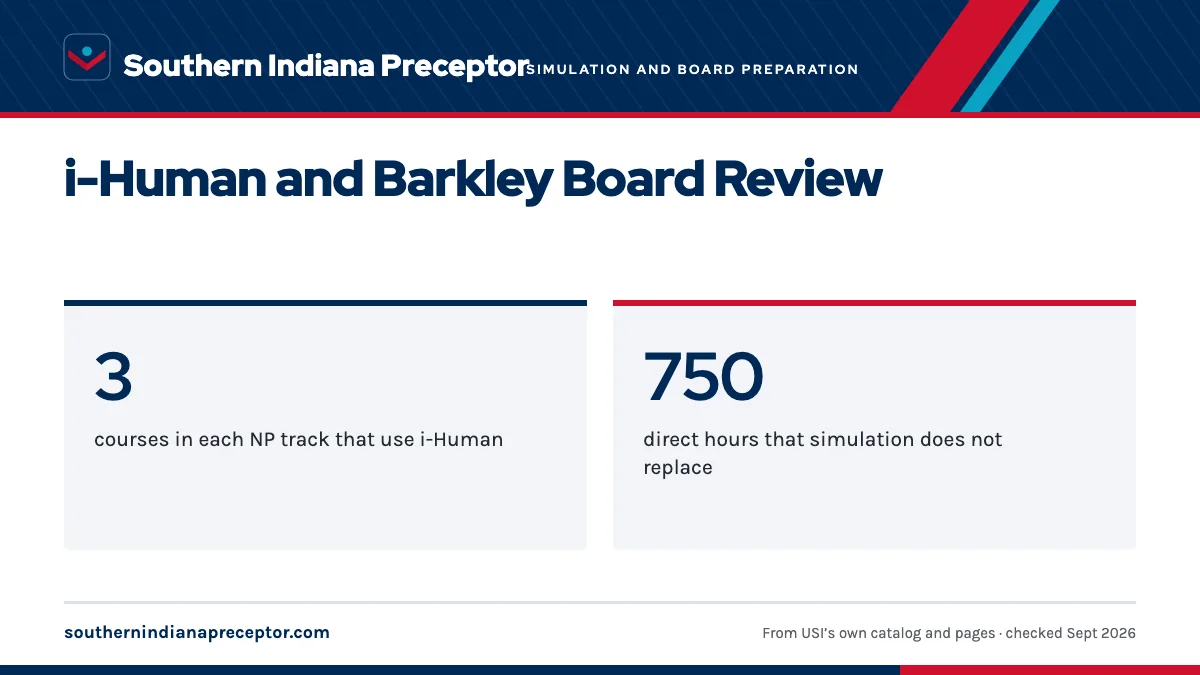
USI requires nurse practitioner students to buy i-Human for NRSG 623 and the first two specialty clinical courses, and it counts those simulations as indirect clinical hours, so they never reduce the 750 direct hours you complete with a preceptor. The Barkley Board Review is a second required purchase, due in the second half of your Specialty II course as preparation for certification.
Get your placement plan
Tell us your USI program and where you live. A placement advisor replies with the preceptor and site options that fit your course.
What USI requires, and when
The handbook's Course Requirements page makes i-Human mandatory for FNP, AGACNP and PMHNP students (it also still names the closed AGCNS track) and requires the Barkley Board Review for FNP, AGACNP and PMHNP students. USI's online exam policy adds two exam checkpoints: the 3-P Diagnostic Exam before clinicals and nationally normed predictor exams at the end. The handbook describes i-Human and Barkley as purchases the student makes.
Each item is tied to a fixed point in the Fall, Spring, Summer clinical sequence, which is why they matter for placement planning as much as for grades.
| Requirement | When | Courses | How USI treats it |
|---|---|---|---|
| i-Human simulations | Summer health assessment, then Specialty I (Fall) and II (Spring) | NRSG 623; FNP NRSG 643 and NRSG 645; AGACNP NRSG 633 and NRSG 635; PMHNP NRSG 653 and NRSG 655 | Indirect clinical hours |
| 3-P Diagnostic Exam | Summer before the first clinical course | After NRSG 621, NRSG 622 and NRSG 623 | Required exam |
| Barkley Board Review | Second half of Specialty II | FNP NRSG 645, AGACNP NRSG 635, PMHNP NRSG 655 | Required purchase |
| Predictor exams | Final semester | Usually the Specialty III term | Nationally normed, required |
i-Human counts, but only as indirect hours
USI's wording is direct: i-Human simulations "are considered indirect clinical hours for the program." That puts them in a separate column from the 750 direct hours in each NP track, which need an approved preceptor, a signed Clinical Education Agreement and Typhon entries your preceptor co-signs.
NRSG 623 Advanced Health Assessment for the APRN shows the change most clearly. The handbook now says the course has no direct clinical hours, with i-Human carrying the hands-on practice. The 2023 handbook was different: the health assessment course of that era, N618, required a minimum of 45 clinical hours. If a classmate mentions that rule, it no longer applies; the NRSG 623 page has the current picture.
In Specialty I and II, i-Human runs beside real clinical hours rather than in place of them. A strong simulation record does not shorten the 200 hours of a Fall specialty course or the 250 of a Spring one. The clinical hours overview lays out every program's direct-hour total.
The Barkley Board Review in Specialty II
USI requires FNP, AGACNP and PMHNP students to buy the Barkley Board Review during the second half of their Specialty II course: NRSG 645 for FNP, NRSG 635 for AGACNP and NRSG 655 for PMHNP, or the matching 800-level course in the BSN-to-DNP. For most students that means the back half of the Spring semester.
The bulletin's Specialty III course entries also mention the Barkley purchase through the University, so the two USI sources differ slightly on timing. Follow the instructions in your Blackboard course, and ask course faculty if your Specialty III syllabus raises it again.
The review course prepares you for certification; it is not the exam itself. USI's outcomes page reports results for FNP graduates on the ANCC and AANP exams, for AGACNP graduates on ANCC and AACN, and for PMHNP graduates on ANCC.
The 3-P Diagnostic Exam and final predictor exams
Before your first clinical course, USI's online exam policy has advanced practice students sit the 3-P Diagnostic Exam, in the summer after NRSG 621 Advanced Pathophysiology, NRSG 622 Advanced Clinical Pharmacology and NRSG 623. At the other end, nationally normed predictor exams are required in the final semester, which for most NP students is the Specialty III term.
The 3-P name echoes the "3Ps" on USI's program pages, its shorthand for the clinical core of pathophysiology, pharmacology and health assessment. The predictor exams share a semester with the 300-hour Specialty III course, so build study days into the clinical schedule you agree with your preceptor rather than squeezing them around shifts.
Online exams may be proctored remotely through Honorlock, which runs in Google Chrome with the Honorlock extension and opens from Blackboard as usual. Test your setup a few days before an exam; the student systems page lists where to get IT help.
Why the timing matters for your preceptor search
The summer you spend on NRSG 623, i-Human cases, your introductory specialty course and the 3-P exam is the same summer your Fall Preceptor Packet comes due. Form G wants it 6 weeks before the rotation starts, which for a mid-August Fall start means early July. Leaving the search until summer coursework ends puts it past that date.
The pattern is the same in every track. FNP students share that summer with NRSG 641, AGACNP students with NRSG 631 and PMHNP students with NRSG 651, each an introductory specialty course with no direct hours, taken alongside NRSG 623.
Spring repeats the squeeze. The Barkley weeks arrive in the second half of Specialty II, just as a Specialty III preceptor needs to be in place for Summer, and Summer rotations at many hospitals are decided in winter. USI's clinical deadlines give the exact counting rules for each packet.
How we keep simulation, study and placements from colliding
USI students choose us so the preceptor search never competes with i-Human cases, the 3-P exam or board review. While you work through NRSG 623 in Summer, your placement advisor is already securing your Specialty I preceptor: collecting license, certification, DEA and site details for Form G and identifying the site's agreement signer, so the packet reaches usi1nursing@usi.edu typed and early.
We plan Specialty II and III at the same time, so the Barkley weeks in Spring and the predictor exams in your final semester go to studying rather than calling practices. A preceptor who pulls out is replaced by your advisor, not by you. USI remains the approver of every preceptor and site; we handle the legwork that gets a complete packet in front of it. See how it works or use the form below.
Questions USI students ask
Do i-Human hours count toward my 750 clinical hours?
No. USI classes i-Human simulations as indirect clinical hours. The 750 direct hours in the FNP, AGACNP and PMHNP tracks come only from approved, preceptor-supervised patient care logged in Typhon. The simulation work in NRSG 623 and the first two specialty courses is required on top of those hours.
Does NRSG 623 need a preceptor?
No. The handbook states that NRSG 623 requires no direct clinical hours, so no preceptor is involved; i-Human supplies the simulated patient encounters. Your first preceptor is needed for Specialty I in Fall, and the paperwork for that placement falls due while you are still taking NRSG 623.
Is the Barkley Board Review the certification exam?
No. Barkley is a review course USI requires you to purchase in the second half of Specialty II so you can prepare for certification. The certification exams are run by national certifying bodies, and USI reports its graduates' results on ANCC and AANP (FNP), ANCC and AACN (AGACNP) and ANCC (PMHNP).
Do BSN-to-DNP students need i-Human and Barkley too?
The requirements are written by NP specialty, and BSN-to-DNP APRN students take NRSG 623 plus 800-level specialty courses such as NRSG 843, NRSG 833 and NRSG 853, which the handbook pairs with the MSN courses. Expect the same purchases, and confirm the timing with course faculty, since the handbook describes them in MSN course terms.
Do Nursing Education Leadership or Healthcare Systems Leadership students use i-Human?
The handbook lists i-Human for the APRN tracks (FNP, AGACNP, PMHNP and the closed AGCNS track) and names no such requirement for NEL or HSL students, whose direct hours start in NRSG 661. If a leadership course syllabus asks for a simulation product, follow the syllabus and ask the course faculty.
Related pages
Last checked 2026-09-25
We check these pages against USI's own bulletin, program pages and Graduate Nursing Handbook. Your handbook, course faculty and the Nursing Clinical Coordinator have the final word.
- University of Southern Indiana Graduate Nursing Handbook: Course Requirements
- University of Southern Indiana Graduate Nursing Handbook: Online Exam Policy
- University of Southern Indiana Nursing: Student and Program Outcomes
- University of Southern Indiana 2026-2027 Graduate Bulletin: MSN, Family Nurse Practitioner
USI makes the search your job. We make it the easy part.
Tell us your USI track, your city and your next clinical semester. We find preceptors who fit the NRSG course and fill the Preceptor Packet and Clinical Education Agreement request with typed, complete details, well before USI's 6-week window.
- Preceptors matched to the course: family primary care for FNP, acute care teams for AGACNP, PMHNPs and psychiatrists for PMHNP
- Preceptor license, certification, years of practice and the site's agreement signer ready for the packet
- Fall, Spring and Summer planned together, close to home in a state USI enrolls
Start your placement plan
Track, city and clinical start is all we need to begin.