NRSG 661 Advanced Nursing Core Concepts: your 40 direct care hours
NRSG 661 Advanced Nursing Core Concepts is the one course in the University of Southern Indiana's Nursing Education Leadership and Healthcare Systems Leadership tracks with a printed hour count: 40 direct care hours in an acute care, long-term care or community clinic setting. It runs in Fall, it uses the same Preceptor Packet and agreement path as the nurse practitioner tracks, and its doctoral twin, NRSG 761, carries the same 40 hours.
Plan your NRSG 661 hours
Tell us your track, your state and the term you start the course.
What NRSG 661 requires
The Graduate Nursing Handbook's Course Requirements page settles the number in a single line: students in this course "are required to complete 40 hours of direct care clinical." The same entry names the settings that qualify, which are acute care, long-term care and community clinics. The 2026-27 Graduate Bulletin adds only that the course "requires direct clinical hours" and lists it as a 3-credit Fall offering.
Direct care is the operative phrase. USI's clinical FAQ lets a student watch without a preceptor agreement, but an observer may not assess patients or carry out a care plan, and that time is left out of direct patient hours. Every one of the 40 hours needs an approved supervisor, a signed agreement and hands-on patient contact.
| Course | Program | Credits | Term | Direct care hours | Settings named |
|---|---|---|---|---|---|
NRSG 661 Advanced Nursing Core Concepts | MSN Nursing Education Leadership and Healthcare Systems Leadership | 3 | Fall | 40 | Acute care, long-term care, community clinics |
NRSG 761 Advanced Nursing Core Concepts for BSN to DNP | BSN-to-DNP Organizational and Systems Leadership | 3 | Summer | 40 | Same handbook line as NRSG 661 |
Where the course sits in the NEL and HSL plans
Both leadership tracks carry NRSG 661 in their clinical core, beside MHA 643 Healthcare Finance. For Nursing Education Leadership that pair is the entire 6-credit clinical core. Healthcare Systems Leadership adds two 1-credit practicums, NRSG 671 and NRSG 673, for an 8-credit core, while education students meet their practicums, NRSG 665 and NRSG 668, inside the education sequence.
On the published term offerings, the direct care course comes before either practicum: NRSG 661 is listed for Fall only, and the practicums sit in Spring and Summer. One well-timed search season can therefore line up the Fall clinical site and the later practicum placements together.
The totals are where USI's own pages part ways. The Specialty Track Overview gives Nursing Education Leadership 200 practice hours and Healthcare Systems Leadership 240, with this course supplying 40 of each, yet neither the bulletin nor the Course Requirements page prints hours for the practicums. Treat 40 as firm here and ask course faculty how the rest is counted; the NEL program page and the HSL program page set the conflict out in full.
Through 2025-26 the same 40 hours lived in NURS 648 Advanced Nursing Core. The 2026-27 rebuild moved graduate courses to the NRSG prefix and renumbered the course without changing its hour count.
NRSG 761: the same 40 hours in the BSN-to-DNP
NRSG 761 Advanced Nursing Core Concepts for BSN to DNP is the doctoral version, and the handbook states its requirement on the same line as the MSN course. It is a 3-credit Summer course in the clinical core of the BSN-to-DNP Organizational and Systems Leadership plan, next to the 2-credit NRSG 867 OSL Practicum Experience.
In the doctoral practice-hour table, those 40 hours are one row of the OSL route's 1,005-hour total, a figure the program's web page rounds to 1,000. The handbook asks that project-course hours be logged with each activity, its date, the course objectives, the program outcomes and the DNP Essentials, so ask faculty whether your NRSG 761 hours belong on that same log. The OSL program page walks through the full 1,005.
Who can supervise your 40 hours
USI publishes no preceptor rule written only for this course. The handbook's graduate standard asks for an unencumbered license where the preceptor practices, certification in their specialty, at least one year as an advanced provider and a signed agreement with USI, and it rules out relatives and partners. That wording was drafted with the nurse practitioner tracks in mind.
So settle the question before you approach anyone. Email course faculty or the Nursing Clinical Coordinator at usi1nursing@usi.edu, describe the setting you are considering, and ask which credentials they accept for a direct care supervisor in NRSG 661.
Whoever supervises you has to be physically present in the facility while you give care, and the handbook's roles page expects one-to-one precepting. The complete graduate standard is on preceptor requirements.
The approval path for a 40-hour rotation
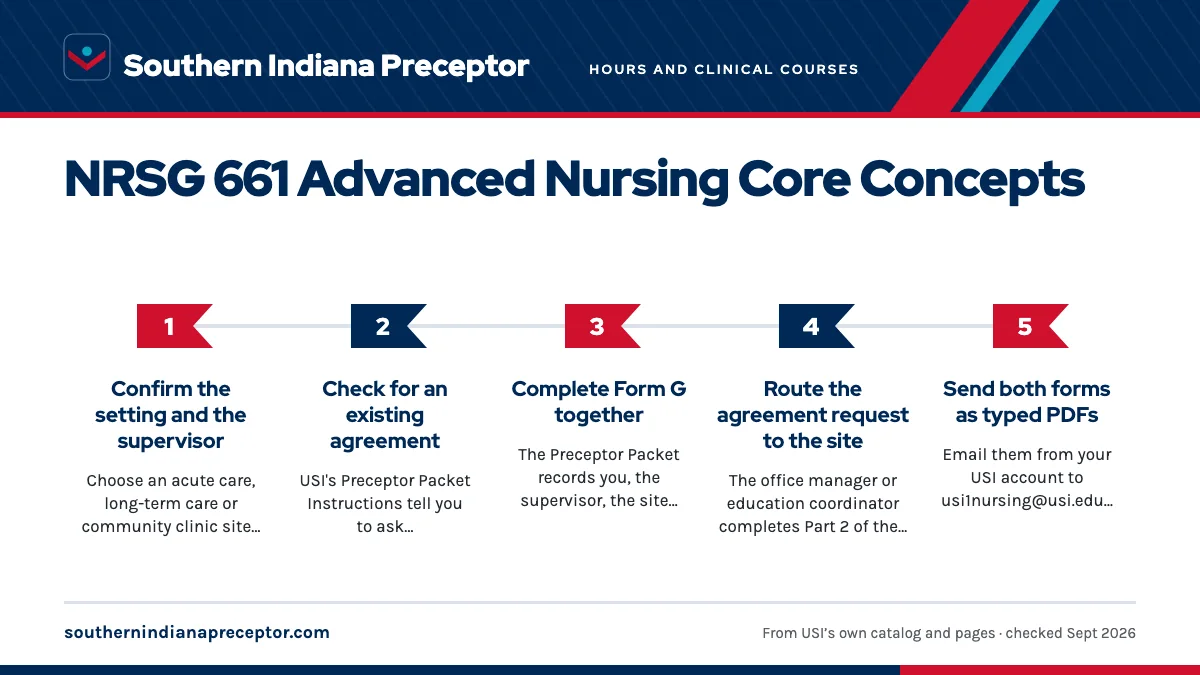
- Confirm the setting and the supervisorChoose an acute care, long-term care or community clinic site, and get course faculty's answer on supervisor credentials first.
- Check for an existing agreementUSI's Preceptor Packet Instructions tell you to ask usi1nursing@usi.edu whether the university already holds an agreement with the facility.
- Complete Form G togetherThe Preceptor Packet records you, the supervisor, the site and a site survey. Its agreement covers only the course and term written in Part One, so enter NRSG 661 and the Fall term.
- Route the agreement request to the siteThe office manager or education coordinator completes Part 2 of the Request for USI Clinical Education Agreement and names the signer. Students are not permitted to sign.
- Send both forms as typed PDFsEmail them from your USI account to usi1nursing@usi.edu, subject line [First and Last Name] Preceptor Packet, at least 6 weeks before the rotation begins.
- Hold until the approval email arrivesStart only after written confirmation, begin by Week 3, keep going weekly, and log nothing during university holidays.
Each form has its own page: the Preceptor Packet (Form G) and the Clinical Education Agreement.
Shadowing time stays out of the 40. Only direct care under an approved supervisor, at a site with a signed agreement, goes in your log.
Clearance, logging and telehealth
The course carries the same entry conditions as any graduate clinical. Your background check and 10-panel drug screen reach USI's designated third-party agency before your first graduate nursing course, BLS stays current, HIPAA and OSHA are renewed every year (an employer certificate is accepted), and no document in your record may expire before the semester closes.
Your RN license must also be unencumbered and held in the state the site sits in. Typhon is a required purchase across the graduate programs, and USI's FAQ asks students to document each patient encounter in the clinical repository, with the preceptor co-signing where applicable.
Plan all 40 hours in person. The Course Requirements page allows telehealth clinical hours only in the FNP and PMHNP tracks, although a second handbook page leaves telehealth to each course coordinator. If a virtual encounter matters to your plan, get the coordinator's decision in writing before you count on it.
Why NEL and HSL students choose us for NRSG 661
A 40-hour course is easy to leave until late summer, and by then the Fall window is closing. We start from the answer your course faculty gave on supervisor credentials, then search acute care, long-term care and community clinic settings near you for a supervisor who meets it and a site ready to sign USI's agreement.
We gather everything Form G asks about, from license and board certification details to years at the practice and the site survey, and we find out who signs agreements at the facility so your Clinical Education Agreement request is complete on the first pass. Your packet goes in typed, early and well inside the 6-week rule.
Because the practicums follow in Spring and Summer, we plan those placements in the same search, so one facility relationship can carry you through the year. If a supervisor steps away, your placement advisor lines up a replacement. Tell us your track, state and start term with the form below.
Questions USI students ask
Can I complete my NRSG 661 hours where I work?
USI has no written rule for or against it. The handbook asks students who are stuck whether their employer offers a preceptor, which suggests an employer site can work, while its FAQ says clinical sites are not for workplace orientation. Your employer still needs a Clinical Education Agreement and your supervisor still needs approval. Raise it with course faculty early; clinicals at your workplace covers the details.
Will NRSG 661 hours count toward a DNP later?
They can count as MSN practice hours. USI's DNP handbook lets up to 500 of the required 1,000 post-baccalaureate hours come from a previous MSN. Students who are not APRNs document those hours on the MSN Practice Hour Documentation Form, signed by the department chair or a designee at the school that granted the MSN, so keep your course log and any practicum logs after you graduate.
How many weeks do I have to finish 40 hours?
The course runs across a 16-week Fall semester, and USI's rule is that clinical begins by Week 3 and continues weekly while you are registered. No hours count during university holidays or when courses are not in session, so Fall Break and the Thanksgiving recess come off your calendar. Your schedule goes to clinical faculty before you attend, which makes a steady weekly block the safest plan.
I live in Alaska. Does USI's Alaska policy apply to NRSG 661?
USI's policy for graduate students living in Alaska says the program selects every preceptor and students may not choose their own. The same policy exempts Nursing Education Leadership and Healthcare Systems Leadership students from the Alaska State Board of Nursing prior authorization that APRN students complete. Confirm with the Nursing Clinical Coordinator how selection will work for your direct care hours before the Fall term.
What happens if my NRSG 661 supervisor backs out mid-semester?
Tell course faculty right away; the handbook expects students to report promptly when a clinical commitment falls through. Hours may be rescheduled within the semester for unforeseen circumstances with faculty approval. A new supervisor needs a new Form G, and a new facility needs its own Clinical Education Agreement, so the approval email has to come again before you resume.
Related pages
Last checked 2026-09-25
We check these pages against USI's own bulletin, program pages and Graduate Nursing Handbook. Your handbook, course faculty and the Nursing Clinical Coordinator have the final word.
- University of Southern Indiana Graduate Nursing Handbook: Course Requirements
- University of Southern Indiana 2026-2027 Graduate Bulletin: NRSG 661
- University of Southern Indiana Graduate Nursing Handbook: Specialty Track Overview
- University of Southern Indiana Graduate Nursing Handbook: Clinical Practice FAQs
- University of Southern Indiana Graduate Nursing Handbook: BSN-DNP and Post MSN-DNP
USI makes the search your job. We make it the easy part.
Tell us your USI track, your city and your next clinical semester. We find preceptors who fit the NRSG course and fill the Preceptor Packet and Clinical Education Agreement request with typed, complete details, well before USI's 6-week window.
- Preceptors matched to the course: family primary care for FNP, acute care teams for AGACNP, PMHNPs and psychiatrists for PMHNP
- Preceptor license, certification, years of practice and the site's agreement signer ready for the packet
- Fall, Spring and Summer planned together, close to home in a state USI enrolls
Start your placement plan
Track, city and clinical start is all we need to begin.