USI MSN Nursing Education Leadership: practicums, preceptors and the 200 hours
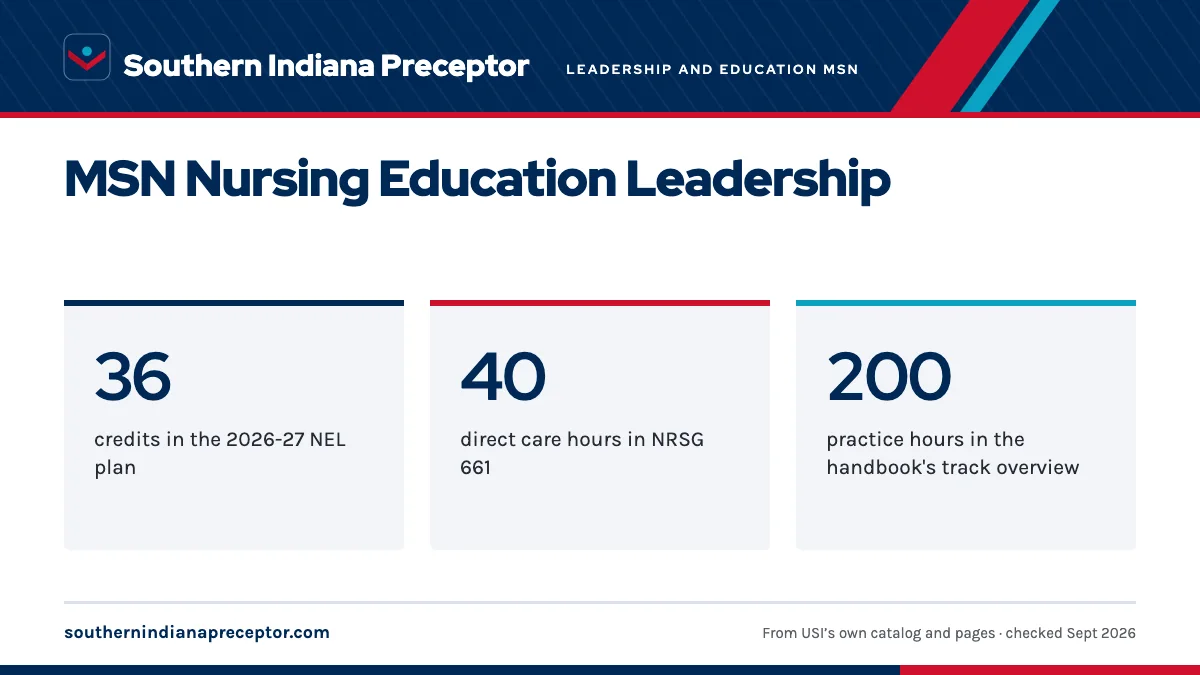
Nursing Education Leadership, one of the University of Southern Indiana's online MSN tracks, runs 36 credits and has three hands-on pieces: NRSG 661 with 40 direct care hours in Fall, then two 1-credit practicums, NRSG 665 and NRSG 668, taught under a faculty or clinical educator preceptor. The handbook's track overview adds up to 200 practice hours, yet neither practicum prints an hour figure, so get the split from course faculty before you commit a site.
Plan your NEL placements
Tell us your state and which of the three courses you need covered.
The program at a glance
The track is taught fully online, and USI lists three entry points a year: January, May and August. Its web page divides the 36 credits into 16 of nursing core, 6 of clinical core and 14 of education courses and an elective, and under the 2026-27 Graduate Bulletin no grade below a B counts in any course.
To be admitted you need a bachelor's in nursing from a school with both national and regional accreditation, at least a 3.0 grade point average, a statistics course passed with a C or higher, and an RN license without encumbrances. USI strongly recommends a year of full-time RN work, or 2,000 clinical hours within the last five years, before you start.
| Block | Courses | Credits |
|---|---|---|
| Nursing core | NRSG 601, 602, 603, 604, 605, 606 | 16 |
| Clinical core | MHA 643 Healthcare Finance; NRSG 661 Advanced Nursing Core Concepts | 6 |
| Nursing education | NRSG 662 Curriculum Development (Fall); NRSG 663 Educational Strategies (Spring); NRSG 665 NEL Practicum I (Spring); NRSG 667 Evaluation Methods (Summer); NRSG 668 NEL Practicum II (Summer) | 11 |
| Elective | One of MHA 621, 624, 625, 626, 628, 633, 637 or 655 | 3 |
Three placements across one academic year
The hands-on work arrives in a clear order. NRSG 661 comes in Fall and asks for 40 hours of direct patient care, placed in one of three settings USI names (acute care, long-term care, community clinics); its own page, NRSG 661, covers settings and supervisors in detail. The two education practicums follow in the Spring and Summer terms, each paired with a lecture course.
NRSG 665 NEL Practicum I is taken with NRSG 663 and is described in the bulletin as the first supervised practicum. Students put learning principles, teaching strategies and curriculum design to work in classroom, simulation and clinical education settings, guided by "a faculty or clinical educator preceptor," in the words of the course description.
NRSG 668 NEL Practicum II runs beside NRSG 667 in Summer. Under the same kind of preceptor, you design and carry out formative and summative assessment methods and "finalize a comprehensive educator portfolio." In practice that means a setting where learners are actually being taught and assessed, such as a nursing program's classroom or skills lab, a simulation center, or a hospital's clinical education team.
200 hours: what USI states and what it leaves open
The Specialty Track Overview in the Graduate Nursing Handbook, updated in July 2026, states for Nursing Education Leadership: "There are a total of 200 practice hours." The Course Requirements page assigns 40 of them to NRSG 661. That is where the published arithmetic stops, because the bulletin prints no hour figure for NRSG 665 or NRSG 668, and no handbook page shows how the remaining 160 are divided.
Read the two sources as a gap in what USI has published so far, not as a hidden rule you are expected to know. Ask course faculty or the Nursing Clinical Coordinator for the per-course expectation before you ask an educator to host you, and keep that answer with your records.
The practicums are also new. Through 2025-26 the track had nine credits of education coursework under NURS numbers and no separate practicum courses, and before 2023-24 it was called Nursing Education. Older student advice about NEL clinical work may describe a plan that no longer exists.
Size each practicum from the hours course faculty confirm in writing, not from the 200-hour track total alone.
Who can precept an NEL practicum
The bulletin's phrase, a faculty or clinical educator preceptor, is the most specific description USI publishes. The handbook's general preceptor standard looks for a clean license where the preceptor works, board certification in the specialty, a year or more of advanced practice and a signed USI agreement. It was drafted for the nurse practitioner tracks, and no page adapts it for education practicums.
Two parts of the general standard are written for every preceptor: a preceptor cannot be family or a romantic partner, and the preceptor must hold a signed, approved agreement with USI. For credentials, name the educator you have in mind and ask course faculty whether that background fits NRSG 665 or NRSG 668.
The direct care supervisor for NRSG 661 is a separate question, since those hours involve patient care rather than teaching. You may need two or three different people across the year, and each one completes their own paperwork.
Paperwork, approval and timing
USI's two main sources describe your part in slightly different tones. The bulletin page for this track says each student "is encouraged to identify preceptors and clinical sites" with the clinical liaison's help, while the handbook states that the student is responsible for identifying them. Whichever wording you go by, no hours start until the Graduate Clinical Liaison signs off on the preceptor and site, and the catalog calls for a written agreement with every agency. The finding your own preceptor page traces how that wording has shifted.
Each placement needs a Preceptor Packet (Form G) and, unless USI already holds one with the facility, a Request for USI Clinical Education Agreement. Because each Form G names one course and one term, the Spring and Summer practicums each need their own packet. The Preceptor Packet page walks through every part.
Form G asks for submission 6 weeks before the rotation starts, while a handbook page speaks of one month; clinical deadlines sets out both. On USI's 2026-27 calendar, six weeks before the January 11 start of Spring classes is November 30, and six weeks before the May 17 summer session is April 5, so those are the latest safe dates for practicums that begin with the term.
One Alaska note: USI's policy for students living there exempts the education and systems leadership tracks from seeking the state nursing board's advance approval before practicum work.
Where you can enroll and do clinical work
Because the track leads to no license, USI's Professional Licensure Disclosure marks its licensure cells "N/A," but the table still bars residents of some states. For NEL and HSL alike the "Enrollment Not Allowed" cell names 13 states, AL, AZ, CO, DE, LA, MA, MN, MS, NV, NY, OK, WA and WY, along with DC and five territories.
That list differs from the nurse practitioner rows. Colorado and Washington residents are barred from NEL but not from the MSN NP tracks, while North Dakota, Oregon and Pennsylvania residents appear on the NP list only. The full table, its conflicts and its "Updated Fall 2025" date are on the licensure disclosure page, and a move mid-program is covered under relocating during the program.
Wherever you live, each placement requires an RN license valid in its own state, and you need a background check and 10-panel drug screen on file before your first graduate nursing course, plus current BLS.
Why NEL students choose us
Nursing Education Leadership asks for three different kinds of host in one year, and we plan all three together: first a patient care placement for NRSG 661, then educators in classroom, simulation or clinical education settings who can guide NRSG 665 and see your assessment work and portfolio through NRSG 668.
We confirm with you which credentials your course faculty accept, then approach educators who match them, so the conversation starts with a qualified host. We collect every field Form G needs and everything the agreement request asks each facility to supply, identify who signs there, and send your packets typed and early for each term.
If a host's schedule changes or an educator withdraws, your placement advisor finds a replacement and rebuilds the paperwork with you. Share your state and start term through the form below and we map the whole year.
Questions USI students ask
Does the Nursing Education Leadership MSN lead to an advanced practice license?
No. USI's licensure table marks the NEL row "N/A" because the degree prepares nurse educators rather than APRNs, and no USI page names a certification exam for the track. The table still restricts enrollment for residents of 13 states, DC and several territories, so check your state before you apply or move.
What changed in the NEL curriculum for 2026-27?
Graduate course numbers switched prefixes, NURS to NRSG, the direct care course formerly numbered NURS 648 became NRSG 661, and two formal practicums, NRSG 665 and NRSG 668, were added to the education sequence. The total stayed at 36 credits. Anyone following a 2025-26 plan of study should compare it with the current bulletin.
How many graduate credits can I transfer into the NEL MSN?
The Graduate Nursing Handbook allows a maximum of 12 graduate credit hours to transfer into the MSN. Transfer requests go through USI's course transfer policies, and every course you complete at USI still needs a B or better. Ask for a transfer review early, since it can change which term you reach NRSG 661 and the practicums.
Do NEL students need Typhon and the compliance tracker?
Yes. Typhon is required for every graduate nursing student, bought once, with access that lasts through the program and five years beyond it. Your background check, drug screen, immunizations, BLS and annual HIPAA and OSHA records go to USI's designated third-party agency, CastleBranch, now DISA.
Can I teach my NEL practicum inside my own hospital's education department?
USI publishes no rule that forbids an employer site, and its placement help asks stuck students whether their employer offers an option. Its FAQ also rules out using a clinical site as workplace orientation, so the practicum has to be a distinct learning experience with an approved preceptor and a Clinical Education Agreement. Confirm the plan with course faculty first.
Related pages
Last checked 2026-09-25
We check these pages against USI's own bulletin, program pages and Graduate Nursing Handbook. Your handbook, course faculty and the Nursing Clinical Coordinator have the final word.
- University of Southern Indiana 2026-2027 Graduate Bulletin: MSN Nursing Education Leadership
- University of Southern Indiana: MSN Nursing Education Leadership program page
- University of Southern Indiana Graduate Nursing Handbook: Specialty Track Overview
- University of Southern Indiana 2026-2027 Graduate Bulletin: NRSG 665 NEL Practicum I
- University of Southern Indiana Professional Licensure Disclosure
USI makes the search your job. We make it the easy part.
Tell us your USI track, your city and your next clinical semester. We find preceptors who fit the NRSG course and fill the Preceptor Packet and Clinical Education Agreement request with typed, complete details, well before USI's 6-week window.
- Preceptors matched to the course: family primary care for FNP, acute care teams for AGACNP, PMHNPs and psychiatrists for PMHNP
- Preceptor license, certification, years of practice and the site's agreement signer ready for the packet
- Fall, Spring and Summer planned together, close to home in a state USI enrolls
Start your placement plan
Track, city and clinical start is all we need to begin.