NRSG 637 Adult and Geriatric Acute Care Management III: 300 hours, with critical care or hospitalist preferred
NRSG 637 closes the University of Southern Indiana's AGACNP clinical sequence with its biggest block: at least 300 direct hours in Summer, at no more than 36 a week. USI prefers a critical care or hospitalist placement for this course and weighs other settings case by case, so this preceptor takes more planning than any before it.
Get your placement plan
Tell us your USI program and where you live. A placement advisor replies with the preceptor and site options that fit your course.
What USI asks for in Management III
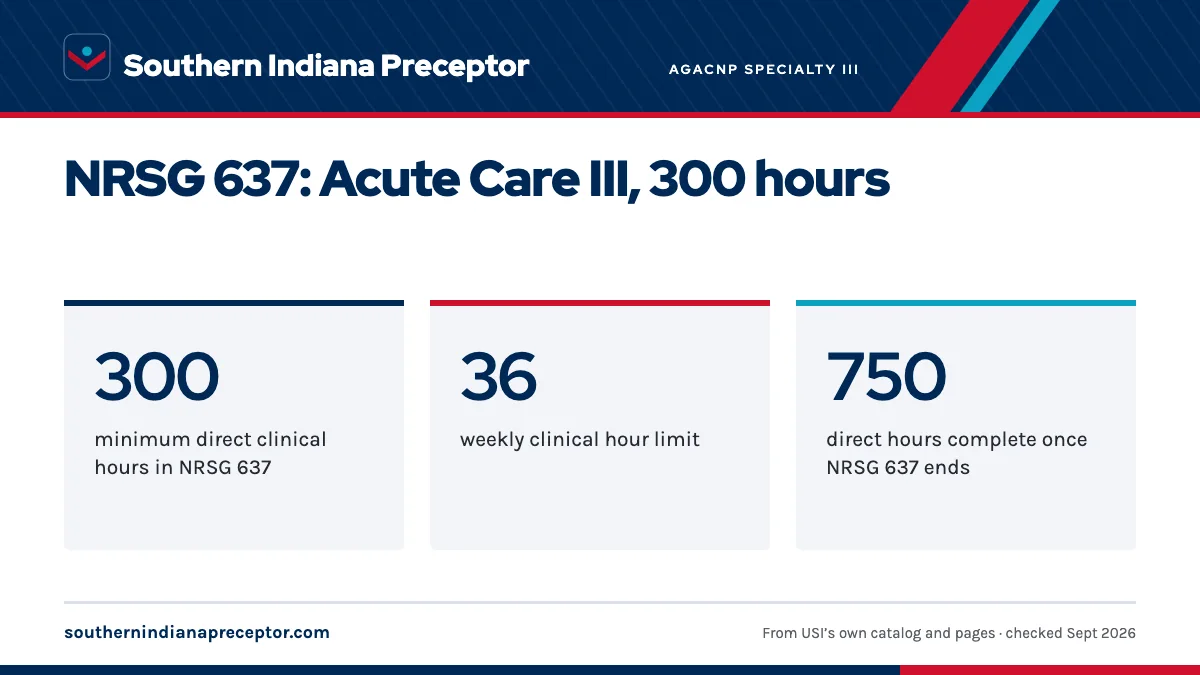
The Course Requirements page gives NRSG 637 a minimum of 300 direct clinical hours and states that critical care or hospitalist experience is preferred, with exceptions considered on a case-by-case basis. The bulletin lists the course at 5 credits with a 2-3 lecture-lab split, the most clinically weighted ratio of the three acute care courses, and offers it in Summer.
Pass it and you reach the 750 direct hours that USI's Specialty Track Overview gives for the AGACNP track. BSN-to-DNP students take the twin course, NRSG 837, with the same floor; for them it completes the 750 specialty hours inside a 1,510-hour doctoral total. Under the NURS numbering used through 2025-26, the matching course was NURS 676 at 270 hours.
Critical care or hospitalist: reading the preference
"Preferred" is the working word. An ICU or other critical care service, or a hospitalist group caring for admitted patients, matches the wording directly. Anything else, for example a specialty consult service or an emergency department, becomes an exception that course faculty weigh one student at a time.
Raise any exception early. Course faculty approve every Preceptor Packet, and a request made in winter leaves room to switch to a hospitalist or critical care preceptor if the answer is no. A request made in May leaves none.
The preceptor rules themselves match the earlier courses: an NP, PA, MD or DO practicing in acute care, licensed where they practice, certified in their specialty, with at least a year as an advanced provider, and board-certified in your track's specialty if they are an NP or PA. The full list is on USI's preceptor requirements page.
A shorter term carrying the biggest number
Summer at USI runs shorter than a 16-week Fall or Spring. On the standard 2026-27 calendar, First Summer runs May 17 to June 17, 2027 and Second Summer June 28 to July 30; the accelerated calendar's summer sessions stretch from May 10 to August 14. USI does not publish which part of term graduate NRSG courses follow, so confirm the dates of your NRSG 637 section in myUSI before you build a schedule.
The arithmetic is what sets this course apart. At the 36-hour ceiling, 300 hours takes at least nine working weeks; at 30 hours a week it takes ten. Subtract Memorial Day (May 31), Juneteenth (June 18) and the observed Independence Day holiday (July 5), and remember that clinical must start by Week 3. A slow start has almost nowhere to go.
If you fall behind anyway, course faculty can approve rescheduled hours within the semester for unforeseen circumstances. The behind on clinical hours page covers how students recover.
Summer holidays, the Week 3 start rule and a 36-hour weekly cap leave little slack: have your NRSG 637 preceptor approved before the term opens.
Deadlines that fall in winter
Form G's 6 weeks, counted back from a May 17, 2027 start, lands on April 5. USI's other wording, one month or 4 weeks, points to mid-April. The deadlines page explains the disagreement and how to plan around it.
Hospitals settle Summer rotations much earlier. Among systems near Evansville and in Indianapolis, IU Health takes Summer applications from December 1 to February 1, Community Health Network closes January 1, Franciscan Health December 31, and Deaconess and Good Samaritan January 31. Those are the systems' own processes, most require an existing affiliation with your school, and together they put the NRSG 637 search in the middle of your Fall semester, not after Spring Recess. The Evansville-area guide summarizes each system's published process.
If your Spring preceptor already works in critical care or hospital medicine, the Summer paperwork is simpler: agree on dates in February, have a new Form G signed with NRSG 637 and the Summer term in Part One, and send it before Spring Recess.
The final-semester pieces
For most AGACNP students NRSG 637 is the final semester, and USI's online exam policy requires nationally normed predictor exams in that semester. The bulletin's Specialty III entry also notes the Barkley Board Review purchase, which the handbook places in the second half of Specialty II; if it is still outstanding, follow course faculty's instructions.
After graduation, USI reports AGACNP certification results on two exams, ANCC and AACN, so these 300 hours are your last structured clinical practice before boards. The final evaluation still decides the course: a Does not meet rating in any domain means failure, and without a clinical Pass the course grade is an F. Grades and progression has the full rule.
Log each shift in Typhon and have it co-signed while the day is fresh. Your Typhon purchase keeps your records available for up to five years after graduation.
How we line up NRSG 637 for USI students
Students choose us for their last acute care course because this is where USI's preference is most specific and the calendar tightest. Your placement advisor looks first to critical care teams, critical care NPs and PAs, and hospitalist groups, checks each candidate against USI's license, certification and experience rules, and aims for a preceptor whose schedule can carry 300 hours inside the 36-hour weekly limit.
We begin the NRSG 637 search while you are still in NRSG 633, so the hospital's own process and USI's Preceptor Packet and agreement request are finished well before April. If the strongest available site sits outside critical care or hospital medicine, we assemble what course faculty need to weigh the exception and keep a preferred-setting option in reserve.
A mid-summer dropout gets the same treatment: a fresh search, run against the same rules, with the clock in mind. Approval stays with USI; completeness is our part of the job. Start with the form below.
Questions USI students ask
Can I do NRSG 637 in an emergency department?
Possibly, but only as an exception. The handbook prefers critical care or hospitalist experience for NRSG 637 and considers other settings case by case, so the decision belongs to course faculty. Ask with your Preceptor Packet well ahead of the deadline, describe the acute care patients you would manage there, and hold an ICU or hospitalist option in case the answer is no.
Can I split NRSG 637 between two preceptors?
Yes, when both are approved. Another provider at your primary preceptor's site needs an additional Preceptor Agreement approved by USI before precepting you, and a second site needs its own Preceptor Packet and Clinical Education Agreement. Splitting helps you reach 300 hours inside the 36-hour weekly limit when one preceptor's schedule is thin.
What is NRSG 837?
NRSG 837 is Adult and Geriatric Acute Care Management III for BSN-to-DNP students. It carries the same 300-hour minimum and the same preference for critical care or hospitalist settings. For doctoral students these hours finish the 750 specialty hours, while embedded course hours and 500 DNP project hours make up the rest of the 1,510-hour total.
Do telehealth hours count in NRSG 637?
No. USI's Course Requirements page permits telehealth hours only in the FNP and PMHNP tracks, so every AGACNP hour, including all 300 in NRSG 637, is care delivered with your preceptor physically present in the facility. Plan your travel and shifts on that basis.
What happens if I end NRSG 637 short of 300 hours?
The 300 hours are a minimum and the clinical component must earn a Pass, so a shortfall is a grading problem, not a paperwork one. Talk to course faculty before the term ends. An incomplete is possible only for passing work with a small amount left, at the instructor's discretion, and USI allows no clinical hours when courses are not in session.
Related pages
Last checked 2026-09-25
We check these pages against USI's own bulletin, program pages and Graduate Nursing Handbook. Your handbook, course faculty and the Nursing Clinical Coordinator have the final word.
USI makes the search your job. We make it the easy part.
Tell us your USI track, your city and your next clinical semester. We find preceptors who fit the NRSG course and fill the Preceptor Packet and Clinical Education Agreement request with typed, complete details, well before USI's 6-week window.
- Preceptors matched to the course: family primary care for FNP, acute care teams for AGACNP, PMHNPs and psychiatrists for PMHNP
- Preceptor license, certification, years of practice and the site's agreement signer ready for the packet
- Fall, Spring and Summer planned together, close to home in a state USI enrolls
Start your placement plan
Track, city and clinical start is all we need to begin.